Dulce de Leche and Chocolate: A Sweet-Tooth Guide to Buenos Aires
What is the best way to try dulce de leche and chocolate in Buenos Aires?
Combine a short guided tasting tour through Palermo or the historic centre with independent stops at a classic confitería for alfajores and a heladería for dulce de leche ice cream. Two to three hours is enough to cover the essentials without overloading on sugar.
A city built around a sweet tooth
Most guides to eating in Buenos Aires point straight at the parrilla and the Malbec, and rightly so — but there is a whole other strand of the city’s food culture that runs on sugar rather than salt. Dulce de leche shows up in breakfast medialunas, in birthday cakes, in ice cream, spread thick on toast, and folded into the alfajores sold at every kiosk from Microcentro to Belgrano.
Alongside it sits a smaller but genuinely old tradition of chocolate houses, some dating back over a century to the waves of Spanish and Italian immigration that shaped the city’s confectionery. This guide sticks to that sweet lane: dulce de leche, alfajores and historic chocolaterías, distinct from the asado, empanada and wine-focused guides elsewhere on this site.
One thing worth settling before anything else: nobody can honestly claim to have invented dulce de leche. Argentina tells its own founding story, but so do Uruguay, Chile, Peru, Colombia and parts of Mexico, each with a version and a local name. Treat any shop or brand that claims sole invention with a raised eyebrow — the more useful question in Buenos Aires is not who invented it, but who makes it well.
What dulce de leche actually is
Dulce de leche is milk and sugar, cooked slowly for hours until the sugars caramelise and the mixture thickens into a spreadable, deep-tan paste. It is not caramel sauce, which is made from sugar and butter or cream without milk solids cooking down the same way — the flavour and texture are genuinely different, and using the words interchangeably will get a gentle correction from anyone behind a counter here.
In practice you will meet it in several forms:
- Clásico, the firm, dark, all-purpose spreading version.
- Repostero, a stiffer version made for baking, which holds its shape inside cakes and alfajores without running.
- Mixto or semi-firm, a middle ground some brands sell for both uses.
- Dulce de leche helado, the ice-cream flavour, arguably the most popular single flavour in the country’s heladerías.
Trying two or three types side by side — a spoon of clásico, a bite of an alfajor filled with repostero, a scoop of the ice cream — is the fastest way to understand the range, and it is exactly what a short tasting stop on a Palermo foodie walking tour or a dedicated tasting itinerary will usually set up for you.
Alfajores: the everyday version worth taking seriously
The alfajor is the single most common vehicle for dulce de leche in Argentina — a round sandwich biscuit, usually two layers of soft cake-like biscuit or shortbread, filled with dulce de leche and coated in chocolate, icing sugar or shredded coconut. It is sold at kiosks on every corner, at bus terminals, at bakeries, and in supermarket multipacks, and the quality swings wildly between a mass-produced snack and something genuinely crafted.
A rough guide to what you will find:
| Type | Texture | Typical coating | Where to find it |
|---|---|---|---|
| Kiosk brands (mass market) | Soft, uniform | Chocolate or plain | Any kiosk, supermarket, bus station |
| Artisanal bakery alfajores | Shortbread or sponge, denser | Chocolate, coconut, sugar glaze | Confiterías and specialist bakeries in Palermo, San Telmo |
| Regional/gourmet versions | Varies, often triple-layer | Dark chocolate, nuts | Specialty food shops, some markets |
None of this needs a tour to enjoy — buying a few from different sources and comparing them over an afternoon in a plaza is a perfectly good way to spend an hour, and it costs very little. Where a guided stop earns its place is in steering you past the blandest supermarket packs toward bakeries locals actually rate.
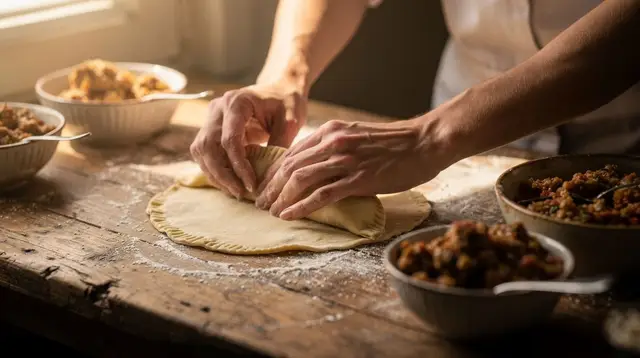
For anyone who would rather make an alfajor than simply eat one, the Buenos Aires empanadas and alfajores guided cooking class pairs the city’s two everyday staples — savoury empanadas and sweet alfajores filled with dulce de leche — into one hands-on session, which is a useful counterpoint if a purely tasting-based afternoon feels too passive. It also settles, from the inside, why the dulce de leche has to be the right consistency: too runny and the biscuit slides apart, too stiff and it never quite spreads to the edges.
Dulce de leche also turns up well beyond alfajores and ice cream. It is the default filling for a medialuna eaten at breakfast, it is stirred into coffee at some confiterías, and it appears as a layer in the sponge cake sold for birthdays across the country — a broader look at how the paste threads through the daily diet, not just the dessert menu, is covered in the site’s dulce de leche and medialunas piece. It also shows up alongside mate, Argentina’s other everyday ritual: a spoon of dulce de leche on the side of a shared mate round is common enough that it is worth reading the mate culture in Argentina guide before assuming the two traditions are unrelated.
Historic confiterías and chocolaterías
Buenos Aires has a small cluster of confectionery houses old enough to count as landmarks in their own right, most tracing back to early-20th-century European immigration. These are not uniformly “chocolate shops” in the Belgian or Swiss sense — many are confiterías, a broader Argentine category covering pastries, cakes, coffee and chocolate under one roof, shaped by Spanish, Italian and French traditions layered on top of local ingredients.
A walk through the Microcentro or around Plaza de Mayo will pass several of these almost by accident if you are paying attention to shopfronts rather than street names. The grandest of the city’s historic cafés, useful as an anchor point for this kind of walk, is covered in detail in the separate Café Tortoni guide — it is as much a chocolate-and-pastry stop as a coffee one, and pairs naturally with a sweets-focused afternoon.
Further out, Palermo has a newer generation of specialty chocolate and dessert bars aimed more at a design-conscious local crowd than at coach tours, worth seeking out if your interest runs toward craft chocolate rather than tradition for its own sake.
Building a sweets-focused afternoon
If you want to organise all of this into something coherent rather than random shop-hopping, a simple structure works well over two to three hours:
- Start with a coffee-and-alfajor stop at a historic confitería in the centre.
- Walk toward Palermo or San Telmo for a specialty bakery or chocolatería, tasting a couple of alfajor styles side by side.
- Finish with dulce de leche ice cream at a heladería — by late afternoon, queues at the better-known ones can build up, so earlier is easier.
For visitors who would rather have this mapped out and guided than pieced together themselves, a short guided option exists that folds dulce de leche tasting directly into a broader city introduction: the Buenos Aires city tour with a dulce de leche tasting stop covers major landmarks alongside a proper sit-down or stand-up tasting, which suits a first full day in the city when you also want an orientation walk.
For those staying longer and wanting a deeper, more food-focused route through the barrio with the best concentration of newer chocolate and dessert spots, the Palermo foodie walking tour spends more time at each stop and typically includes both savoury and sweet tastings, dulce de leche among them.
Combining sweets with a wider city tour
Not everyone wants a tour built entirely around dessert, and that is a reasonable instinct — a whole afternoon of sugar is a lot. Two alternatives let you fold a sweets element into a broader day rather than dedicating one to it:
The Essential Buenos Aires Tour covers the landmark sights across the Microcentro, Recoleta and Puerto Madero in one outing, and usually passes at least one well-regarded confitería or bakery where a stop for something sweet fits naturally into the itinerary.
For a more active option that still makes room for tasting, the Buenos Aires bike tour with mate tasting centres on mate rather than dulce de leche specifically, but mate and dulce de leche are frequently paired in Argentine snacking — a spoon of dulce de leche stirred into nothing, or a mate accompanied by alfajores, is an everyday combination worth experiencing at least once, and the ride itself covers ground through Palermo and along the river that you would otherwise walk.
Fitting a sweets stop into a longer stay
If this is one part of a longer trip rather than the whole point of it, the good news is that dulce de leche and alfajores do not need a dedicated day — they slot naturally into almost any itinerary that already has you walking through the centre or Palermo. A three-day first-timer’s itinerary or the fuller five-day Buenos Aires essentials plan both already route through the Microcentro and Palermo, so a confitería or heladería stop is simply a matter of pausing between the scheduled sights rather than adding a separate outing.
Travellers building their days around neighbourhoods rather than sights specifically will find the same logic in the two-day Palermo and Recoleta plan, which passes close to several of the newer specialty chocolate bars mentioned above.
For a single focused morning or afternoon rather than a multi-day plan, the one-day historic centre walk already threads past the Microcentro’s older confiterías, and adding a stop for alfajores or a coffee-and-dulce-de-leche pairing costs little more than the time to sit down.
Other neighbourhoods worth a sweet detour
Beyond the Microcentro and Palermo, a couple of other barrios reward a slight detour if sweets are the theme of the day. San Telmo, best known for its Sunday antiques fair, also has a handful of long-standing bakeries worth a look on the way to or from the market stalls — the San Telmo Sunday market guide covers the fair itself, but treat any bakery queue you pass as a reasonable excuse to stop.
Recoleta, more commonly visited for its cemetery, also has an older-money confitería tradition of its own, covered in the Recoleta neighbourhood guide. And out at the weekend Mataderos fair, on the edge of the city, homemade dulce de leche and criollo sweets are sold alongside gaucho crafts — a different, less polished setting from the centre’s historic confiterías, but a genuine one.
A note on origin claims
It is worth repeating, because shop signage in Buenos Aires does not always repeat it: the true origin of dulce de leche is genuinely disputed. Argentina has a well-known founding legend involving an 1829 political meeting and a forgotten pot of sweetened milk left on the stove, but nearly identical legends and near-identical products exist across the continent — Uruguay makes an equally strong historical claim, and versions under different names (cajeta in Mexico, manjar in Chile and Peru) predate clean national attribution.
Enjoy the story if a shopkeeper tells it to you, but treat it as folklore rather than settled history, and be wary of any single confitería or chocolatería that presents itself as the sole inventor. The more interesting story in Buenos Aires is not who invented dulce de leche, but how thoroughly the city absorbed it into everyday life — breakfast, dessert, snack and gift, all at once.
Practical notes
- Timing: bakeries and confiterías are typically busiest mid-afternoon around the local coffee-and-cake hour (roughly 17:00–19:00); mornings are quieter for browsing.
- Packaging for travel: tinned or vacuum-sealed jars of dulce de leche travel well in checked luggage; check your home country’s customs rules on dairy imports before buying in bulk.
- Allergies and dietary needs: most alfajores and confitería sweets contain wheat, dairy and eggs; gluten-free and vegan alfajores exist in specialty shops, particularly in Palermo, but are not the default.
- Prices: a single alfajor from a kiosk costs a small amount in pesos, historic confitería pastries and cakes cost more, and prices shift quickly with inflation — treat any peso figure as a dated snapshot and check current pricing on arrival.
- Pairing: a short walk between stops works better than trying to fit everything into one seated visit; the historic centre, San Telmo and Palermo are each walkable in their own right, and combining all three in one afternoon means more transit time than tasting time.
Frequently asked questions about dulce de leche and chocolate in Buenos Aires
What exactly is dulce de leche?
It is milk and sugar slow-cooked until it caramelises into a thick, spreadable paste, used in cakes, alfajores, ice cream and simply on toast. It is not the same as caramel sauce, which is made from sugar alone.
Did Argentina invent dulce de leche?
Argentina claims it, but so do Uruguay, Chile, Peru, Colombia and Mexico, each with its own origin story and local name (such as manjar or cajeta). The honest answer is that its exact origin is disputed across South America, and no single country or brand can prove it invented the recipe.
What is an alfajor?
A round sandwich biscuit, typically two soft or shortbread-style layers filled with dulce de leche and coated in chocolate, dusted sugar or shredded coconut. It is sold everywhere from kiosks to specialist bakeries, with quality varying enormously.
Are Buenos Aires chocolaterías the same as European chocolate shops?
Not quite. Several historic Buenos Aires chocolaterías and confiterías date to early-20th-century European immigration and blend Spanish, Italian and French confectionery traditions with local ingredients like dulce de leche, rather than following a single national style.
Is a dedicated sweets tour worth it, or can I just walk in and buy?
You can absolutely just walk in, and locals do. A short guided tasting adds context on which bakeries are genuinely historic versus tourist-oriented, and it saves time if you only have a day or two in the city.
Where can I buy dulce de leche to take home?
Supermarkets and specialist food shops sell tinned or jarred dulce de leche in sealed packaging suitable for travel; check your destination country’s customs rules on dairy products before packing it.
Is dulce de leche very sweet, or can I find lighter versions?
It is intensely sweet by design. Some producers sell a lighter, less-cooked version sometimes labelled “repostero” (for baking) versus a firmer, darker “clásico” for spreading, so tasting a couple of types side by side helps you find a preference.
Food Tours and Argentine Wine Tastings
Verified deep-linked GetYourGuide tours. Book through these links and we earn a small commission at no cost to you.
GetYourGuide does not provide a product photo for this activity — the image shows the meeting point, photographed by us.