Café Tortoni: A Visitor's Guide to Buenos Aires' Oldest Café
Is Café Tortoni worth visiting during the day?
Yes — by day Café Tortoni is a genuine historic landmark rather than a staged experience: an 1858 café with an intact Belle Époque interior, marble tables and stained glass, where you can have coffee or a light meal without booking a show. It is one of the most photographed interiors in the Microcentro, so expect a queue at busy times and treat any wait as normal, not a failure of planning.
A Café That Predates the Subte
Café Tortoni opened its doors on Avenida de Mayo in 1858, which makes it older than the Subte, older than the Casa Rosada in its current form, and older than Argentina’s status as a fully unified republic. It is, by most accounts, the oldest café still operating in Buenos Aires, and it has spent more than a century and a half as a fixture of the Microcentro rather than a curiosity revived for tourism. This guide covers the café as a heritage site to be visited by day — its history, its interior, what to order, and how to handle the crowds — and deliberately leaves the evening performance to its own page, since the two are genuinely different visits inside the same building.
If you have come here looking for ticket details on the nightly show, that is covered separately at Café Tortoni’s tango show guide. What follows is for the version of the visit that most people actually do first: walking in off the street during the day, finding a table, and having a coffee inside a room that has barely changed since the early twentieth century.
Where Café Tortoni Sits in the Microcentro
Café Tortoni stands on Avenida de Mayo, the broad boulevard that connects the Plaza de Mayo and the Casa Rosada to the Congress building further west. It sits comfortably inside the Microcentro, Buenos Aires’ dense downtown core of banks, theatres and government buildings, and it is an easy stop to fold into a walk that also takes in the plaza, the Cabildo and the surrounding streets. It is a short walk from the Teatro Colón as well, which makes it a natural pairing for anyone spending a morning on foot in the historic centre.
Unlike attractions further out — Recoleta Cemetery, Palermo or La Boca — nothing here requires a taxi or a metro transfer if you are already exploring downtown. That accessibility is part of why it draws a constant stream of visitors, which matters more for planning your visit than almost anything else on this page.
A Short History: From 1858 to National Landmark
The café takes its name from the Café Tourtoni in Paris, and its founders modelled it on the grand European coffeehouses of the nineteenth century — a place for conversation, chess, cards and, later, gatherings of writers and artists. Over the decades it became closely associated with Argentine literary and intellectual life: figures from poetry, tango and the arts are commonly cited among its regular patrons through the early and mid-twentieth century, and the walls carry portraits and memorabilia reflecting that history.
The building itself has been recognised for its historic and architectural value, and the interior you walk into today is substantially the same room those regulars would recognise — not a themed recreation built to look old, but a genuinely old room that has been maintained rather than replaced. That distinction is worth holding onto, because it is the single biggest difference between Café Tortoni and the newer “historic-style” cafés that have opened elsewhere in the city in recent years.
Inside: The Belle Époque Decor
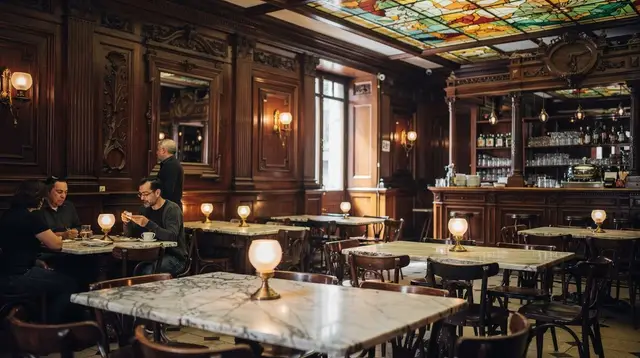
Step past the entrance and the room opens into a long salon with marble-topped tables, bentwood chairs, dark wood panelling and columns rising to a stained-glass ceiling that filters daylight into the space even at midday. Mirrors along the walls make the room feel larger than its floor space, and framed photographs and portraits of past patrons — writers, poets, tango figures — line much of the wall space nearest the entrance.
Toward the back of the building is a separate room used for the evening tango performances; during the day this space is generally closed or set for the coming show, so the daytime visit centres on the main salon and the smaller side rooms rather than the performance space itself. Waitstaff move in traditional black-and-white uniforms, which is part of the theatrical continuity of the place rather than a costume put on for visitors — it has been the house style for a very long time.
Photography inside is normal and expected; this is one of the more photographed café interiors in the city, and you will regularly see people pausing at the entrance to take a picture of the room before finding a seat, which is part of why the doorway itself can bottleneck at busy hours.
What to Order (and What Not to Expect)
Café Tortoni functions as a proper café with a food menu, but the realistic way to treat a first visit is as a coffee-and-pastry stop rather than a destination restaurant. The classics to order are:
| Order | What it is |
|---|---|
| Cortado or café con leche | Standard Argentine coffee styles, served with the usual short glass of soda water on the side |
| Medialunas | Small sweet croissants, the standard Argentine coffee-break pastry |
| Submarino | A bar of chocolate served with a jug of hot milk, stirred to melt — a house classic rather than an everyday order elsewhere |
| Short lunch dishes | A limited savoury menu is available if you want to sit for longer than a coffee |
Prices sit above the Buenos Aires average for a café of this kind, reflecting the location and the history rather than unusually large portions. Because Argentina has been through years of high inflation and repeated changes to exchange rules, any specific peso figure quoted here would be stale within weeks — treat this as a dated note rather than a fixed price, check a current menu or a recent visitor report before budgeting, and see the budget and currency guide for how to think about peso prices in general.
Service is attentive but unhurried, in the old-café style rather than fast-turnover — plan for a relaxed half hour rather than a quick stop if the room is busy.
Visiting by Day vs the Evening Tango Show
It is worth being explicit about this, because the two experiences are easy to conflate when planning a trip. A daytime visit is an open, walk-in stop: you arrive, wait if necessary, sit in the main salon, and order coffee or a light meal at your own pace, with no set schedule and no ticket. The evening tango show is a distinct, ticketed performance held in the dedicated room at the back of the building, sold in advance, with a fixed start time and its own price tier that typically bundles a drink or a light supper with the performance.
Visitors who only want to see the historic room and have a coffee do not need to book the show at all — and conversely, those coming specifically for the tango performance should not assume that turning up for dinner without a reservation will get them a seat. If an evening tango show at Café Tortoni is what you are after, the details — including how it differs from the dinner-and-show houses elsewhere in the city and from the informal street performances in San Telmo and Caminito — are covered on its own page:
an evening tango show inside Café Tortoni’s historic back roomFor the daytime version this guide describes, none of that booking machinery applies — you simply arrive.
Getting In Without the Queue (Mostly)
Being blunt is more useful than being reassuring here: Café Tortoni is genuinely popular, it is genuinely small relative to its fame, and there is very often a line at the door, particularly in the late morning through mid-afternoon and again in the early evening before the tango show. There is no trick that reliably avoids this — it is simply the cost of visiting a landmark this well known in a room this size.
What does help:
- Go early. Arriving close to opening time, before tour groups and coach parties build up, is the single most effective way to get a table quickly.
- Go for a mid-afternoon lull rather than the lunch rush, if your schedule allows it — the gap between lunch and the evening surge tends to be calmer.
- Expect a wait and plan around it. Do not build a tight schedule around a guaranteed five-minute stop here; give yourself slack before your next stop.
- Consider a guided pairing. A short guided walk through the historic centre that includes a coffee stop at Café Tortoni removes some of the uncertainty, since the visit is built into a planned itinerary rather than left to a queue you cannot predict:
No operator, guide or article — this one included — can promise you a table with no wait at a landmark this popular. Treat any claim of a guaranteed, queue-free table with the same scepticism you would apply to a guaranteed match ticket at La Bombonera: it is not how a genuinely in-demand, walk-in space works.
Nearby: Building a Microcentro Morning Around It
Café Tortoni sits close enough to several other landmarks that it slots naturally into a longer morning on foot rather than standing as an isolated stop. From the café it is a short walk to the Plaza de Mayo itself, with the Casa Rosada and the Cabildo, and a similarly short walk to El Ateneo Grand Splendid, the converted-theatre bookshop on Avenida Santa Fe, if you are extending the walk north into Recoleta’s edge.
A practical way to sequence it: start at Casa Rosada and the plaza in the cooler part of the morning, walk down Avenida de Mayo to Café Tortoni for a coffee once the queue has thinned a little, then continue on a broader Microcentro walking route or a dedicated walk of Plaza de Mayo if you want more historical context along the way. Anyone building a full day around the downtown core rather than just this one stop can also look at the one-day historic-centre walk, which sequences these same landmarks into a single loop.
If your interest runs toward performance venues and grand interiors more broadly, the guided tour of Teatro Colón — a short walk from here — covers a different kind of historic room: a working opera house rather than a café, toured by day and performed in by night, in a structure that mirrors the Tortoni’s own day/evening split. For a broader cemetery-and-café combination that pairs a landmark visit with a wealthy-barrio walk further north, this option covers Recoleta on the same trip:
a combined tour of Recoleta Cemetery and the surrounding wealthy neighbourhoods of Retiro and RecoletaPractical Details
| Detail | Note |
|---|---|
| Location | Avenida de Mayo, Microcentro, a short walk from Plaza de Mayo |
| Best for | Coffee, pastries, a short historic stop — not a full sit-down dinner |
| Busiest times | Late morning to mid-afternoon; again before the evening tango show |
| Booking | Not required for a daytime coffee visit; required for the evening tango show |
| Typical visit length | 30–45 minutes, including a possible wait for a table |
| Payment | Confirm current card acceptance and any foreign-card surcharges on arrival — rules and rates have shifted more than once in recent years |
For anyone weighing where to stay to make casual stops like this one easy on foot, the neighbourhood-by-neighbourhood accommodation guide is a useful starting point, and the broader things to do in Buenos Aires hub, or its museums and landmarks category, rounds out the historic-centre options if you want to build a longer day around similar stops.
Café Tortoni Visitor FAQ
Do I need a reservation to visit Café Tortoni during the day?
No reservation is needed just to have coffee or a meal at the bar and table service during the day. Walk-ins are the norm; the only booking that matters here is for the evening tango show, which is a separate ticketed event in the back room.
Why is there always a queue outside Café Tortoni?
It is one of the most visited historic interiors in the Microcentro, sitting on Avenida de Mayo a short walk from Plaza de Mayo, and it is small relative to its fame. At peak midday and early-evening hours, arriving groups and coach tours can mean a genuine wait for a table, especially near the entrance and the main salon.
Is Café Tortoni just a tourist trap?
It is touristy by any measure, but it is not fake: the café has operated continuously since 1858 and the room itself — the columns, the stained-glass ceiling, the marble-topped tables — is original, not a reconstruction. Prices run higher than an ordinary Buenos Aires café because of the location and the history, which is a fair trade for many visitors and not one for others.
What is the difference between visiting Café Tortoni and the Café Tortoni tango show?
A daytime visit means walking in, sitting where a table is free, and ordering coffee or a meal in the historic salon at your own pace. The tango show is a separate, ticketed evening performance held in a dedicated room at the back of the building, sold in advance and covered on its own page — the two are different products inside the same building.
What should I order at Café Tortoni?
The café is best treated as a coffee-and-pastry stop rather than a full restaurant: a cortado or café con leche alongside medialunas or the house submarino (hot milk with a bar of chocolate to melt in) is the classic order. A short lunch menu is also available if you want to sit longer.
How long should I plan for a visit to Café Tortoni?
Thirty to forty-five minutes is enough for coffee and a look around the room, including a reasonable wait for a table. Add extra time if you are visiting at a busy hour, and treat it as a stop within a longer Microcentro walk rather than a destination for a whole morning.
Is Café Tortoni accessible for wheelchair users or those with limited mobility?
The main salon is at street level and generally manageable, but the building is over a century and a half old, with narrow spacing between some tables and steps in parts of the interior, including toward the tango-show room. If accessibility is essential, it is worth asking staff on arrival which sections are reachable without stairs.
Can I just look at the interior without ordering anything?
Café Tortoni operates as a working café, not a museum, so the normal expectation is that visitors passing through the salon are there to be served. A brief look near the entrance is generally tolerated, but settling in to photograph the room at length without ordering is not really how the space is meant to be used.
Historic Sites and Landmarks
Verified deep-linked GetYourGuide tours. Book through these links and we earn a small commission at no cost to you.
GetYourGuide does not provide a product photo for this activity — the image shows the meeting point, photographed by us.