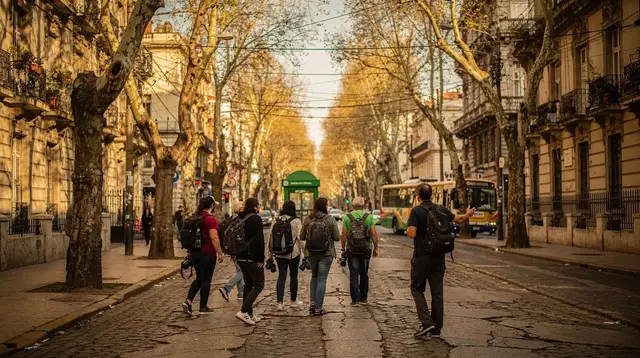
Buenos Aires’ opera house, one block from Plaza Lavalle
The Teatro Colón sits on Cerrito, on the edge of the Microcentro, a short walk from Plaza de Mayo and from the Plaza Lavalle courts district. It opened in 1908 after nearly two decades of construction, and it is routinely counted among the handful of opera houses in the world with the finest acoustics — a reputation built on the shape of the horseshoe auditorium, the materials used inside it, and a scale that seats close to 2,500 people without losing intimacy.
This page is about the building itself and how to actually get inside it. For what else sits around it on the same walk — Plaza Lavalle, the Tribunales courts, the wider grid of the Microcentro — see the neighbourhood page rather than this one; the two are written to complement each other, not repeat each other.
The single most useful thing to understand before planning a visit is that the Teatro Colón is a working theatre, not a museum. It runs two entirely different kinds of visit, on two different schedules, at two different price points, and mixing them up is the most common planning mistake. Sort out early which one you actually want — or whether you want both.
Two different visits, not one
The daytime guided tour takes visitors through the public areas of the building — the golden hall, the main auditorium from the stalls or a box, and, depending on the day’s access, backstage or workshop areas where sets and costumes are built. Tours run in multiple languages across the day, are led by a guide, and last on the order of one hour. They are the only way to see the interior if there is no performance that evening, and they are bookable well ahead of a visit — the sensible approach for anyone who wants a guaranteed slot at a set time, particularly in the high season around the southern-hemisphere summer and around any major festival dates.
The evening performance is the other visit entirely: an opera, ballet or concert staged in the auditorium the tour walks through by day. Seeing a performance means buying a ticket to a specific date and a specific seat, at a price that depends heavily on where in the house that seat is — a seat in the stalls or a box costs a great deal more than a seat high in the gallery, and the gallery (the paraíso, literally “paradise”) is the traditional budget option for genuine opera-goers, with a more limited view but real atmosphere. The performance season runs roughly March through December, with a pause over the southern summer.
Do not treat these as interchangeable. A guided tour does not include watching a performance, and a performance ticket does not include a guided walk through the building — you take your seat, watch the show, and leave. Anyone who wants both experiences needs to plan for two separate visits, on two different occasions, and budget for both separately.
| Visit type | What it includes | Typical length | When it runs |
|---|---|---|---|
| Guided tour | Golden hall, auditorium view, guide commentary, often backstage areas | ~1 hour | Daytime, most days of the year |
| Performance | A specific opera, ballet or concert, seated in the auditorium | 2–3 hours (varies by programme) | Evenings, March–December season |
Booking the guided tour
Guided tours are ticketed and run on a schedule of fixed departure times through the day, with tours offered in Spanish, English and other languages depending on demand and staffing. Two things are worth planning around:
- Book ahead in high season. Slots do sell out, particularly around the summer months when the city is full of visitors and around any period with extra demand from cruise arrivals or holidays. Turning up on the day and hoping for the next departure works outside peak periods, but it is a risk, not a plan.
- Check the current price and schedule before travelling. Ticket prices, opening hours and the exact route the tour follows have all changed more than once in recent years, and this page will not attempt to quote a figure that is likely to be stale within weeks — check the official box office or a recognised ticketing partner for the current, dated price.
Photography rules, bag restrictions and whether backstage areas are included on a given day can also vary, so it is worth reading the specifics on the booking page rather than assuming last year’s visit still applies.
Booking a performance
Performance tickets are sold by date, by opera/ballet/concert title, and by seat category, which means the useful planning question is not “how much does a ticket cost” but “how much does a ticket in this part of the house, for this specific show, on this specific date cost” — and that only exists once a programme is published. A few structural points hold regardless of the season’s line-up:
- Seat location drives price more than almost anything else. Boxes and the stalls closest to the stage sit at the top of the range; the upper gallery sits at the bottom, and is the traditional way locals have seen opera here for generations.
- Popular titles and opening nights sell out first. If a specific date matters — a particular production, a specific singer or company — book as early as the season’s tickets go on sale rather than waiting for the week of the trip.
- Dress and etiquette lean towards smart, not casual, though the Colón is not as strict as some European houses; check current guidance if in doubt.
Anyone weighing a night at the Colón against an evening of tango instead — a different art form, a different room, a different price bracket — is really choosing between two distinct Buenos Aires evenings rather than two versions of the same thing.
A polished dinner-and-show tango house such as the Rojo Tango Show is built around a set dinner, a stage show and a tourist-friendly format, while a more theatrical, non-dinner staging like the Immersive Tango Show puts the dance itself front and centre — both are worth comparing against a Colón performance on the tango shows guide rather than treated as the same category of evening.
What makes the building itself worth the visit
The Colón’s reputation rests on two things that a guided tour is built to show off: the acoustics and the interior architecture. The horseshoe-shaped auditorium, the density and type of materials used in its construction, and the volume of the hall are frequently cited by musicians and acousticians as producing one of the most naturally resonant opera spaces anywhere — a reputation that predates modern amplification entirely and has nothing to do with sound equipment.
Visually, the building blends a French Beaux-Arts exterior with an interior that draws on Italian and German influences: a grand marble staircase, a golden hall used for smaller recitals and receptions, and a domed ceiling over the main auditorium repainted in the 20th century.
None of this needs to be taken on faith from a guide’s commentary alone — it is the reason opera and ballet companies from outside Argentina have historically prioritised a Colón booking on South American tours, and it is the reason architecture-focused visitors put this building ahead of most other Microcentro stops.
Getting there and around
The theatre fronts onto Cerrito (also signed as Avenida 9 de Julio at this stretch) at the corner with Libertad, right at the edge of Plaza Lavalle. It is a five-to-ten-minute walk from most points in the Microcentro, reachable on foot from Plaza de Mayo in about fifteen to twenty minutes along Avenida de Mayo or a parallel street, and close enough to Retiro and to Recoleta’s southern edge to fold into a single day covering several of the city’s central sights. The nearest Subte access is on Line D (Tribunales) or Line B, both a short walk away; buy or top up a SUBE card before travelling, since none of the city’s public transport accepts cash fares directly.
For a first Microcentro half-day, the theatre pairs naturally with a walk that also takes in Plaza Lavalle itself, the Tribunales courts, and a coffee stop at a historic café such as Café Tortoni a little further along — a combination covered in more detail on the Microcentro walking tour guide and the Café Tortoni guide.
Travellers building a longer first stay can see where this fits into a fuller schedule on the three-day first-timer itinerary, or compare it against other multi-day options via a broader planning tour such as the 4 Day Discovering Buenos Aires package, which bundles several central sights including time in this area.
Planning it around the rest of the city centre
Because the Colón sits right at the seam between the Microcentro and the courts district, it’s easy to treat it as one stop on a longer central walk rather than a dedicated outing. A realistic half-day sequence: Plaza de Mayo and the Casa Rosada in the morning, a walk up towards Plaza Lavalle, the Teatro Colón guided tour around midday, and a coffee or lunch stop nearby before continuing towards Recoleta or back through the Microcentro. Full details on the Casa Rosada stop are on the Casa Rosada visit guide, and a fuller Plaza de Mayo circuit is on the Plaza de Mayo walking tour.
Travellers who prefer a single museum-and-monument pass covering several central sights, rather than booking each one separately, should check current bundle options on the museum tickets guide and the city pass guide — coverage and inclusions for these change from year to year, so treat any pass as worth verifying against what it actually includes before assuming the Colón is part of it.
Two other nearby stops reward a short detour on the same walk: the El Ateneo Grand Splendid bookshop, a converted 1919 theatre a bus or taxi ride away on Avenida Santa Fe (see the El Ateneo guide), and a wander through Recoleta if there’s a full day rather than a half-day to spend. None of these need to happen on the same outing as the Colón tour — the theatre stands well enough on its own — but they slot in easily for travellers building a single, unhurried day around the centre and the Microcentro rather than rushing between fixed time slots.
Frequently asked questions about visiting the Teatro Colón
Can I just walk into the Teatro Colón without a ticket?
No. The building is not open for casual walk-in entry outside of the guided tour and performance schedules. Seeing the interior requires either a booked guided tour ticket for a specific daytime slot or a ticket to an evening performance — both should be reserved ahead of arrival, particularly in high season, since slots and seats genuinely sell out.
What’s the difference between the guided tour and a performance?
The guided tour is a roughly one-hour, guide-led daytime walk through the public areas of the building — the golden hall, the auditorium, and often backstage or workshop spaces. A performance is an evening opera, ballet or concert seen from a booked seat in the auditorium, lasting two to three hours depending on the programme. They are two separate visits, bought separately, and one does not include the other.
How long does the guided tour take?
On the order of one hour. Exact timing can vary slightly by language group and by which areas are accessible on a given day, but plan for roughly fifty minutes to an hour from start to finish.
Do I need to book the guided tour in advance?
Booking ahead is the safe approach, especially during the southern-hemisphere summer and around any period of higher visitor demand, when tour slots can sell out for the day. Walking up and hoping for space on the next departure is possible outside peak periods but is not something to rely on for a tight schedule.
How much does a performance ticket cost?
It depends entirely on the seat category and the specific production — boxes and stalls near the stage sit at the top of the range, while the upper gallery is the traditional budget option. Because programmes and prices change from season to season, check the official box office or a recognised ticketing partner for the current, dated figures rather than relying on a fixed number.
Is the Teatro Colón worth visiting even without an interest in opera?
Many visitors go purely for the architecture and the acoustics, both of which the guided tour is built to showcase, rather than for a specific musical interest. The building’s reputation among architects and acousticians stands on its own, independent of whether a visitor plans to return for a performance.
How do I get to the Teatro Colón from the Microcentro?
It’s a five-to-ten-minute walk from most points in the Microcentro, right at the edge of Plaza Lavalle. The nearest Subte stops are on Line D (Tribunales) or Line B, both within easy walking distance; a SUBE card is required for any Subte, bus or suburban train journey in the city.
Should I book the tour or a performance if I only have time for one?
That depends on what’s on offer and on personal interest: the guided tour guarantees seeing the interior at a fixed, shorter time commitment regardless of the season’s programme, while a performance is the fuller experience of the building doing what it was built for, but only works if a suitable date and seat are available. Travellers with a tight, fixed schedule often default to the tour for its reliability; those planning further ahead, or already keen on opera or ballet, tend to prioritise booking a performance instead.