Travel tips for Buenos Aires
Everything you need to know before visiting Buenos Aires and its surroundings — money, transport, getting in and when to go.
Planning essentials
Visas, budgets, packing, eSIMs and the cultural etiquette worth knowing before you land.

Getting around
Using the Subte's six lines (A to E and H) and colectivo buses with a SUBE card, which both require and which won't take cash at the turnstile, plus remises and ride-hailing apps for door-to-door trips, and the Tren de la Costa or Mitre line out to Tigre.


Good to know about travel tips for Buenos Aires
Buenos Aires sits in the southern hemisphere, so its seasons run opposite to Europe and North America: summer falls in December through February and winter in June through August, meaning a trip planned for what feels like midsummer back home can actually land in the coldest local months. Spring, from September to November, and autumn, from March to May, tend to offer the most comfortable weather, and the jacaranda trees that bloom in late October are a genuine seasonal highlight worth timing a visit around.
Money matters more here than in many destinations because the Argentine peso is highly volatile; any price quoted in pesos should be treated as a snapshot that can be outdated within weeks, and travellers should expect to check current exchange rates close to their travel dates rather than relying on older figures. Two airports serve the city: Ezeiza, also known as EZE, handles international flights and sits about thirty-five kilometres south of the centre, while Aeroparque Jorge Newbery, or AEP, handles domestic routes and is located within the city itself, so confirming which airport a flight uses matters for transfer planning.
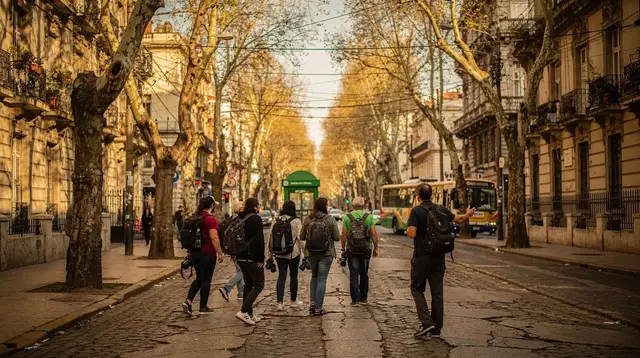
Getting around the city relies on the Subte metro, with six lines labelled A through E plus H, along with an extensive network of colectivo buses; both require a SUBE card, which is effectively mandatory since cash fares are not accepted on board. There is no tram network. Remises, a form of pre-booked car service, and ride-hailing apps fill the gaps the metro and buses don't cover. Safety is a matter of ordinary city awareness rather than particular alarm: some neighbourhoods and their edges warrant more caution after dark than others, and the usual precautions around bags and phones in busy areas apply.
The local dialect, Rioplatense Spanish, uses ‘vos’ instead of ‘tu’ and has its own accent and vocabulary, which can catch out travellers who learned Spanish elsewhere. Electrical outlets run on 220 volts at 50 hertz using type C and I plugs, so most visitors from North America will need an adapter and, in some cases, a voltage converter for sensitive devices.
Frequently asked questions about travel tips for Buenos Aires
When is the best time of year to visit Buenos Aires?
Spring (September to November) and autumn (March to May) offer the most comfortable weather, with late October adding the bonus of jacaranda blooms across the city.
Should I exchange money before arriving in Buenos Aires?
It's better to check current rates close to your travel dates given how volatile the Argentine peso is; any figure quoted more than a few weeks in advance should be treated with caution.
Which airport will I land at in Buenos Aires?
International flights use Ezeiza (EZE), about 35 km south of the city, while domestic flights use Aeroparque Jorge Newbery (AEP), located within the city itself.
Do I need a SUBE card to use public transport?
Yes, the SUBE card is required for both the Subte metro and colectivo buses, since cash fares generally aren't accepted on board.
Is Buenos Aires safe for tourists?
Buenos Aires is generally safe with ordinary city precautions; being more alert in certain neighbourhoods after dark and keeping valuables secure in busy areas is sensible rather than a sign of particular danger.
Trip Planning
Verified deep-linked GetYourGuide tours. Book through these links and we earn a small commission at no cost to you.
GetYourGuide does not provide a product photo for this activity — the image shows the meeting point, photographed by us.