Downtown by day, empty by night: reading the Microcentro correctly
The Microcentro is what Buenos Aires calls its own downtown: the dense grid of office towers, banks, ministries, theatres and bookshops that fills the wedge of the city between Avenida 9 de Julio, the Retiro rail yards and the Río de la Plata waterfront. It is not a barrio in the residential sense that Palermo or San Telmo are — almost nobody lives here — and that single fact should shape how a visitor plans time in it.
By day, especially on weekdays, it is one of the most crowded and energetic parts of the city: office workers filling the sandwich counters at lunchtime, queues at bank branches, a constant flow of colectivos and taxis along its one-way streets. By early evening on a weekday it still has real life, mostly along one axis. By night on a weekday, and for most of the weekend, it is close to deserted — shutters down, streets quiet, a different city entirely from the one at midday.
That contrast is worth stating plainly rather than glossing over, because the Microcentro is easy to misread from a map. It sits at the geographic heart of the city, walking distance from Puerto Madero and not far from San Telmo, so it is tempting to imagine it as a natural place to stay or to plan an evening around. In practice it works best as a daytime destination: a half-day of walking woven into a broader day in the historic centre, not a base and not an evening plan on its own — with one clear exception, the theatre strip along Avenida Corrientes, covered below.
What the Microcentro actually is
Geographically, the Microcentro is the roughly rectangular core bounded by the Plaza de Mayo area to the south, Avenida 9 de Julio to the west, the Retiro station district to the north, and the Río de la Plata docks to the east — overlapping at its eastern fringe with the newer development of Puerto Madero. Calle Florida, a long pedestrian shopping street, cuts through the middle of it from Plaza de Mayo up toward Plaza San Martín near Retiro, lined with shoe shops, leather-goods stores, currency exchange offices and, in season, street performers and money-changers touting informal exchange rates.
Functionally, the Microcentro is where Argentina does its national business: government ministries cluster near Plaza de Mayo, the Buenos Aires stock exchange and the head offices of major banks sit along Avenida Corrientes and Calle Reconquista, and law firms and corporate headquarters fill the office towers further north. This is the administrative and financial spine of the country, not a museum piece — which is exactly why it thins out so sharply once the working day ends.
This page treats the Microcentro as that wider business-and-theatre district. Plaza de Mayo itself — the square, the Casa Rosada presidential palace, the Cabildo and the cathedral — has its own dedicated page focused on those institutional buildings; here it is mentioned only as the Microcentro’s southern anchor and starting point for a walk.
Avenida Corrientes: the one street with real evening life
If the Microcentro has a single redeeming evening identity, it is Avenida Corrientes. For a stretch of roughly ten blocks north of 9 de Julio, Corrientes is Buenos Aires’ theatre row, sometimes compared loosely to a smaller, less commercial cousin of Broadway or the West End. Independent and commercial stages sit shoulder to shoulder here, staging everything from long-running comedies and musicals to serious drama, often with several showtimes a night and prices well below equivalent seats in London or New York.
Corrientes is also the street of the all-night bookshop. Several stores along here — the most famous being the extraordinary former-theatre bookshop covered on its own page — keep hours that would be unusual almost anywhere else, staying open past midnight on weekends. Pizzerias serving thick, cheese-heavy slices by the piece late into the night are a Corrientes institution in their own right, a fixture of post-theatre suppers for generations of porteños.
The single best-known café in this stretch, an ornate, wood-panelled room with a long literary and tango history, sits just off Corrientes and rewards an unhurried coffee or a short tango show booked in advance rather than a rushed walk-through. For the shows themselves — a dinner tango production, a no-dinner performance, or a comparison of the different formats on offer — dedicated guides cover the options in detail rather than repeating them here.
Away from Corrientes itself, do not expect this energy to extend across the rest of the Microcentro. A block or two east or west and the streets are quiet office frontages, closed for the night, with little reason to wander.
The Teatro Colón, on the district’s edge
The Teatro Colón, widely rated among the great opera houses of the world, sits right at the western edge of the Microcentro, on Avenida 9 de Julio at Libertad — close enough to fold into a Microcentro walk, distinct enough in scale and importance that it merits its own detailed page for tours and performances rather than a few paragraphs here. Worth knowing in passing: it operates as a working theatre, not a museum, so a look at its exterior during a Microcentro walk is a different visit from a guided interior tour or an evening performance, and the two are booked separately.
Walking the Microcentro: a practical route
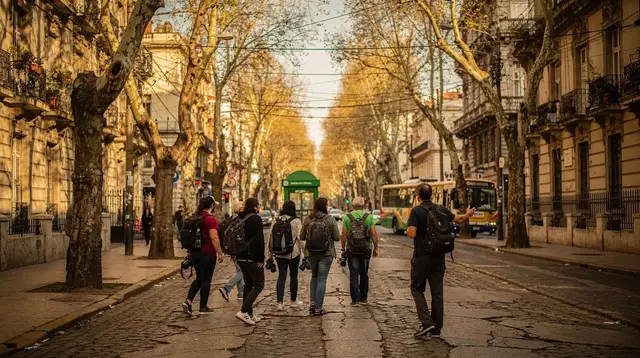
A sensible half-day route starts at Plaza de Mayo, takes in the square’s institutional buildings from the outside, then heads up Calle Florida — Buenos Aires’ oldest shopping street, pedestrianised and lively with office workers at lunchtime — toward Plaza San Martín near the Retiro rail and bus terminals. A short detour west brings the Teatro Colón into view on 9 de Julio. Doubling back toward Corrientes for a coffee, a browse through one of the late-opening bookshops, and a look at the theatre marquees rounds out a comfortable few hours on foot.
This is flat, dense, entirely walkable terrain — no hills, short blocks, wide pedestrian crossings at the main avenues — but also some of the most crowded pavement in the city on a weekday, particularly around lunchtime and the evening commute. Comfortable shoes and a bit of patience with foot traffic matter more here than almost anywhere else in Buenos Aires.
For a structured version of this same ground, a guided walking tour of the district or a broader historic-centre walking tour that folds in San Telmo is a straightforward way to see it with context rather than working it out block by block; several such tours run daily and cover the Microcentro alongside the adjoining historic core.
Getting there and getting around
The Microcentro is the best-connected patch of the entire city, which is part of why it makes sense as a passing-through district rather than a base. Subte Lines B, C and D all cut through it, along with the interchange stations near Plaza de Mayo; from Palermo or Recoleta, Line D puts a visitor in the heart of the district in roughly 15-25 minutes. Retiro, the city’s main rail and long-distance bus hub, sits at the Microcentro’s northern edge, making this the natural transfer point for a day trip out to Tigre or further afield. Every Subte and colectivo journey here requires a loaded SUBE card — cash is not accepted on board.
Because it sits between Puerto Madero and San Telmo, the Microcentro also works well as a midday link between the two rather than a destination to return to separately: a morning in San Telmo, lunch and a Corrientes browse in the Microcentro, an afternoon along the Puerto Madero docks, is a natural sequence for a first full day in the city.
Where the Microcentro is not the answer
It’s worth being direct about what the Microcentro is not, since guidebooks sometimes blur this. It is not a nightlife district — the bars, late kitchens and clubs that define an evening out in Buenos Aires belong to Palermo and, to a lesser extent, San Telmo, not here. It is not a residential neighbourhood with the kind of street life, apartment buildings and corner cafés that make Recoleta or Belgrano pleasant to simply live among for a few days.
And it is not a sensible base for a stay: a hotel here means quiet, closed streets after about 21:00 on weekdays and for the entirety of most weekends, a poor trade against the walkable evening life of Palermo Soho, Recoleta or San Telmo. Save the Microcentro for daytime hours and let it go quiet without you in it.
Practical notes
Lunch is the Microcentro’s peak meal — the district’s countless sandwich counters, bakeries and quick-service parrillas exist to feed the office lunch rush, and queues form fast between roughly 12:30 and 14:00. Dinner, by contrast, is thin outside the Corrientes theatre strip; plan to eat elsewhere once the working day ends, unless staying specifically for a show.
Banks and currency-exchange offices cluster here, which also makes it a common spot for money-changers working the informal exchange rate to approach pedestrians on Calle Florida — a legal grey area that visitors are not obliged to engage with, and ordinary ATMs and cards work throughout the district. As everywhere in central Buenos Aires, keep phones and bags attended in cafés and away from the kerb near passing traffic.
For a first full day that uses the Microcentro as connective tissue rather than the whole plan, a structured historic-centre itinerary covering Plaza de Mayo, the Microcentro and San Telmo in sequence is the most efficient way to see the old city core without doubling back.
Frequently asked questions about visiting the Microcentro
Is the Microcentro the same as Plaza de Mayo?
No. Plaza de Mayo is the specific square with the Casa Rosada, the Cabildo and the cathedral, on the Microcentro’s southern edge. The Microcentro is the wider business and theatre district around it, running north to Avenida Corrientes and the office blocks near Retiro.
Is the Microcentro safe to walk around?
By day it is one of the busiest, most policed parts of the city and generally straightforward to walk. The usual opportunistic-theft precautions apply — keep a phone out of sight near traffic and in crowds — and the area is far quieter and less watched after dark.
Should I stay in a hotel in the Microcentro?
It is possible and central hotels exist there, but most visitors are better placed in Palermo, Recoleta or San Telmo, which stay lively at night and on weekends. The Microcentro itself goes quiet once offices close and on Saturdays and Sundays.
What is there to do on Avenida Corrientes at night?
Corrientes is Buenos Aires’ theatre street, close to a dozen stages within a few blocks, plus bookshops that keep genuinely late hours and pizzerias serving until midnight or later. For an evening built around porteño tango rather than theatre, a dedicated show such as a classic Buenos Aires tango dinner show or a skip-the-line tango performance is a short taxi ride from this stretch, not part of it.
Is the Teatro Colón in the Microcentro?
It sits right on the district’s edge, on Avenida 9 de Julio at the corner of Libertad. It has its own detailed guide for tours and performances; this page treats it only as a Microcentro landmark, not as a visit in itself.
How much time should I set aside for the Microcentro?
A half-day weekday walk covers it comfortably: Plaza de Mayo’s edges, a stretch of Corrientes, one or two of the classic cafés and bookshops, and a look at the Teatro Colón’s exterior. Travellers building a longer, guided first visit sometimes fold this district into a multi-day guided introduction to Buenos Aires alongside the other historic-centre sights, or pair a downtown morning with a day trip to the provincial capital of La Plata in the afternoon.
Is the Microcentro walkable from Palermo or Recoleta?
It is too far to walk comfortably as a single trip — figure 40-60 minutes on foot from Recoleta and well over an hour from Palermo. The Subte (Lines D or B) or a short taxi/rideshare ride, both around 15-25 minutes, are the practical options.
What should I eat in the Microcentro?
Lunch, not dinner, is the district’s strength: sandwich counters, bakeries and quick parrillas aimed at the office crowd, busiest between 12:30 and 14:00. In the evening, the classic move is a Corrientes pizza slice on the way to or from a show rather than a sit-down dinner elsewhere in the district.
Does the Microcentro have things to do for a whole day?
Not really, and it is not designed to. Pair a Microcentro morning or afternoon with neighbouring San Telmo or Puerto Madero rather than treating the district as a full day on its own; the things to do in Buenos Aires hub groups activities by type across the whole city for exactly this kind of planning.