Free Walking Tours in Buenos Aires: How They Really Work
Are free walking tours in Buenos Aires actually free?
No. 'Free' means no ticket is sold in advance, but a tip at the end is the strong social norm the whole model depends on, typically in the range a paid tour would cost. Groups also tend to be larger and less personalised than a booked small-group walking tour.
What “free” actually means on the street
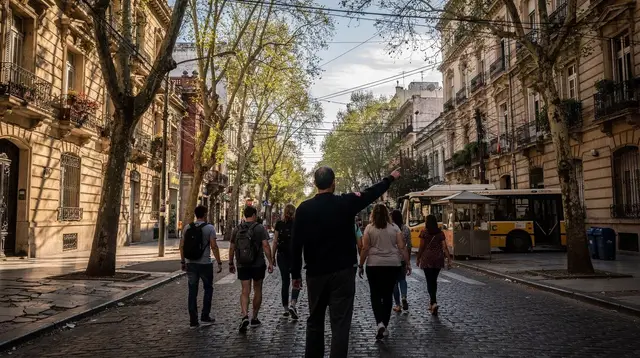
Every city with a serious tourist trade now has a “free walking tour” scene, and Buenos Aires is no exception: posters and sandwich boards outside hostels in San Telmo and around Plaza de Mayo advertise tours with no listed price, a fixed meeting point, and a departure time. It is worth being honest about the word before you show up. “Free” in this context describes the ticketing model, not the economics.
No one buys a ticket in advance and no card is charged. What actually funds the guide’s day is the tip collected at the end, from everyone in the group, and that tip is not a polite optional extra — it is the entire business model. A guide who leads two groups a day and collects nothing at the end has, in practical terms, worked for free. The tours run because enough people understand that and pay accordingly.
This matters for how you plan the day. If you walk in assuming “free” means the outing costs nothing, you are quietly relying on other people in the group to cover the guide’s wage while you keep your cash in your pocket. That works exactly once per guide per city before word gets around and the model breaks. The honest way to use a free walking tour in Buenos Aires is to treat the eventual tip as the price of the activity, decided at the end rather than at the start, and to bring the cash to pay it.
How much people actually tip
There is no fixed rate, no printed menu, and no single correct answer — that is part of what “free” is doing here, shifting the pricing decision from the operator to the visitor. But regular users of these tours converge on a rough benchmark: somewhere in the range of what a modest paid activity would cost in the city, typically a few thousand Argentine pesos per person, or the equivalent in a handful of small US dollar or euro notes. Argentina’s peso has moved through years of high inflation and repeated changes to exchange rules, so any specific number written here would be stale within weeks — check a current rate before you go, and think in dollar or euro terms if that is easier to hold steady in your head.
A few practical notes on the tip itself. Cash is the norm; card tipping is rare to nonexistent on a street corner at the end of a two-hour walk. Small notes matter, because handing over one large bill for a group of four is awkward and the guide cannot make change on the spot. If you enjoyed the tour and the guide was clearly good — knew their material, managed a large group well, answered questions properly — tipping toward the upper end of what you’d planned is the norm, not an exception. If you can genuinely not afford anything, the tours are still open to you; the entire point of the model is that payment is not a barrier to entry. But that generosity from operators is exactly why the norm from everyone who can pay matters so much.
Group size and what you lose
The other thing “free” changes is the shape of the experience itself, and this is worth weighing against a paid alternative even before money comes into it. Free tours are built to scale: a single guide, a fixed route, a fixed script, and as many people as show up. In high season a group of 20 to 30 is common outside the more popular meeting points, and it can run larger. That has real consequences.
You will spend more of the walk straining to hear over traffic and other groups, you will get through fewer stops per hour because moving 25 people across a street takes longer than moving 6, and the guide has very little room to slow down for a question that only interests two or three people, or to skip a stop nobody cares about in favour of one that does. The route and the script are fixed for the day, not adapted to your particular interests.
A paid small-group or private walking tour is the direct trade against that. Numbers are capped, often at 8 to 12 people or fewer, you book a specific date and time rather than turning up and hoping, and the guide has both the incentive and the room to adjust pace, depth and even route to the people actually in front of them. You are also protected against the free model’s weak point: since there is no ticket revenue at stake, a free tour is usually the first thing cancelled or cut short in bad weather or with low turnout, while a paid, booked tour is a firmer commitment on both sides.
| Free walking tour | Paid small-group / private tour | |
|---|---|---|
| Price | No upfront ticket; tip expected at the end | Fixed price, paid at booking |
| Typical group size | 15–30+, especially in high season | Roughly 6–12, or private |
| Booking | Usually walk-up, sometimes a free reservation | Booked in advance for a set date/time |
| Personalisation | Fixed script and pace for the whole group | Guide can adapt pace, depth, sometimes route |
| Weather/low turnout | First to be cancelled or shortened | Firmer commercial commitment |
| Typical routes | Historic centre, San Telmo | Wider range: food, street art, tango history, single barrios |
Neither model is objectively better — a free tour is a genuinely good, low-commitment way to get oriented on your first morning in the city, and a good guide on a free tour can be every bit as knowledgeable as a paid one. The difference is mainly about scale, flexibility and what you’re implicitly agreeing to pay.
Where free walking tours actually run
In Buenos Aires the free-tour scene concentrates on two areas. The historic centre route covers the Microcentro hub of banks and theatres, Plaza de Mayo with the Casa Rosada and the Cabildo, and usually finishes or starts near the Teatro Colón.
The second common route works through San Telmo, the antique-market barrio south of the centre, often timed to end near the Sunday Feria de San Telmo when it runs on the right day of the week. Some operators extend into La Boca as a paid add-on rather than as part of the free walk itself, since La Boca’s Caminito lane is small, densely touristy, and better handled in daylight with a guide who knows exactly where the safe, well-trafficked strip ends.
What you will not typically find as a free tour is anything thematic or barrio-specific beyond that: a Palermo street art walk, a food-focused route through San Telmo’s markets or Palermo’s restaurants, or a Recoleta Cemetery walk that actually finds Evita’s unmarked Duarte family vault without you wandering the walled city of mausoleums for twenty minutes. Those routes require smaller groups, more specialised guiding, and generally exist only as paid products.
Booking, or not booking, a free tour
Most free walking tours in Buenos Aires still work on a walk-up basis: turn up at the stated meeting point — often a specific statue, corner or café in the Microcentro or on Plaza de Mayo — a few minutes before the departure time, and join whoever else is there.
A growing number of operators now ask for a free online reservation as well, not to charge you anything but to gauge numbers in advance; they may cap the group, split it into two departures, or cancel it outright if turnout is too low to justify sending a guide. If you have a tight schedule that day, treat that reservation step as worth doing even though it costs nothing, since it is the only signal the operator has that you’re actually coming.
Compare that with a paid tour, such as a discounted hop-on hop-off pass bundled with guided walking routes or a full-day walking tour covering several barrios in one outing, where the booking is a genuine confirmation: a specific date, a specific time, and a guide committed to showing up for the number of people who paid, rain or shine within reason. If your schedule in Buenos Aires is tight — a single free morning before an afternoon flight to Iguazú, say — that certainty is worth something beyond the ticket price itself.
When a paid walking tour is the better call
There are a few situations where paying for a smaller, booked walking tour clearly beats the free model rather than merely offering a different trade-off. If you have a narrow window of time and cannot afford a cancelled or oversubscribed free tour to blow a hole in your day, book something confirmed. If your interest is specific rather than general — you want the story of Buenos Aires’s indigenous and immigrant history rather than the standard centre-and-plaza script, which a guide runs through on something like an Indigenous Buenos Aires walking tour — a themed small-group tour will simply cover ground a generic free route does not touch.
And if you want tango’s history explained on foot through the streets and cafés of a barrio that actually shaped the dance, rather than a stage show later that evening, a route like an authentic tango walking tour through Almagro is a different, more specialised product than anything the free-tour model is built to deliver.
None of this is an argument against free walking tours — they are a legitimate, well-established part of how independent travellers see a city, and a good free-tour guide in Buenos Aires can be genuinely excellent. It is an argument for walking in with clear eyes: budget for the tip as you would for any other activity, expect a bigger and less flexible group than a paid alternative, and choose a paid, booked, small-group tour instead when your time is tight or your interest is specific enough that a fixed general-interest script won’t scratch the itch.
Free walking tours in Buenos Aires: frequently asked questions
Are free walking tours in Buenos Aires actually free?
No. There is no upfront ticket price, but guides work for tips only, and a tip at the end is expected. Most visitors give roughly what a modest paid activity would cost; paying nothing at all is technically possible but goes against the model the guide relies on to earn a living.
How much should I tip on a free walking tour?
There is no fixed number, but a common benchmark among regular users of these tours is somewhere in the range of a few thousand Argentine pesos per person, or an equivalent in US dollars or euros in small cash notes. Check a current rate before you go, since the peso figure moves fast, and round up rather than down if the guide was good.
How is a free walking tour different from a paid small-group tour?
The free model relies on volume: groups are often 15 to 30 people or more in high season, gathered at a fixed meeting point and time with no pre-booking. A paid small-group or private walking tour caps numbers, lets you book a specific date and time in advance, and usually gives the guide room to adjust the route or pace to the group in front of them.
Do I need to book a free walking tour in advance?
Usually not for the walk-up spot itself, though many operators now ask for a free online reservation so they can plan guide numbers, and they may cancel or cap the group if too few or too many people show up. A paid tour, by contrast, is confirmed and ticketed the moment you book it.
What happens if it rains or the group is too small?
Free tours are the first to be cancelled or shortened in bad weather or with low turnout, since the guide has no ticket revenue to protect. A paid tour is a firmer commercial commitment on both sides, which is part of what the price is paying for.
Which neighbourhoods do free walking tours in Buenos Aires usually cover?
Most operators run a Microcentro and Plaza de Mayo route covering the historic centre, and a separate San Telmo route; some add La Boca. Palermo, Recoleta and thematic routes (food, street art, tango history) are almost always the paid, smaller-group product instead.
Can I do a free walking tour instead of a paid one to save money?
You can, but budget for the expected tip rather than treating it as a free substitute, and understand you are trading personalisation and group size for a lower, flexible price. For a specific interest — food, street art, a single barrio in depth — a paid small-group tour usually delivers more of what you actually came for.
Walking Tours of Buenos Aires Neighborhoods
Verified deep-linked GetYourGuide tours. Book through these links and we earn a small commission at no cost to you.
GetYourGuide does not provide a product photo for this activity — the image shows the meeting point, photographed by us.