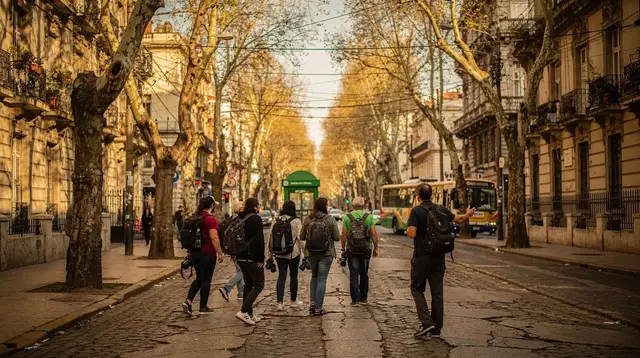
Buenos Aires is where almost every trip to Argentina begins, and for many visitors it is where the trip is centred: the national capital, the country’s main international gateway, and a dense, flat, largely nineteenth- and twentieth-century city built on a grid, with more in common architecturally with Madrid or Paris than with any tropical capital.
That last point is worth stating plainly, because it is the single most common misreading of the city: Buenos Aires is not tropical and it is not a Central American city. It sits in the temperate southern hemisphere, on the wide brown estuary of the Río de la Plata, at a latitude roughly comparable to Sydney or Cape Town, and its seasons behave accordingly — inverted from the northern hemisphere, not absent.
This page is a map of the map: how the city is organised into barrios, how to arrive and get around, and when to come. It deliberately does not lay out a day-by-day itinerary — that is the job of the itinerary pages built for exactly that — and it does not attempt to describe each barrio in detail, since each one has its own page linked below. Treat this as the page you read before you decide where to stay and which neighbourhood pages to open next.
The city, in outline
The city proper is the Ciudad Autónoma de Buenos Aires (CABA), an autonomous federal district with its own government, distinct from the much larger Province of Buenos Aires that surrounds it. The built-up area that spills beyond the city limits into the province is generally called the conurbano, or Greater Buenos Aires — for a first visit, almost everything worth seeing sits inside CABA itself, a compact and walkable-by-metro area.
Geographically, the city is flat and faces the river to the east; there is no coastline of beaches, since the Río de la Plata here is a wide, brown, silt-laden estuary rather than open sea. The barrios that matter for a first visit cluster into three loose bands:
- The historic and riverfront core: the Microcentro, the financial and shopping district, and Plaza de Mayo, the seat of national government, with the Casa Rosada and the Cabildo. East of here, Puerto Madero is the youngest barrio, a converted dock district of glass towers and restored red-brick warehouses, backing onto the wetlands of the Costanera Sur reserve.
- The southern barrios: San Telmo, the oldest residential quarter, known for its antique trade and its Sunday street fair, and La Boca, the working-class port barrio built around the painted lane of Caminito and Boca Juniors’ stadium.
- The northern barrios: Recoleta, the grandest and most formal district, home to the monumental cemetery; Palermo, by far the largest barrio, split in practice into a leafy park district and the nightlife-and-design subzones known as Palermo Soho and Palermo Hollywood; and further out, Belgrano, a quieter residential barrio.
Elsewhere in the city, Retiro is the transport hub for trains north and buses nationwide; the Abasto and Mataderos sit further west and are covered on their own pages; and the Teatro Colón opera house and the two great football grounds — La Bombonera in La Boca and El Monumental in the northern barrio of Núñez — anchor two of the city’s most distinctive institutions, tango and football, each with dedicated guides linked below.
Beyond the city limits, the same estuary and the same flat land open onto very different territory within a couple of hours: the wooded islands of the Paraná Delta north of Tigre, the cattle country of the pampas to the west, and, across the river itself, a second country, Uruguay. Those areas each have their own orientation and are not covered in detail here.
Arriving: two airports, and they are not interchangeable
Getting the airports right is the first practical decision of any trip, and it is also the most common source of confusion for first-time visitors.
Ezeiza / Ministro Pistarini (EZE) handles nearly all intercontinental flights. It sits roughly 30–35 km south-west of the centre, and the drive in takes anywhere from about 45 minutes with clear roads to well over an hour in heavy traffic — budget on the longer side, especially for a fixed onward connection. Airport buses, remises and taxis all run the route; pre-booking a transfer removes the guesswork on arrival.
Aeroparque Jorge Newbery (AEP) handles domestic and most regional flights, and it sits inside the city, on the riverfront a short distance from Palermo. From AEP into the centre is usually 15–30 minutes. The two airports are genuinely on opposite sides of the city’s travel geography: connecting between them — say, an international arrival at EZE followed by a domestic flight from AEP to Iguazú — means crossing the entire city and should never be planned as a quick hop. Allow several hours between flights at the two different airports, not one.
Getting around: the Subte and the SUBE card
Within the city, the workhorse is the Subte, Buenos Aires’s metro: six lines, labelled A to E plus H. Line A, opened in 1913, was the first underground railway built anywhere in the southern hemisphere and in Latin America, and parts of its original rolling stock ran for decades afterward. There is no tram network in Buenos Aires today — the light-rail Tren de la Costa in the northern suburbs is a separate, scenic commuter line, not a city tram, and is really a way of reaching Tigre rather than a way of getting around the city centre.
Almost everything that moves on the ground runs on the SUBE contactless card: the Subte, the citywide network of colectivo buses, which cover the city far more finely than the metro and run through the night on many routes, and the suburban trains out to Tigre and the pampas towns. Drivers do not accept cash fares, so buying and topping up a SUBE card at a station, kiosk or machine is one of the first things to do on arrival. Outside SUBE-based transport, remises (pre-booked cars), metered taxis and the standard ride-hailing apps are all normal and widely used, particularly late at night or with luggage.
Climate: read the seasons the right way around
Buenos Aires is in the southern hemisphere, and its calendar of seasons is the mirror image of the one most visitors carry in their heads. Summer runs December to February — hot, humid, and the city noticeably emptier in January as residents head to the coast or the countryside. Winter runs June to August — cool and damp, with days that rarely reach freezing and snow that is essentially unknown; a July visit here is a winter visit, not a summer one, whatever the month suggests from a northern-hemisphere habit.
The most comfortable windows are the shoulder seasons: spring, September to November, and autumn, March to May. Spring has the added draw of the city’s jacaranda trees, which flower a vivid purple along many streets and squares from late October into November — a short, specific window worth timing a visit around if that particular sight matters. Whichever season you land in, pack for what the calendar actually means south of the equator, not what the month implies elsewhere.
Practicalities worth knowing before you plan further
Argentina uses the Argentine peso (ARS), and the country has lived through years of high inflation and repeated changes to exchange and payment rules — treat any peso figure, including the ones on this site, as a dated snapshot rather than a fixed price, and check a live rate plus the current rules for foreign cards and cash before setting a budget.
The country runs on a single time zone year-round, UTC−3, with no daylight saving and no clock change to track. Sockets are Type C and Type I at 220V/50Hz — a European two-pin plug fits directly, while an Australian-style plug or an adapter is needed for anything else, and visitors from 110V countries should confirm their devices are dual-voltage. The general emergency number is 911. Tap water in the city is treated and generally considered drinkable.
The language is Spanish, spoken locally in its distinctive rioplatense form — vos rather than tú, and a soft sh sound where other varieties of Spanish use “ll” or “y” — and residents of the city are known as porteños. Meals run late by many visitors’ standards: dinner rarely starts before 21:00, and plenty of restaurants do not open their kitchens for dinner before 20:00, so lunch tends to be the earlier, quieter meal of the day. A tip of roughly 10% in restaurants is customary where service is not already included, generally appreciated in cash, but it is a norm rather than a strict rule.
On safety, the honest picture is opportunistic theft rather than a broadly dangerous city: phone snatching from café tables or from a hand held near passing traffic is the classic incident. Keep valuables out of sight on the street, be more careful around Retiro and Constitución stations and after dark generally, and in La Boca keep to the Caminito tourist strip in daylight rather than wandering into the surrounding streets.
Where to start once you’re here
A first walk through the historic core — Plaza de Mayo and the Microcentro — gives a fast, legible introduction to how the city reads: wide avenues, a French- and Italian-influenced skyline, and the seat of government at its centre.
A half- or full-day guided walk is a practical way to get that orientation without getting lost on day one; the full-day walking tour through the historic centre covers the Microcentro, Plaza de Mayo and San Telmo in a single guided loop, and the half-day essential city tour is the faster version aimed at travellers with limited time.
From there, most first visits alternate between the southern barrios — antique-market San Telmo and the painted lane of Caminito in La Boca — and the northern ones: the monumental cemetery in Recoleta, the parks and nightlife of Palermo, and the reclaimed riverfront of Puerto Madero.
A bike is a genuinely good way to link these northern barrios, since the routes are flat and largely follow dedicated paths along the parks and the river; the guided biking tour through Palermo and the riverfront covers that ground in a few hours.
For an evening once the day’s walking is done, a tango show is the classic first-night choice, and the Rojo Tango dinner show is one of the well-established dinner-and-show options in the city — worth knowing it is one of three distinct kinds of tango experience on offer here, alongside social dance halls (milongas) and the free street performances in San Telmo and Caminito, each covered on their own guide pages.
Getting the logistics settled early pays off for the rest of the trip: read the Subte guide and the SUBE card guide before your first metro ride, and compare EZE against AEP as soon as your flights are booked so airport transfers and any domestic connection are planned rather than improvised. For timing the whole trip, the best-time-to-visit guide and the note on jacaranda season go into more depth than the summary above.
What this page will not do is hand you a day-by-day plan — the barrios above, the day trips to Tigre and beyond, and a possible crossing to Colonia del Sacramento in Uruguay, combine in different orders depending on how many days you have and what you care about. That sequencing lives on the itinerary pages, built specifically to turn this map into a schedule.
Buenos Aires at a glance
| Topic | What to know |
|---|---|
| Country | Argentina — Buenos Aires is the national capital |
| Airports | EZE (international, ~30–35 km out) and AEP (domestic, in the city) |
| Currency | Argentine peso (ARS); check a live rate before budgeting |
| Transport | Subte (6 lines, A–E plus H) and colectivo buses, both via the SUBE card |
| Time zone | UTC−3 year-round, no daylight saving |
| Best seasons | Spring (Sep–Nov) and autumn (Mar–May) |
| Language | Spanish, rioplatense form (vos, distinctive “sh” sound) |