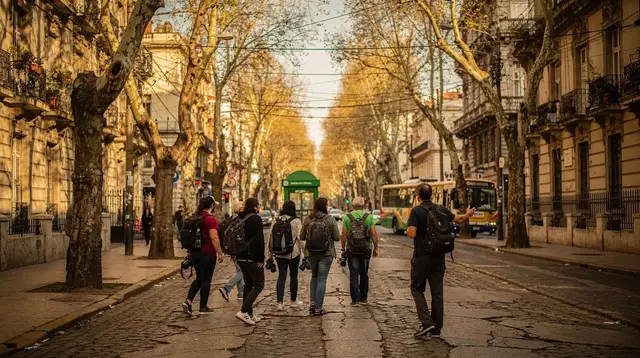
Puerto Madero is the newest of Buenos Aires’s barrios, and it looks it. Where San Telmo has cobbled streets and antique shops and La Boca has a century of dockworker history behind its painted houses, Puerto Madero has glass office towers, a marina lined with restored red-brick warehouses, and apartment blocks that were still building sites twenty years ago.
It sits directly east of the Microcentro, between the old city and the river, on docks that were built in the 1880s, fell out of use within a couple of decades because ships outgrew them, and then sat mostly abandoned until a redevelopment project in the 1990s turned the warehouses into lofts, offices and restaurants and filled in the gaps around them with new construction. That is the honest starting point for a visit: this is not where to come for the layered, weathered Buenos Aires of the postcards. It is where to come for a good meal by the water, a flat and pleasant walk, and a clear view of a city that also builds things new.
What the district actually is
Puerto Madero runs along a set of four rectangular docks — diques — filled with water and lined on both sides with promenades. The old red-brick dockside warehouses on the western side, closer to the Microcentro, have been converted into restaurants, offices and a few hotels, and they are the closest thing the barrio has to a historic streetscape, even though the conversions themselves are recent.
On the eastern side, across the docks, the newer towers rise — some of the tallest residential buildings in the city, many with river views, all built within the last three decades. Between the two, a series of footbridges cross the water, the best known being the white, sail-shaped Puente de la Mujer, designed by the Spanish architect Santiago Calatrava and completed in 2001. It pivots open on its central pier to let boats through and it is the single most photographed structure in the neighbourhood.
Because the whole district was purpose-built as a mixed-use waterfront rather than grown organically over centuries, it reads differently from the rest of central Buenos Aires: wider pavements, more glass, less street life spilling out of doorways, and a general sense of order that can feel closer to a modern marina development in any global city than to the Plaza de Mayo a short walk away. That is a fair trade for some visitors and a disappointment for others — it depends on what you came to Buenos Aires to see. Treat Puerto Madero as a pleasant, contemporary counterpoint to the older barrios, not as a substitute for them, and it earns its place on an itinerary without over-promising.
Getting there and getting around
Puerto Madero is one of the most centrally located barrios in the city, which makes it easy to fold into a walk from the Microcentro or Plaza de Mayo — it is a flat 10 to 15 minute walk east from either. From San Telmo it is a similarly short walk or a five-minute taxi ride along the southern edge of the docks.
There is no Subte station directly inside Puerto Madero; the nearest lines run through the Microcentro, so most visitors arrive on foot, by taxi, by rideshare app, or via the buses that run along Avenida Alicia Moreau de Justo and Avenida Huergo. The district itself is entirely walkable once you are there: it is flat, the promenades run the full length of the docks, and nothing inside it is more than a 20-minute walk end to end.
The waterfront and the bridges
The core experience in Puerto Madero is the walk itself: down one side of the docks, across a footbridge, back up the other. The Puente de la Mujer is the obvious anchor and the best photo stop, particularly in the late afternoon when the white steel catches the light and the towers behind it start to glow. From there, the promenade on the western bank, past the converted warehouses, is generally the more scenic stretch, with outdoor restaurant seating spilling toward the water and a steady flow of joggers and cyclists through the evening.
At the southern end of the docks, the promenade leads naturally into the Costanera Sur Ecological Reserve, a large riverside wetland on reclaimed land that has its own separate character and its own page on this site — worth treating as a distinct visit rather than folding it into a Puerto Madero stroll, since it has its own opening hours, its own pace, and very little of the district’s polish. If you are combining the two, do the reserve in the cooler part of the day, since it has little shade, and save the docks and dinner for later.
At the northern end, moored in the water, sits the Fragata Presidente Sarmiento, a 19th-century Argentine naval training ship now open as a small museum — a modest stop rather than a headline attraction, best treated as something to see in passing if you are already walking that stretch.
Active ways to see the docks
Walking both banks covers the essentials, but Puerto Madero also works well for visitors who want a more active or a more curated look at the district. A bike tour through Puerto Madero, La Boca and San Telmo uses the flat promenades here as an easy warm-up stretch before crossing into the older, more textured barrios to the south — a sensible way to link the new docks and the historic city in a single morning without doubling back on foot.
For a different vantage point entirely, a helicopter tour over Puerto Madero and the football stadiums gives an aerial read on how the docks, the river and the grid of the wider city fit together — a splurge, but one that makes the geography of Buenos Aires click in a way a ground-level walk cannot.
Photographers drawn to the glass-and-brick contrast along the water can also book a editorial-style photo shoot in the modern district, aimed at visitors who want a proper set of portraits against the towers and the Puente de la Mujer rather than phone snapshots. See the guide to biking Puerto Madero and the coast and the helicopter tour guide for more on how these compare with other ways to move around the city.
Getting between stops inside the district has also gotten easier with the arrival of Mobi, a small-scale local shuttle aimed at tourists; it is worth checking out for anyone finding the distance between the northern and southern ends of the docks longer than expected on a hot afternoon.
Puerto Madero as a launch point for the river
Because the docks sit directly on the Río de la Plata, Puerto Madero is also where a handful of river-based excursions begin, distinct from the Uruguay ferries. A sailing trip from Puerto Madero up the river to the Tigre Delta and a round-trip cruise between Puerto Madero and Tigre both use the marina here as a departure point instead of the more usual train from Retiro, trading a longer travel time for a scenic approach to the Paraná Delta by water rather than by rail.
Either option effectively folds a Puerto Madero morning into a Tigre day trip, so it suits visitors who want to see the docks properly rather than pass through them on the way to the train station. For the standard rail approach and the Puerto de Frutos market once in Tigre, see the dedicated Tigre day trip guide and the lancha tour guide.
Puerto Madero after dark
The waterfront changes character once the sun goes down: the towers light up, the restaurant terraces fill, and a smaller but genuine nightlife scene appears around the docks’ southern stretch, including a floating casino moored on the water.
A nightlife experience covering Puerto Madero and the casino on the water packages an evening here for visitors who want a guided introduction rather than working out the bar and casino scene alone. It pairs naturally with the rooftop bars guide for those staying out later, or with dinner reservations booked well ahead, since the best docks-facing tables go quickly on weekend evenings.
Where Puerto Madero fits on a wider visit
Two things make Puerto Madero worth a specific mention beyond “nice waterfront district”: it is where restaurants tend to cluster for a special-occasion dinner, and it is where the ferry to Uruguay departs from.
On the dining side, the converted warehouses along Alicia Moreau de Justo hold one of the highest concentrations of upscale parrillas (steakhouses) in the city, many with docks-facing terraces. It is not the cheapest place to eat in Buenos Aires — prices run above the city average, reflecting the setting — but for a waterfront dinner with river views it is hard to beat within the city limits. Book ahead for a table with a view, especially at weekends, and remember that dinner in Buenos Aires runs late: most places do not fill up until well after 21:00.
On the ferry side, Puerto Madero is home to the passenger terminal serving the fast boats across the Río de la Plata to Uruguay — a short crossing to Colonia del Sacramento in around an hour, or a longer direct run to Montevideo in around two and a quarter hours.
It is worth being precise about what this means: the ferry terminal is in Puerto Madero, but the destination itself is a separate visit to a separate country, with its own passport control, its own currency and its own dedicated pages on this site. Do not conflate an afternoon in Puerto Madero with a day trip to Colonia — they share a departure point and nothing else. If Uruguay is on your plan, treat the walk through Puerto Madero on the way to or from the terminal as a bonus, not the main event of that day.
A realistic amount of time to spend here
Puerto Madero rewards a focused visit rather than a long one. A walk along both sides of the docks, a stop at the Puente de la Mujer, and a coffee or a meal is comfortably done in two to three hours, and half a day covers it generously even with a stop at the Fragata Sarmiento or a slower pace. Visitors who try to build a full day around Puerto Madero alone tend to find themselves looking for something to do by mid-afternoon; it works far better as one stop within a longer day that also takes in the Microcentro, San Telmo or the ferry terminal, or as an evening-only outing built around dinner.
Table: Puerto Madero at a glance
| Character | Modern dockside redevelopment, 1990s–present; no historic core |
| Main draw | Waterfront promenade, Puente de la Mujer, upscale dining |
| Time needed | 2–3 hours walking; half a day with a meal |
| Nearest older barrios | Microcentro and San Telmo, both a short walk west |
| Connects to | Costanera Sur reserve (south end) and the Uruguay ferry terminal |
| Best time of day | Late afternoon into evening, for light and dinner |
A few practical bookings
A handful of tours touch Puerto Madero directly or use it as a starting point. For a ferry crossing that turns the terminal walk into a full day out, the Montevideo day trip with lunch and ferry included handles the crossing and border formalities as a packaged excursion. For an evening in the district itself, the Puerto Madero tango dinner show with a beginner tango class pairs a waterfront setting with one of the city’s signature evenings out.
Visitors combining Puerto Madero with the older barrios on the same day might look at the guided walk through Montserrat, San Telmo, La Boca and Puerto Madero, which gives useful context on how the modern docks relate to the neighbourhoods that surround them. For a longer stay that folds a Puerto Madero evening into a fuller itinerary, the four-day Buenos Aires discovery itinerary is worth a look.
Puerto Madero: frequently asked questions
Is Puerto Madero the historic centre of Buenos Aires?
No. Puerto Madero is the newest barrio in the city, redeveloped from disused 1880s docks starting in the 1990s. For the historic centre, go to the Microcentro and Plaza de Mayo, a short walk away.
How long does it take to walk around Puerto Madero?
A full loop of both sides of the docks with a stop at the Puente de la Mujer takes around two to three hours at an easy pace, including photo stops.
Is Puerto Madero close to the ferry terminal for Uruguay?
Yes, the passenger terminal for the fast ferries to Colonia del Sacramento and Montevideo is inside Puerto Madero. The crossing itself, however, is a separate trip to another country — passport, border control and Uruguayan pesos, not Argentine ones.
Is Puerto Madero worth it for dining alone?
If a waterfront dinner is the goal, yes — it has one of the highest concentrations of upscale parrillas in the city. Prices run above the citywide average, so it suits a special-occasion meal more than everyday budget dining.
Is Puerto Madero the same as the Costanera Sur Ecological Reserve?
No, they are adjacent but distinct. Puerto Madero is the built district of docks and towers; the Costanera Sur reserve is a riverside wetland just south of it, with its own hours, its own pace and almost no built infrastructure.
Is Puerto Madero safe to walk around?
Yes, it is generally considered one of the more orderly and well-lit central barrios, including in the evening, which is part of why it is popular for dinner. Ordinary city precautions still apply, as anywhere in Buenos Aires.
Do I need a full day for Puerto Madero?
No. Two to three hours covers a proper walk, and half a day is generous even with a meal or a museum stop. It works best as part of a longer day that also includes older barrios nearby.
Is Puerto Madero good for photography?
Yes, particularly the Puente de la Mujer and the contrast between the converted brick warehouses and the glass towers behind them. Late afternoon and early evening give the best light over the water.