Buenos Aires Bike Tour: The Complete Guide
Is a bike tour a good way to see Buenos Aires?
Yes, on the city's dedicated cycle path network (ciclovías), which links Palermo, Puerto Madero, Costanera Sur, Recoleta and San Telmo. Outside those lanes, traffic is dense and fast, so guided tours stick to marked routes and quieter streets rather than mixing with cars.
Why cycling works in Buenos Aires
Buenos Aires is flat, and that single fact makes it one of the more comfortable big cities in South America to cover by bike. What makes it actually pleasant, rather than merely possible, is the city’s network of dedicated cycle paths, the ciclovías — physically separated lanes, often protected by a curb or a painted buffer, that link several of the barrios visitors actually want to see.
A bike tour uses that network to string together neighbourhoods that would otherwise mean three separate taxi rides or a long, tiring walk: the parks and boutique streets of Palermo, the glass-and-brick docks of Puerto Madero, the wetland boardwalks of the Costanera Sur reserve, and the cobbled antique quarter of San Telmo.
This page is a general orientation to bike touring in the city — what a typical route covers, how tours are organised, what to expect from the roads, and which operators do what. If you already know you want to focus on one area, two more specific guides go deeper: a Palermo bike tour for the parks-and-barrios version, and a Costanera Sur bike tour for the riverside nature-reserve version.
One thing worth saying plainly before anything else: cycling in Buenos Aires is not uniformly easy for every rider. On the ciclovías themselves, a casual cyclist manages without difficulty — the paths are flat, wide enough for two-way traffic, and separated from cars. But no city-wide network is complete, and every real route includes at least a few blocks where the group shares the road with colectivos, taxis and delivery vans, none of which slow down for a stray cyclist.
A good guide routes around the worst of it and rides at the back of the group through any unavoidable stretch, but a first-time visitor should not assume the whole ride happens inside a bubble of dedicated lanes. If that matters to you, ask the operator directly how much of their route is on-path versus on-road.
What a typical bike tour covers
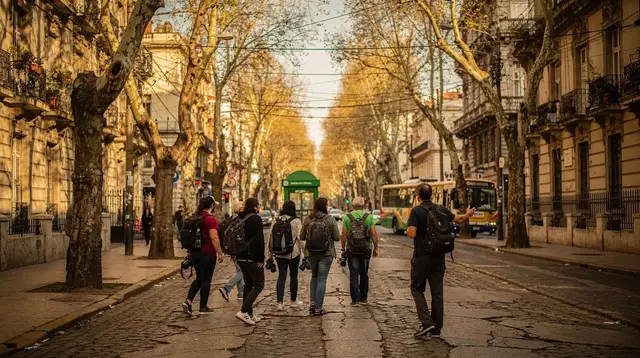
Group bike tours in Buenos Aires generally run three to four hours and 15 to 25 km, departing mid-morning or, for some operators, mid-afternoon to catch better light along the river. The building blocks are consistent across companies even when the exact route differs:
- Palermo’s parks (Bosques de Palermo): wide paths, a rose garden, a small lake, and some of the flattest, easiest cycling in the city.
- Puerto Madero’s dockside promenade: converted warehouses, the Puente de la Mujer footbridge, and a broad riverside path.
- Costanera Sur Ecological Reserve: a large riverside wetland on reclaimed land, free to enter, with its own internal dirt-and-gravel paths rather than paved ciclovía — a change of surface and pace from the rest of the ride.
- A historic-centre stretch, on some itineraries: San Telmo’s cobblestones, Plaza de Mayo, or a run along Avenida de Mayo.
Fewer operators extend the ride north toward Belgrano or south toward La Boca; those additions lengthen the day and usually appear on full-day rather than half-day itineraries. It is worth reading the stop list of any tour you book rather than assuming it matches the outline above — company routes genuinely vary, and “Buenos Aires bike tour” is used loosely across very different itineraries.
Choosing between group, private and themed rides
| Format | Typical length | Best for |
|---|---|---|
| Half-day group tour | 3–4 hours | First-time visitors wanting a broad overview |
| Full-day tour with lunch | 6–7 hours | Travellers with one full day to dedicate to cycling |
| Private tour | 2–4 hours, flexible | Families, slower riders, custom stop lists |
| Night tour by e-bike | 2–3 hours | Visitors who want illuminated landmarks and cooler evening air |
| Bike tour with mate tasting | 3–4 hours | Riders who want a cultural stop built into the route |
| Bike-and-boat combo to the Delta | Full day | Combining cycling with a launch trip on the Paraná |
A group ride keeps costs down and adds the social element of riding with other travellers, but it moves at the pace of the slowest rider and follows a fixed stop list. A private bike tour costs more per person but lets you set the pace, skip stops that don’t interest you, and add time somewhere you like — a reasonable choice for families with children or anyone recovering from a long flight who doesn’t want to keep up with a group.
For visitors with limited time who still want a solid overview, the half day Buenos Aires bike tour is the standard entry point: it fits into a morning or an afternoon and leaves the rest of the day free for a museum, a Teatro Colón tour, or an early dinner reservation. If you have a full day to give it, the full day bike tour with lunch adds distance, a sit-down meal partway through, and usually reaches at least one barrio the half-day version skips.
Themed variants add a cultural layer to the same basic loop. A bike tour with a mate tasting stop pairs the ride with Argentina’s ubiquitous herbal infusion, explained by a local guide rather than picked up cold from a supermarket shelf. For evenings, a night tour by e-bike trades daytime park views for illuminated landmarks — the Puente de la Mujer, Plaza de Mayo, the obelisk district — with the electric assist flattening out any fatigue from a day of walking beforehand.
Combining cycling with the Delta
Cycling and boating pair naturally in and around Buenos Aires, because the Tigre waterfront and the Paraná Delta sit at the end of flat, rideable terrain along the northern suburbs. Two combined itineraries show up regularly: the bike and boat tour from Buenos Aires to the south, which pairs urban cycling with a river crossing, and the day tour combining biking and boating to the north and south, a longer format for visitors who want both halves of the riverfront in one outing.
These run longer than a standard city ride — plan on a full day — and suit travellers who have already done a shorter Palermo or Puerto Madero loop and want something more ambitious for a second day. For a boat-only version of the Delta without the cycling component, see the dedicated Tigre day trip guide.
Wine, graffiti and other specialised rides
Not every bike tour in Buenos Aires stays within the city. A private bike tour on the wine route near Buenos Aires heads out toward vineyard country for a slower, tasting-focused day rather than an urban sightseeing loop — worth considering if you already know you like wine tourism and want to combine it with light exercise rather than a seated tasting room.
Within the city, street-art tours are a growing niche. A Buenos Aires graffiti tour follows the large-scale murals concentrated in Palermo and parts of Villa Urquiza, typically on foot or occasionally by bike depending on the operator, and pairs well with the more general Palermo street art walking tour if you’d rather explore on foot instead. For a straightforward, no-theme ride that simply covers the city’s greatest hits, the plain Buenos Aires biking tour is the closest thing to a default option among the operators listed here.
Extending the ride north or south
The core Palermo–Puerto Madero–Costanera Sur loop is the default, but it is not the only shape a Buenos Aires bike tour can take. Riders who have already done the central route, or who simply want a longer day in the saddle, have two directions worth considering.
North of the city, the flat riverside terrain continues through Belgrano and on to San Isidro, a leafy riverside town with a neo-Gothic cathedral roughly on the way to Tigre.
The Buenos Aires bike tour of the north follows this stretch, trading the density of the Microcentro for quieter residential streets and river views, and it pairs naturally with a later, separate visit to the Belgrano neighbourhood on foot. It is a good option for a second cycling day rather than a first, since it assumes some familiarity with how the ciclovía network connects to ordinary streets once you leave the main loop.
South of the centre, La Boca and the adjoining barrio of Barracas offer a very different kind of ride, built around the working-class port history and the large-scale street art both areas are known for. The bike tour of urban art in La Boca and Barracas covers ground that most standard city loops skip entirely, since La Boca’s cobbled streets and heavier traffic keep it off the default ciclovía-linked route.
It suits riders who have already seen the Caminito on foot and want the surrounding neighbourhood at a slightly greater distance, rather than a first introduction to La Boca itself — the packed pedestrian lane around Caminito is better walked than cycled.
Neither extension is essential for a first visit, but both answer the same practical question: what to do once the standard loop starts to feel familiar. A traveller staying five days or more, following an outline like five days Buenos Aires essentials, has enough time to fit one of these alongside the central ride without feeling rushed.
What to bring and what to expect
Standard practice among Buenos Aires bike tour operators is to include the bicycle, a helmet and often a small bag or water-bottle holder in the price. E-bikes are offered by some companies, especially for night tours or longer full-day routes where the extra assist matters more. Bring:
- Comfortable closed shoes rather than sandals.
- Sunscreen and a hat for daytime rides — Buenos Aires summer sun (December to February) is strong and the ride offers little shade along the river.
- A layer for wind, especially along the Puerto Madero docks and the Costanera Sur, both fully exposed to the river breeze.
- A charged phone or camera; several stops are genuinely photogenic, particularly the Puente de la Mujer and the wetland paths of Costanera Sur.
Tours generally do not run in heavy rain, and operators reschedule or refund in that case rather than sending a group out on wet cobblestones. Confirm the weather policy at booking if your dates are tight.
Planning your visit around a bike tour
A bike tour slots naturally into a first full day in the city, since it gives a physical sense of how the barrios connect before you return to explore any of them on foot. It pairs well with the outline in Buenos Aires in one day if you’re short on time, or as the opening activity of a longer stay following three days first-time Buenos Aires. Riders who want to go deeper into a single barrio afterward should look at the Palermo neighbourhood guide or the Puerto Madero walking tour for a slower, on-foot follow-up to whichever stretch of the ride you liked best.
If your schedule allows a second cycling day, consider splitting the city and the water: one day on the urban ciclovía network through Palermo and Puerto Madero, and a separate day on the Tigre Delta bike and boat combination for a change of scenery entirely. Both use the same basic skill set and comfort level, so there’s little reason to force them into a single exhausting day when spreading them out gives better light, less fatigue and more time to actually look around.
Buenos Aires bike tours: frequently asked questions
Do I need to be an experienced cyclist to join a bike tour in Buenos Aires?
No, most routes are flat and largely follow dedicated cycle paths, so a casual rider manages fine. That said, some short stretches leave the ciclovía network and share the road with buses and cars, so basic bike handling and awareness of traffic matter.
How long does a typical Buenos Aires bike tour last?
Most guided tours run 3 to 4 hours, covering 15 to 25 km across two or three barrios. Half-day and full-day options exist, and night tours by e-bike typically run shorter, around 2 to 3 hours.
Which neighbourhoods do bike tours usually cover?
The core loop links Palermo’s parks, Puerto Madero’s docks, the Costanera Sur reserve and often San Telmo or Recoleta. Some operators extend north toward Belgrano or south toward La Boca; routes vary by company, so check the itinerary before booking.
Is cycling safe in Buenos Aires traffic?
On the ciclovía network it is reasonably safe, since these are physically separated lanes. Off the dedicated paths, traffic is dense, colectivos stop abruptly, and drivers do not always yield to cyclists, so guided tours are built to minimise time on open roads.
Do bike tours provide the bicycle and helmet?
Yes, standard practice is that the tour price includes a bike, helmet and often a small backpack or water bottle holder. E-bikes are offered by some operators for night tours or longer full-day routes.
Can I do a private bike tour instead of a group tour?
Yes, private bike tours are widely offered and let you set the pace, add stops, or focus on specific barrios. They cost more per person than group tours but suit families, slower riders or anyone with a tight schedule.
Is there a bike tour that combines cycling with a boat trip to Tigre?
Yes, several operators run combined bike-and-boat itineraries that pair a morning or afternoon ride with a launch trip on the Paraná Delta. These run longer than a standard city ride, often a full day.
Bike Tours
Verified deep-linked GetYourGuide tours. Book through these links and we earn a small commission at no cost to you.
GetYourGuide does not provide a product photo for this activity — the image shows the meeting point, photographed by us.