Half-Day City Tours of Buenos Aires: What You Can Actually See
What can a half-day city tour of Buenos Aires realistically cover?
A half-day tour (roughly three to four hours) realistically covers one compact route, usually Plaza de Mayo and the Microcentro plus Recoleta or Puerto Madero, not all three. Traffic between barrios and time at each stop eat the clock fast, so most operators pick two anchor neighbourhoods and move at a brisk pace rather than trying for a full survey of the city.
What “half a day” actually buys you in Buenos Aires
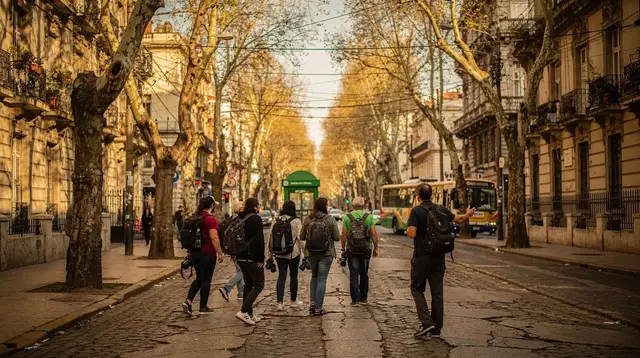
Buenos Aires is flat, dense, and laid out in long, straight avenues — which makes it easy to photograph and slow to cross. The Microcentro, Recoleta, and Puerto Madero sit within a few kilometres of each other on a map, but between traffic lights, one-way systems, and the time it takes to actually get out of a vehicle and look at something, a three- to four-hour tour has real limits. This guide is about those limits, and about choosing the half-day format — bus, private car, bike, or boat-linked — that fits what you specifically want to see.
The honest starting point: no half-day tour “does Buenos Aires.” A full-day city tour or a one-day itinerary gets closer to a broad survey. A half day is for a focused slice — and that’s not a compromise so much as a different kind of trip. You arrive, see two barrios properly, and either continue independently or head to your next commitment (a flight to Iguazú, a ferry to Colonia, an afternoon at leisure).
The three neighbourhoods most half-day tours draw from
Almost every half-day itinerary in Buenos Aires builds from the same short list of anchor points, then combines two, rarely all three.
Plaza de Mayo and the Microcentro. The Casa Rosada (presidential palace), the Cabildo, the Metropolitan Cathedral, and the surrounding financial district — this is the historic and political core, and the natural stop for anyone who wants the “this is the capital of a country” context before anything else. A guided stop here usually runs 30–45 minutes on foot, plus transit time in and out.
Recoleta, above all the Recoleta Cemetery — a walled city of elaborate mausoleums in the middle of one of the city’s wealthiest barrios, and the resting place of Eva Perón in the (unmarked enough to need pointing out) Duarte family vault. A worthwhile visit here needs 45 minutes to an hour, more if your guide walks you through in detail rather than gesturing from the gate.
Puerto Madero, the redeveloped dockland of glass towers and converted warehouses along the old port basin, often paired with a look at the Costanera Sur Ecological Reserve next door. This is the newest and least dense of the three stops — a shorter, more photogenic add-on than a destination that needs an hour on its own.
Put together, that’s a lot of ground for three to four hours once you count driving, parking, group logistics, and simply walking from a coach to a landmark and back. Operators who are candid about this pick two of the three and build a real visit around them, rather than a rushed photo stop at all three.
Comparing the half-day formats
| Format | Typical length | Group size | Best for | Example |
|---|---|---|---|---|
| Bus/coach city tour | 3–4 hours | Large group, fixed seats | Budget orientation, first exposure to the layout | a half-day city tour by bus |
| Private half-day tour | 3–4 hours, flexible | 1–6 people, your vehicle | Choosing which two stops matter to you, custom pace | a private half-day city tour |
| Small-group discovery tour | 3–4 hours | Small group, mixed walking/vehicle | A guided narrative without the scale of a coach | a half-day tour that introduces the city’s main sights |
| Bike tour | 3–4 hours | Small group, bicycles | Puerto Madero, the reserve, and Palermo’s flatter routes | a half-day bike tour of the city |
| Cruise-passenger tour | 3–5 hours, timed to ship | Group or private, fixed return | Cruise stops docking at Puerto Madero or the port | a half-day tour built around cruise arrival and departure times |
Prices for these tours vary by season and group size — check current rates when booking rather than relying on a fixed figure, since Argentina’s currency situation (more on that below) makes older price references unreliable fast.
Bus and coach tours
A fixed-route bus tour is the cheapest way to get oriented across a wider stretch of the city in one sitting, because the vehicle does the connecting work rather than a series of taxis or metro changes. The trade-off is pace: stops are timed for the group, not for you, and if Recoleta Cemetery genuinely interests you, a 20-minute allotment can feel thin. This format suits a first afternoon in the city, before you know yet which barrios you want to return to on foot.
Private tours
A private half-day tour costs more per person (especially solo) but solves the core problem of this format directly — you can tell the guide to spend the extra 30 minutes in the cemetery and skip Puerto Madero entirely, or the reverse. For travellers with a specific interest (architecture, the Eva Perón story, football history en route to La Bombonera or El Monumental), this flexibility is usually worth the premium.
Bike tours
Buenos Aires is flat and increasingly equipped with protected bike lanes, which makes a half-day bike route through Puerto Madero, the ecological reserve, and parts of Palermo genuinely pleasant rather than a novelty. It won’t reach Recoleta or the Microcentro comfortably in the same window — the routes lean toward the riverside and green spaces rather than dense historic streets — so this is the format to pick if open air and moving at your own rhythm matter more than ticking off monuments.
Group bike tours run on a fixed schedule with a set group; if you’d rather set your own pace, or you’re travelling as a couple or small family, a private bike tour of the city covers similar ground with a guide dedicated to your group alone, and can shift its route toward whichever of Puerto Madero, the reserve, or Palermo you actually want more time in. Neither substitutes for the historic-centre stops above — a bike isn’t the tool for weaving through Microcentro foot traffic or standing still in front of the Cabildo — but as a half-day format in its own right, it fills a different afternoon than the Plaza de Mayo/Recoleta pairing rather than competing with it.
Cruise-passenger tours
Buenos Aires is a common stop or turnaround port for South Atlantic cruises, and operators run half-day tours timed precisely to ship arrival and all-aboard times, usually starting and ending at the port or a nearby pickup point. If you’re on a ship, this is the format built around your actual constraint — a fixed return deadline — rather than a generic tourist schedule.
Airport arrivals and departures
A half-day tour can also bracket a flight rather than a cruise call. Buenos Aires’s domestic airport, Aeroparque Jorge Newbery (AEP), sits close to Palermo and the northern barrios, which makes it realistic to book a private transfer to or from AEP and pair it with a half-day city tour on the same day — landing in the morning, touring Plaza de Mayo and Recoleta in the afternoon, or the reverse before an evening flight onward to Iguazú or elsewhere in Argentina.
This works less cleanly from Ezeiza (EZE), the international airport further out, where transfer time alone eats into the half-day window; check the AEP airport transfer guide for the practical difference between the two before building a same-day plan.
A realistic half-day route: Plaza de Mayo + Recoleta
If forced to pick the single most representative half-day combination, most guides land on Plaza de Mayo and Recoleta: one stop for the country’s political and colonial-era core, one for its most striking cemetery and a wealthier residential barrio, with a reasonable drive between them. A rough shape:
| Segment | Approx. time |
|---|---|
| Plaza de Mayo, Casa Rosada, Cabildo | 45–60 min |
| Transfer to Recoleta | 15–20 min |
| Recoleta Cemetery and surrounding barrio | 45–60 min |
| Return / drop-off | 15–20 min |
That’s roughly three hours before allowing for traffic, which is the honest floor for this pairing done properly rather than skimmed. Add Puerto Madero and you’re either extending into a fuller half-day (four-plus hours) or cutting time from the other two stops — which is exactly the trade-off to ask your operator about before booking, not after.
What half-day tours tend to skip
Because the format forces choices, several major sights routinely fall outside a half-day city tour, and it’s worth knowing that going in rather than being surprised:
- San Telmo and La Boca — the antique-market barrio and the painted Caminito lane sit south of the centre and are usually their own half-day or full-day itinerary, not tacked onto a Plaza de Mayo/Recoleta route.
- Palermo, in its Soho/Hollywood and parkland forms, is large enough to need its own visit.
- Teatro Colón guided tours run on a separate ticketed schedule and rarely slot into a moving city tour’s timing.
- Tigre and the delta, an estancia day, and the Uruguay ferries are full-day excursions in their own right, well beyond a half day.
None of this is a flaw in the half-day format — it’s the same trade-off any dense city with a real geography presents. The answer, for most visitors, is treating a half-day tour as the first chapter of a longer stay, not the whole book.
Practical notes for the day
Timing and heat. Argentina’s seasons run inverted to the northern hemisphere — summer is December to February, and a midday half-day tour in January can be genuinely hot and humid. A morning departure is generally more comfortable in summer; in the cooler June–August winter, midday light is milder and the extra warmth is welcome.
Currency. Argentina’s peso has moved through years of high inflation and shifting exchange rules, so any peso price you see attached to a tour — including on this site — should be treated as a dated snapshot, not a fixed figure. Check a current rate and your card’s foreign-transaction terms before budgeting, and don’t assume a price quoted months ago still holds.
Footwear and pace. Even vehicle-based tours involve walking stretches — cobbled sections in the older parts of the centre, gravel paths inside the cemetery. Comfortable shoes matter more than anything you pack for a half-day tour specifically.
Pickup logistics. Private and premium tours typically offer hotel pickup within central areas (Microcentro, Recoleta, Palermo, Puerto Madero); fixed-route bus tours more often use a set meeting point. If you’re staying further out, confirm pickup coverage before booking.
Half-day tour vs. going independently
A guided half-day tour buys you two things an independent walk doesn’t: a driver who handles Buenos Aires traffic and parking, and a guide who can explain what you’re looking at — the Casa Rosada’s political history, why Eva Perón’s vault is unmarked, what Puerto Madero’s warehouses used to be.
If you’d rather set your own pace and don’t mind figuring out the Subte or a SUBE card, a self-guided walking tour of Plaza de Mayo or a Recoleta Cemetery walk covers similar ground for the cost of your own time. The half-day tour earns its price mainly on logistics and narration, not on reaching places you couldn’t reach yourself.
Turning a half-day tour into a longer stay
Most visitors don’t take a half-day tour as their only look at Buenos Aires — it’s the orientation stop at the start or end of a longer trip. If you’ve just landed and want the lay of the land before exploring on foot, a half-day tour on day one pairs naturally with a plan like three days for first-time visitors or, with more time, a full one-week Buenos Aires itinerary that works outward from the centre into Palermo and Recoleta and Puerto Madero and the Costanera Sur reserve at a walking pace.
Travellers with a week or more sometimes use the half-day tour as the anchor for the city portion of a trip that also reaches Tigre and the delta, an estancia day in the pampas, or a ferry crossing to Uruguay — none of which fit inside the half-day window itself, but all of which sit a short trip beyond the two barrios a half-day tour actually covers.
Half-day city tours of Buenos Aires: frequently asked questions
Can a half-day tour cover Plaza de Mayo, Recoleta, and Puerto Madero together?
Rarely comfortably. Most half-day itineraries pick two of the three and give each real time, rather than rushing through all three with photo-stop-only visits.
Is a bus tour or a private tour better for a half day?
A bus tour is cheaper and fixed-route, good for orientation; a private tour costs more but adapts the stops and pace to what you actually want to see, which matters more when time is this tight.
Does a half-day tour go inside the Recoleta Cemetery or just past it?
This varies by operator — check the itinerary. Some include a guided walk inside the cemetery to see the Duarte family vault where Eva Perón is buried; others only stop at the entrance.
Is a half-day city tour enough for a first visit to Buenos Aires?
It’s a strong orientation, not a substitute for more time. Most first-time visitors pair a half-day tour with two or three additional days of independent exploring in Palermo, San Telmo, and La Boca.
How early should I book a half-day tour in high season?
A few days ahead in the December–February and September–November peaks; smaller private and bike tours have limited capacity and sell out faster than large bus tours.
Do half-day tours include hotel pickup?
Many private and premium tours do; standard bus tours often use a fixed meeting point in the centre instead. Check before booking if you’re staying outside the Microcentro or Palermo.
What should I wear on a half-day walking or bike tour?
Comfortable shoes above all — most itineraries mix a coach or van with walking stretches. Layers help given Buenos Aires’s changeable weather, and sun protection matters in the summer months.
Buenos Aires and San Telmo City Tours
Verified deep-linked GetYourGuide tours. Book through these links and we earn a small commission at no cost to you.
GetYourGuide does not provide a product photo for this activity — the image shows the meeting point, photographed by us.