Buenos Aires Full-Day City Tour: Is It Too Much in One Go?
What does a full-day Buenos Aires city tour cover, and is it worth the fatigue?
A full-day tour typically adds La Boca and Caminito or a longer Palermo stop to the half-day route through Plaza de Mayo, San Telmo and Recoleta, usually with a lunch break built in. It suits visitors with one day in the city; those with two or more days often get more out of splitting the same ground into a slower, two-day pace.
Buenos Aires is a large, flat, spread-out city, and its landmarks do not sit close together. A full-day city tour exists to solve a real problem: on a single visit, the historic centre, San Telmo, Recoleta and a barrio like La Boca or Palermo are each worth seeing, and none of them is a quick add-on to the others. Stitching them into one day is possible. Whether it is the right way to see Buenos Aires depends less on the itinerary than on how you actually travel, and this guide tries to be honest about both the appeal and the cost of the long version.
What a full-day itinerary usually covers
Operators vary in the details, but the shape of a full-day Buenos Aires city tour is fairly consistent. It starts where the half-day version starts — Plaza de Mayo, with the Casa Rosada and the Cabildo, then a walk or short drive to the Microcentro — and continues through San Telmo for its cobbled streets and antique trade. What separates a full day from a half day is usually one or two additional stops that would otherwise need a separate outing: a proper visit to La Boca and the painted houses of Caminito, or extra time in Palermo rather than a drive-through.
Recoleta and its cemetery almost always appear, since Eva Perón’s grave in the Duarte family vault is one of the most requested stops on any city tour, and Puerto Madero is a common afternoon stretch — flat, scenic, and easy walking after a morning of denser sightseeing. Some itineraries drive past La Bombonera for a photo rather than a full stadium visit; that distinction matters, because a stadium tour and museum is its own separate booking, not something a city tour absorbs in passing.
A private guided version, such as the private guided city tour, can reorder or drop stops on request. A scheduled group option like the bus-based city tour moves the group as a block and does not flex mid-route.
The honest math on hours
A tour advertised as “full day” typically runs 7 to 9 hours door to door, and that figure includes pickup, transfers between neighbourhoods, and a lunch break. Subtract those and the time actually spent walking, listening to a guide, or standing in front of something worth seeing is closer to 5 or 6 hours. That is still a long day of sightseeing, and it is the part that tends to catch visitors off guard: the itinerary reads as a list of highlights, but the lived experience is several hours of being on your feet with breaks measured in minutes, not the leisurely half-days a two-day plan allows.
This is worth saying plainly because the marketing language around full-day tours leans toward “see it all” framing, and that framing oversells what a single day, however well planned, can actually deliver. A full day gets you an orientation to four or five neighbourhoods. It does not get you a thorough visit to any one of them.
Where the fatigue actually comes from
Three things wear people down on a full-day Buenos Aires tour, and none of them is the walking distance itself, which is usually broken up by transfers.
The first is heat and humidity in summer (December to February), when midday sun in the Microcentro or on the open riverfront path at Costanera Sur is genuinely draining — that reserve has little shade and no water for sale on much of its circuit, which is one reason it is not usually stacked into a packed midday schedule.
The second is cobblestones: San Telmo and much of La Boca are laid with uneven paving that is scenic to photograph and hard on ankles after several hours. The third, less obvious, is decision fatigue from moving through five distinct barrios in one day, each with its own atmosphere, history and set of things to notice — it adds up mentally even when the itinerary is not physically demanding.
None of this is an argument against the full-day format. It is an argument for building in real breaks rather than treating lunch as the only pause, and for choosing footwear and clothing for a long day outdoors rather than a city stroll.
Full day versus two slower days
Here is the comparison worth making before booking, and it does not have a single right answer.
| Full-day tour | Half-day tour + free afternoon | Two-day self-paced plan | |
|---|---|---|---|
| Neighbourhoods covered | 4–5 | 2–3 | 4–6, in more depth |
| Typical active hours | 5–6 | 2.5–3.5 | 3–4 per day |
| Flexibility mid-visit | Low (group) / moderate (private) | High after the tour ends | High throughout |
| Best for | One day in the city, first-time overview | Visitors who tire on long days | Visitors with time to spare |
| Cost | Higher per day, lower per day of trip | Moderate | Similar or lower total, spread out |
A visitor with exactly one day in Buenos Aires — arriving in the morning, leaving that night, or connecting onward — genuinely benefits from the density of a full-day tour: it is the only realistic way to see the centre, San Telmo, Recoleta and La Boca in one visit. A visitor with two or three days, by contrast, usually gets more out of splitting the same ground across two mornings, with an afternoon left free each day for a café, a second look at something that caught their eye, or simply resting before dinner, which in Buenos Aires rarely starts before 21:00 anyway.
There is no version of this trade-off where the full day is simply “better.” It is denser, and density suits some travellers and exhausts others. Families with young children, older travellers, or anyone recovering from a long-haul flight the night before are usually better served by the half-day plus free-afternoon model, or by the two-day Palermo and Recoleta itinerary, than by pushing through a nine-hour day on unfamiliar streets.
Who a full-day tour genuinely suits
The full-day format earns its place for a specific traveller: someone with a single day in the city who wants a structured overview rather than a self-planned route, who is comfortable on their feet for several hours, and who would rather see five neighbourhoods briefly than two neighbourhoods thoroughly. Cruise passengers on a single port call fall squarely into this group, and operators run itineraries built for exactly that constraint, such as the city tour designed for cruise passengers.
It also suits visitors who dislike planning and would rather hand the logistics of transfers, timing and neighbourhood order to a guide. A packed group itinerary removes decision-making almost entirely, which some travellers find restful in its own way even as the physical day is demanding.
Who should choose something slower instead
If your trip includes two or more days in Buenos Aires, consider whether a full-day tour on day one is the best use of your freshest energy. An alternative that many visitors prefer: a half-day city tour covering the historic centre and San Telmo on arrival day, followed by independent time in Palermo or Recoleta on a later, less jet-lagged day. This spreads the same sights across a gentler pace and leaves room to linger where something is actually interesting, rather than moving on because the schedule says so.
Walking-focused alternatives, such as the full-day walking tour, trade the bus transfers of a bus-based itinerary for more time on foot in fewer neighbourhoods — worth considering if you would rather really see three barrios than skim five. And for visitors who want a full day but a change of pace within it, the full-day bike tour with lunch covers similar ground with less time standing and more distance covered per hour of fatigue.
Practical notes for the day itself
Buenos Aires’s Subte and colectivo buses both require a SUBE card, but a booked tour handles its own transport, so this only matters if you plan to break away mid-day. Argentina keeps a single time zone year-round with no daylight saving, so there is no clock adjustment to plan around, and sockets are Type C and Type I at 220V — irrelevant for the day itself but worth checking before you leave the hotel if you are carrying a phone that needs charging on the move.
Tipping guides at the end of a private tour, roughly 10%, is a customary courtesy rather than a fixed rule, and cash is usually appreciated. If the itinerary includes a restaurant lunch, service is sometimes included and sometimes not; ask rather than assume.
For visitors weighing this against other formats, the Discover Buenos Aires City Tour and premium full-city tour both offer variations on the same full-day structure, with differences mainly in group size and the exact stop order — details worth checking against your own tolerance for a long day before booking.
The bottom line
A full-day Buenos Aires city tour is the right tool for a specific job: covering the city’s core sights in a single visit when a single visit is all you have. It is not automatically the superior choice for every traveller, and treating it as the default risks turning a trip’s first day into its most exhausting one.
If you have more than a day to spend, weigh the full-day option against a half-day tour paired with unstructured time, or a two-day plan that covers the same neighbourhoods without the single-day squeeze. Either way, plan the rest of that evening lightly — dinner in Buenos Aires rarely starts before nine, which gives tired feet a few hours to recover before the day is actually over.
Full-day tour FAQ
How many hours does a full-day Buenos Aires city tour actually run?
Most operators quote 7 to 9 hours including pickup, transfers between neighbourhoods and a seated lunch stop. Actual walking and sightseeing time is closer to 5 to 6 hours once transport and the meal are subtracted.
Is a full-day tour better than a half-day tour?
Not automatically. A full day covers more ground, typically adding La Boca or a longer Palermo visit, but it also means more hours on your feet and less flexibility. A half-day plus a self-guided afternoon suits visitors who prefer to set their own pace.
Does the full-day tour include lunch?
Many itineraries build in a lunch stop, often at a parrilla, but this varies by operator and is sometimes at an extra cost. Check the specific tour’s inclusions before booking rather than assuming.
Can I skip part of a full-day tour if I get tired?
On a group tour, no: the group moves together on a fixed schedule. A private guided tour can usually be shortened or reordered on request, which is the main practical advantage of going private for a full day.
Is one full day enough to see Buenos Aires properly?
It is enough for an orientation to the historic centre, San Telmo, Recoleta and one or two outer barrios such as La Boca or Palermo, but it is a survey, not a thorough visit. Two or three days allow a slower pace and time in each neighbourhood without the clock running.
What should I wear and bring on a full-day walking tour?
Comfortable, already broken-in walking shoes, a hat and sunscreen in summer, a layer for cooler months, and a bottle of water. This is not a day to worry about sockets or currency; it is a day to worry about your feet.
Does the full-day tour include La Bombonera or Teatro Colón?
Some itineraries pass La Bombonera for a photo stop without going inside; entering the stadium museum or the opera house is usually a separate, dedicated visit. Confirm what a specific tour includes rather than assuming either is part of the day.
Buenos Aires and San Telmo City Tours
Verified deep-linked GetYourGuide tours. Book through these links and we earn a small commission at no cost to you.
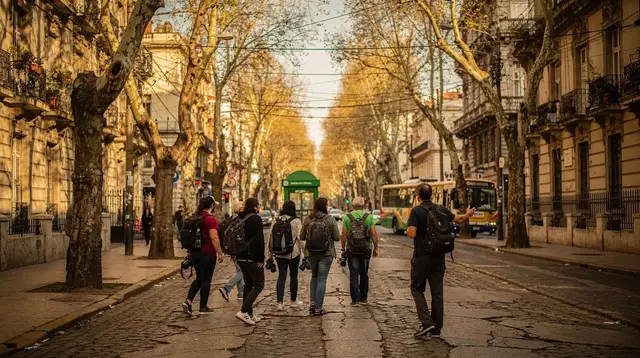
GetYourGuide does not provide a product photo for this activity — the image shows the meeting point, photographed by us.