Recoleta Cemetery Walking Tour: A Route Through Buenos Aires' Past
What does a walking tour of Recoleta Cemetery actually cover?
A route through the cemetery's oldest avenues, its most elaborate mausoleums, and the families who shaped Buenos Aires, ending at the unmarked Duarte vault where Eva Perón is buried. The layout is dense and unsigned enough that most visitors get more out of a guided route or a map than wandering alone.
Walking Recoleta Cemetery: A Route Through the Mausoleums
Recoleta Cemetery does not read like a graveyard. It reads like a miniature stone city, with its own street grid, its own architecture, and its own hierarchy of families who spent fortunes on the buildings where they would eventually be laid to rest. Walking through it is less a visit to a single grave and more a walk through the social history of Buenos Aires, told in marble, bronze, and stained glass. This guide lays out a route through that history, with the honest warning that the cemetery’s own layout works against anyone trying to follow it without help.
Why the layout matters before you start
The cemetery was laid out in the early 19th century and has been filled in, section by section, ever since, with almost none of the logic of a modern site plan. The result is a dense grid of narrow lanes — some barely wide enough for two people to pass — lined on both sides by mausoleums built right up against the path. There is very little directional signage inside, and the family names carved into the stone are the only labels most visitors get. A walking tour of the Recoleta neighborhood that includes the cemetery, or a map picked up at the entrance kiosk, is the difference between a purposeful hour and forty minutes of doubling back down identical-looking lanes.
For a version of this walk led by a guide who threads the history together in real time, a Recoleta walking tour paired with a live jazz show covers the cemetery route and then carries the afternoon into the neighbourhood’s café culture, which is a natural way to close out the walk without a second trip back.
At the entrance: what the gate itself tells you
The main entrance sits on Junín street, framed by Doric columns that predate most of what lies behind them, and it opens directly onto Plaza Intendente Torcuato de Alvear before the cemetery gates proper. Just outside, the Basílica of Our Lady of Pilar — a whitewashed colonial church finished in 1732 — sits close enough that many visitors see the two as a single stop, and it is worth five minutes on its own before or after the walk. Non-resident visitors pay an entry fee at the gate; Argentine residents do not. The figure has changed more than once in recent years, so treat any number quoted here as provisional and confirm it on arrival.
Inside the gate, the cemetery opens onto its widest avenue, the closest thing the site has to an orienting spine. Almost everything else branches off it into narrower lanes, and it is from this avenue that a route through the highlights makes the most sense.
The Duarte vault: Eva Perón’s grave, and why it hides in plain sight
Most visitors come with one destination in mind: the grave of Eva Perón, universally known here as Evita. It is worth saying plainly before anything else — this is not an easy grave to find alone. Eva Perón is not buried under a monument of her own, and she is not in the Chacarita cemetery, where some visitors mistakenly expect to find her. She lies in the Duarte family vault, her mother’s family, several rows deep into one of the cemetery’s denser blocks, marked only by a modest black granite plaque bearing the Duarte name and a handful of smaller memorial plaques left by admirers over the decades. There is no arrow pointing to it, no crowd gathered around it most of the day, and no obvious reason, walking past, to stop.
The honest account from people who have tried to find it unguided is that they walk past it — sometimes more than once. The lane it sits on looks identical to a dozen others, lined with vaults of comparable size and comparable stonework, and the plaque itself is easy to read as one more family name rather than the one people came to see.
A map from the entrance kiosk marks the location, and cemetery staff will point the way if asked, but neither is a substitute for simply knowing, before you go in, that this is a labyrinth and not a signposted museum. A guided route — such as the one built into a Recoleta neighborhood walking tour — removes this problem entirely and folds the search into a wider account of who else is buried around her.
Beyond Evita: the mausoleums worth slowing down for
The temptation is to treat the Duarte vault as the only stop and rush toward it, but that skips most of what makes the cemetery worth the walk. Recoleta holds the graves of several Argentine presidents, military leaders from the wars of independence, scientists, and the founding families whose names now label half the streets of the city — Alvear, Anchorena, Pueyrredón. Domingo Faustino Sarmiento, the writer and president often credited with shaping Argentina’s education system, is buried here in a tomb marked with a condor, a detail worth pausing at even without knowing the full biography.
The architecture carries as much of the story as the names. The mausoleums range from severe neoclassical blocks to Art Nouveau structures with stained glass and wrought iron, and a handful stand out enough that they function as informal waypoints even without signage: a bronze statue of a young woman with a dog, worn smooth in places by decades of visitors touching it for luck; elaborate stairways leading down to underground burial chambers stacked several coffins deep, visible through glass or iron grates in a few of the older vaults; and Carrara marble angels and mourning figures that were carved in Europe and shipped across the Atlantic at a cost few families outside Recoleta’s elite could have matched.
None of this is captioned. A guided walk, or research done before arriving, is what turns these into recognisable stops rather than handsome stonework passed at a glance.
A route through the cemetery
The following order works reasonably well as a self-guided loop, starting and ending near the main entrance on Junín street, though the cemetery’s irregular grid means some backtracking is unavoidable whichever route is taken.
| Stage | What it covers | Approx. time |
|---|---|---|
| Main avenue from the entrance | Orientation, first row of large 19th-century mausoleums | 10 min |
| Central blocks | Sarmiento’s tomb, Art Nouveau vaults, underground burial chambers | 20 min |
| Duarte vault (Eva Perón) | Deep interior lane, best found with a map or guide | 15 min with searching, less with a guide |
| Southern and western sections | Military figures, founding families, quieter lanes | 20 min |
| Return to entrance via the Basílica | Basílica of Our Lady of Pilar, plaza | 10–15 min |
A visitor moving at a steady pace, not stopping to read every plaque, can complete this in about an hour. Anyone reading the architecture and the names closely should budget closer to two hours, and the cemetery’s 5.5 hectares comfortably support that pace without repetition.
For visitors who want the history explained rather than pieced together from plaques, a guided option built specifically around storytelling — such as a walking tour with acting elements set in Recoleta — turns some of these same stops into short performed scenes rather than static stonework, which works particularly well for visitors travelling with children or anyone who finds a straight historical lecture hard going in the heat.
Practicalities that shape the walk
The cemetery is entirely outdoors, paved in stone and gravel, with uneven surfaces throughout the older sections — comfortable shoes matter more here than in most of the city’s other landmark stops. Shade is inconsistent: some lanes run between tall mausoleums that block the sun for most of the day, while the wider avenues offer little cover, so sun protection is worth carrying in the warmer months between December and February, when most visitors reach the cemetery by taxi or rideshare rather than on foot from farther neighbourhoods.
There are no facilities of note inside beyond the entrance area, and no food or drink sold within the walls, which is one more reason visitors typically treat Recoleta’s surrounding cafés as the natural next stop rather than trying to make a full afternoon of the cemetery alone. The wider Recoleta neighbourhood around the cemetery gate is where that second half of the visit usually happens.
Photography is permitted and the cemetery is, by a wide margin, one of the most photographed sites in the city — a fact that shapes crowd flow around its most recognisable statues and vaults, particularly in the late morning. Visitors specifically interested in the photographic side of the cemetery, rather than the historical walk, are better served by a dedicated Recoleta Cemetery photo session built around the light and the angles rather than the route.
Finding the Duarte vault without a guide
For anyone determined to find Eva Perón’s grave unassisted, a few concrete pointers help. The vault sits closer to the cemetery’s interior than to any of the outer walls, reached by turning off the main avenue into one of the narrower cross-lanes rather than staying on the widest paths. The plaque itself is dark and unobtrusive compared with the scale of the surrounding mausoleums, several of which are considerably larger and more ornate, which is part of why visitors expecting a grand monument tend to overlook it. Small floral tributes or handwritten notes left at the base are often the clearest sign that a particular vault is the right one, when the plaque itself is hard to read from a distance.
Staff near the entrance and the small information point close to the gate will mark the location on a paper map on request, at no charge, and this remains the single most reliable free option for anyone skipping a guided tour. A guided route removes the uncertainty entirely and adds the context — who the Duartes were, how Eva Perón came to be buried under her mother’s family name rather than the Perón name, and what happened to her remains in the years between her death in 1952 and their final return to this vault in 1976 — that a plaque alone cannot convey.
Visitors who prefer a more immersive, character-led version of this same history have the option of a skip-the-line Recoleta walking tour built around the cemetery’s most compelling stories, which is worth considering specifically for the queue-avoidance on the cemetery’s busier mornings.
Combining the walk with the rest of Recoleta
Recoleta Cemetery rarely works as a self-contained half-day, and most visitors are better served treating it as the anchor of a longer neighbourhood walk. The Basílica of Our Lady of Pilar sits immediately beside the entrance. El Ateneo Grand Splendid, the bookshop set inside a converted 1919 theatre, is a short walk up Avenida Santa Fe and makes a natural next stop for anyone who has an hour left afterward. Cafés along Avenida Alvear and around Plaza Francia give the walk a place to end that is not, itself, a cemetery — a small but real consideration for anyone walking with children or visitors uneasy about the setting.
For a version of the day that folds in more of Recoleta beyond the cemetery walls, a Recoleta and Retiro tip-based walking tour extends the route north toward Retiro, while visitors planning their very first day in the city more broadly may prefer to see where this walk fits inside a one-day Buenos Aires itinerary rather than treating it as a standalone outing.
For those who would rather have a guide handle the route, the searching, and the historical framing in one pass, a private, in-depth Recoleta walking tour covers the same ground as this self-guided route without the risk of walking past the one grave most visitors came specifically to see. a small-group walking tour that goes deep into Recoleta’s history is built around exactly this problem — turning an unsigned maze into a coherent hour of storytelling.
Visitors who want the cemetery walk combined with a longer feel for the neighbourhood’s cafés and streets afterward often choose a guided walk through the Recoleta neighbourhood that includes the cemetery route, which extends naturally into the surrounding blocks once the walk through the mausoleums is done.
For a lighter, more theatrical approach to the same ground — useful for travellers with children or anyone who prefers stories over dates — a walking tour that uses short acted scenes to bring Recoleta’s history to life covers several of the same mausoleums with a different pace entirely.
And for visitors who want to close out the walk with something unrelated to the cemetery itself, a Recoleta walking tour that ends with a live jazz show is one straightforward way to turn the afternoon into a full outing rather than stopping cold at the cemetery gates.
Recoleta Cemetery Walking Tour: Frequently Asked Questions
Is Eva Perón’s grave easy to find on my own?
No. The Duarte family vault sits deep inside a dense grid of narrow lanes with no directional signage, and the plaque naming her is modest. Most independent visitors either walk past it or spend a frustrating half hour searching. A map from the entrance kiosk or a guided walk solves this in minutes.
How long does a walk through Recoleta Cemetery take?
A focused route to the main historical mausoleums and the Duarte vault takes 60 to 90 minutes. Visitors who linger over the sculpture and read every plaque often stay two hours or more, since the cemetery covers roughly 5.5 hectares.
Is Recoleta Cemetery free to enter?
Argentine residents enter free; non-resident visitors are charged an entry fee, and the amount has changed more than once in recent years, so check the current price at the gate or with your tour before budgeting.
Do I need a guide to understand the cemetery?
You do not need one to enter, but the cemetery has almost no on-site interpretation beyond family names on the vaults themselves. A guide or a good printed map turns a walk past decorative stonework into a walk through the families who built Buenos Aires.
Who else besides Eva Perón is buried in Recoleta Cemetery?
Presidents, generals, scientists, and the city’s founding families are buried here, including several Argentine presidents and Domingo Faustino Sarmiento. It functions as a walkable cross-section of the country’s 19th- and 20th-century elite, not a single-grave site.
What should I wear or bring for the walk?
Comfortable shoes for uneven stone paving, and sun protection in the warmer months, since the narrow lanes offer little shade in places. The cemetery is entirely outdoors and the walking surface is stone and gravel throughout.
Can I combine the cemetery walk with anything else nearby?
Yes. The cemetery sits beside Recoleta’s cafés, the Basílica of Our Lady of Pilar, and a short walk from El Ateneo Grand Splendid, so most visitors fold the walk into a wider morning or afternoon in the neighbourhood rather than treating it as a standalone stop.
Historic Sites and Landmarks
Verified deep-linked GetYourGuide tours. Book through these links and we earn a small commission at no cost to you.
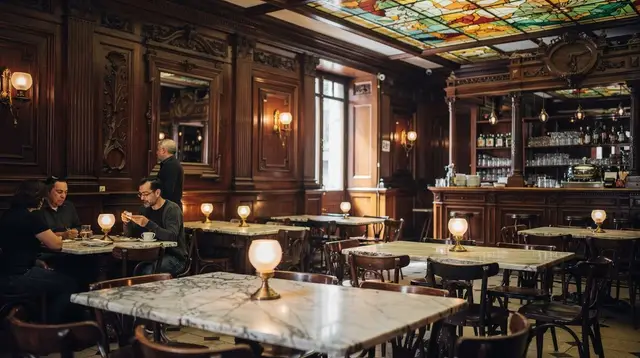
GetYourGuide does not provide a product photo for this activity — the image shows the meeting point, photographed by us.