Tigre by Bike and Boat: Combining Both in One Active Day
Can you combine cycling and a boat ride in Tigre on the same day?
Yes. Several operators run tours that alternate an e-bike or bike segment along the Tigre riverfront and delta paths with a lancha crossing to the islands, and independent travellers can do the same by renting a bike near the station and booking a separate boat trip. There is no single official cycling route shared by every provider, so expect the bike portion to vary.
Why Pair Cycling With a Boat Ride in Tigre
Most visitors to Tigre do one thing: they get on a boat. That is reasonable, because the Paraná Delta is a maze of wooded islands and stilt houses that can only be reached by water. But it misses half of what makes Tigre worth the trip out from the city. The town itself sits where several rivers meet, and its riverfront — the stretch running from the old rowing clubs near the train station down toward Puerto de Frutos, and along the Río Tigre and Río Luján — is flat, shaded in places, and genuinely pleasant to cover on two wheels rather than on foot.
A day that combines cycling and a lancha crossing plays to the strengths of each. Cycling covers ground on the mainland quickly and lets you stop wherever something looks interesting — a rowing club, a fruit market stall, a quiet bend in the river — without waiting for a scheduled departure. The boat does what cycling cannot: it gets you out onto the water and into the delta itself, past stilt houses, past small general stores that double as floating shops, and along channels that have no road equivalent. Neither mode alone gives the full picture. Together, over a few hours, they do.
This is also, practically speaking, a way to fill a day trip from Buenos Aires without over-committing to a single long boat excursion, which can feel repetitive after the first hour on the water. Breaking the day into a riverfront ride, a market stop, and a shorter boat segment keeps the pace varied and works well for travellers who prefer to be doing something active rather than sitting for an extended cruise.
Be Honest About What “Bike Route” Means Here
It is worth being direct about a common source of disappointment: there is no single, official, signposted cycling route through the Tigre Delta that every operator follows, and no tour promising a fixed loop through the islands by bike should be taken literally. The delta is criss-crossed by water, not roads. Islands are connected to each other, where they are connected at all, by narrow footbridges and footpaths built for pedestrians, not bicycles. Almost all cycling on a Tigre day happens on the mainland — along the riverfront promenades near the town centre, the paths around the Río Luján, and in some cases short stretches near Puerto de Frutos or San Isidro.
What varies from one tour to the next, and sometimes from one week to the next with the same operator, is the exact path taken, which riverside stretches are included, how much of the ride is on quiet streets versus dedicated paths, and whether the route loops back through town or continues further along the water before turning around.
Two “bike and boat” tours booked from two different providers can look quite different in practice — different starting points, different distances, different emphasis on the cycling versus the boat segment. None of that makes either tour wrong; it is simply the nature of a route built around a town’s waterfront rather than a marked trail, and it means the smart approach is to read what a specific tour actually includes rather than assuming it matches a generic mental picture of “cycling through the delta.”
How the Day Typically Unfolds
A representative combined day, whether organised through a tour or assembled independently, tends to follow a similar shape, even if the exact order and timing shift by operator.
Arrival and bike pickup. Most people reach Tigre by the Mitre line train from Retiro, or by the more scenic Tren de la Costa, in roughly an hour. Bikes — often e-bikes on organised tours, to keep the pace comfortable for a mixed group — are collected near the station or a riverfront meeting point.
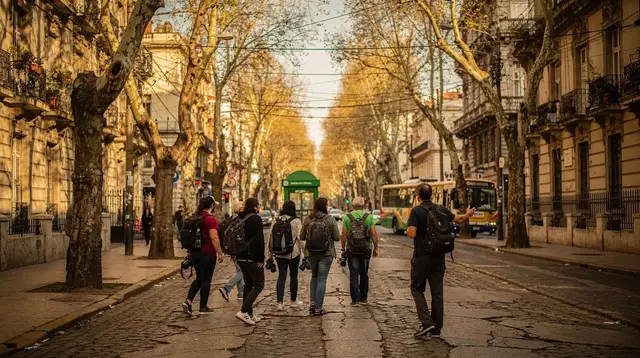
The riverfront ride. This is the core cycling segment: a loop or out-and-back along the water, passing the cluster of century-old rowing clubs that give Tigre its slightly genteel, regatta-town character, crossing a bridge or two, and often continuing toward or through the area near Puerto de Frutos. Flat terrain throughout, generally 1 to 2 hours of actual riding time including stops.
A stop at Puerto de Frutos. The old fruit port is now a craft, wicker and homeware market, and it is a natural break point between the cycling and boat segments — a chance to walk around stalls, get a coffee or a choripán, and leave the bikes for the next stage.
The boat segment. This is where operators diverge most. Some use a scheduled lancha colectiva, the same public water-bus service that island residents rely on for daily transport, which gives a more workaday, unstaged view of the delta. Others charter a private launch or run on a fixed sightseeing loop with a catamaran, which trades a little authenticity for a set, predictable itinerary and often a guide’s commentary. A handful of specialised tours substitute a canoe segment for part of the boat time, paddling into narrower, quieter channels that larger launches cannot reach.
Return. Bikes are dropped back near the station, and the train returns to Retiro. A full combined day, door to door from central Buenos Aires, generally runs 6 to 8 hours.
What to Book, and What to Arrange Separately
Two approaches work for a bike-and-boat day in Tigre, and neither is clearly better — it depends on how much you want arranged in advance.
A single combined tour. An operator handles the bike rental, the route, and the boat segment as one booking, usually with a guide for at least the cycling portion. This removes the logistics of coordinating two separate activities and timing them to fit together, which matters if you are only in Tigre for a single day and don’t want to spend part of it working out where to rent a bike or which boat departure to catch.
an e-bike tour that combines Tigre’s riverfront with a delta boat segmentBike independently, boat separately. Rent a bike near the Tigre station or along the riverfront on your own schedule, ride at your own pace, and then buy a lancha or catamaran ticket separately at the Estación Fluvial when you’re ready for the water portion. This gives more flexibility on timing — useful if you want a longer or shorter ride than a set tour offers — at the cost of arranging two bookings instead of one.
For the boat segment specifically, whether booked as part of a combined tour or added on independently, the main choice is between a general sightseeing loop and something narrower and more specific:
a panoramic boat tour through the main delta channels, a classic delta boat ticket, or, for something quieter and closer to the water, a canoe paddling session finishing with a snack on an island wharf.
Comparing the Ways to Combine Cycling and Boating in Tigre
| Approach | Cycling portion | Boat portion | Best for |
|---|---|---|---|
| Guided combined bike-and-boat tour | Fixed riverfront loop, often e-bike, guided | Scheduled lancha or private launch, included | Travellers who want one booking and a set pace |
| Independent bike rental + separate lancha ticket | Self-paced, own route and distance | Chosen separately at the Estación Fluvial | Travellers who want flexibility and don’t mind two bookings |
| Bike + canoe combination | Riverfront ride, shorter than a full loop | Canoe into narrower channels, more physical | Travellers who want a quieter, more active water segment |
| Bike + Puerto de Frutos + panoramic boat | Riverfront ride ending at the market | Fixed sightseeing loop by catamaran | First-time visitors who also want the market stop |
A related option worth mentioning for context, even though it is not a bike-and-boat day itself, is a broader delta excursion that also folds in the market: a Tigre Delta and Puerto de Frutos trip, which some travellers pair with a separately arranged bike rental for the riverfront portion rather than a formally combined tour.
Practicalities: Timing, Weather and What to Wear
Season matters more here than in the city. The riverfront ride has little shade in places, and summer (December to February) heat and humidity make an afternoon ride uncomfortable; an early departure from Buenos Aires, arriving in Tigre by mid-morning, is the more comfortable plan in summer. Spring and autumn are the most pleasant seasons for the cycling portion, and the jacaranda trees along parts of the riverfront flower purple from late October into November. Winter (June–August) is cool and occasionally damp but rarely cold enough to be unpleasant for a few hours outdoors; check the forecast for rain, since the boat segment is far less enjoyable in a downpour and some operators reschedule around it.
What to wear and bring: closed, comfortable shoes rather than sandals for the bike segment; a hat and sunscreen, since there is real exposure on both the riverfront and the open sections of the boat ride; a light layer for the water, where the breeze is noticeably cooler than on land even on a warm day; and insect repellent, particularly near wooded, still-water stretches.
Fitness level: the riverfront routes are flat, and e-bikes remove most of the remaining effort on guided tours. This is an accessible activity for most reasonably mobile adults; it is not a technical or hilly ride.
Getting to Tigre and Timing the Day
Tigre sits roughly 30 km north of central Buenos Aires. The Mitre line train from Retiro is the standard route, taking about an hour, and the SUBE card used on the Subte works on it too. The more scenic alternative is the Tren de la Costa, a light-rail line along the northern suburbs that many travellers combine with a stop in San Isidro on the way out or back — its neo-Gothic cathedral and riverside town centre make a pleasant half-hour detour if time allows, though adding it does stretch what is otherwise a full day into a longer one.
Because the combined bike-and-boat day already uses most of a day on its own, it is worth deciding in advance whether San Isidro fits or whether it is better saved for a separate, shorter outing. Travellers building a longer stay around Tigre and the delta sometimes split the two: a dedicated bike-and-boat day on one visit, and a slower, boat-only exploration of the islands — including options like a two-hour boat ride on the delta with lunch on board — on a return trip.
Who This Day Suits, and Who It Doesn’t
This combination works well for travellers who find a single long boat cruise slow-going and prefer to break a day trip into distinct, active segments. It also suits people short on time who want a broader sense of Tigre — the town, the riverfront, the market, and the delta itself — rather than just the water. It is less suited to travellers who specifically want a leisurely, sit-down boat day with lunch on board and minimal physical activity, or to anyone expecting a marked cycling trail through the islands themselves, which, as covered above, does not really exist in that form.
For a first visit to the area, pairing a morning bike ride with an afternoon boat segment, and treating Puerto de Frutos as the hinge between the two, is a reliable structure. For a return visit, swapping the standard panoramic boat for something narrower — a canoe session, or a smaller lancha route into quieter channels — tends to be the more memorable choice, precisely because it avoids retracing the same loop covered the first time around.
Related Guides for Planning a Tigre Day
If this is your only trip out to Tigre, it is worth reading the broader Tigre day trip guide alongside this one, since it covers logistics — trains, timing, what else is nearby — that a bike-and-boat-specific page does not repeat.
For the boat segment on its own, the Tigre Delta boat trips guide rounds up the main options beyond the ones already linked above, and the lancha tour guide goes deeper into how the public water-bus network works for anyone choosing the independent route. Deciding between a scheduled lancha and a private catamaran is also covered on its own in the lancha versus catamaran comparison, which is worth reading before booking either the boat segment of a combined tour or a standalone crossing.
For the market stop itself, the Puerto de Frutos guide has more detail on what to expect from the stalls than fits naturally into a bike-and-boat itinerary. Travellers building a full itinerary around the day, rather than a single outing, can also look at the one-day Tigre Delta itinerary for a sense of how this combination fits into a broader schedule, or the longer five-day Buenos Aires, Tigre and pampas itinerary for a trip that treats Tigre as one stop among several.
Anyone extending the day with a stop in San Isidro can also read the dedicated San Isidro day trip guide for more on the cathedral and riverside centre mentioned above. Public transport in and around Buenos Aires, including the SUBE card used on the Tigre train, is covered in full in the SUBE card guide.
Frequently Asked Questions About Tigre Bike and Boat Tours
Is there one official bike route through the Tigre Delta that every tour follows?
No. The islands are served by water, not roads, so cycling happens on the mainland riverfront and on a limited number of paths near Tigre town and Puerto de Frutos. Operators design their own loops, and the bike segment on a combined tour is a curated ride to and around the waterfront, not a signed cycling trail through the delta itself.
Do I need to be an experienced cyclist for a Tigre bike and boat tour?
No. The riverfront routes used on these tours are flat and mostly paved or well-packed gravel, and many outfitters use e-bikes, which flatten out any effort. A reasonable level of fitness for a few hours of gentle riding is enough.
How long does a combined bike and boat day in Tigre take?
Budget a full day from central Buenos Aires: roughly an hour each way to and from Tigre by train, plus 2 to 4 hours split between cycling and the boat, plus time at Puerto de Frutos or an island stop. Most people are back in the city by early evening.
Is the boat part of these tours a scheduled lancha or a private tour boat?
It depends on the operator. Some combined tours use the public lancha colectiva network that also serves island residents; others charter a private launch or catamaran for a fixed sightseeing loop. The two are different experiences at different prices, and it is worth checking which one a specific tour uses before booking.
Can I do a bike and boat day in Tigre independently, without booking a tour?
Yes. Bikes can be rented near the Tigre train station and along the riverfront, and lancha tickets for the delta are bought separately at the Estación Fluvial. Doing it independently gives more control over timing but means arranging two separate bookings rather than one.
Is cycling allowed on the delta islands themselves?
Only in a limited way. The islands are crossed by narrow footpaths and small footbridges rather than roads, and most island transport is by boat. A handful of tours include a short guided walk or a light path ride on a specific island, but the cycling portion of these tours is mainly on the mainland riverfront, not island-hopping by bike.
What should I bring on a combined cycling and boat day?
Sun protection, a hat, water, comfortable closed shoes, and a light layer for the boat, since the breeze on the river is noticeably cooler than the riverfront path. Insect repellent is useful on wooded stretches near the water.
Bike Tours
Verified deep-linked GetYourGuide tours. Book through these links and we earn a small commission at no cost to you.
GetYourGuide does not provide a product photo for this activity — the image shows the meeting point, photographed by us.