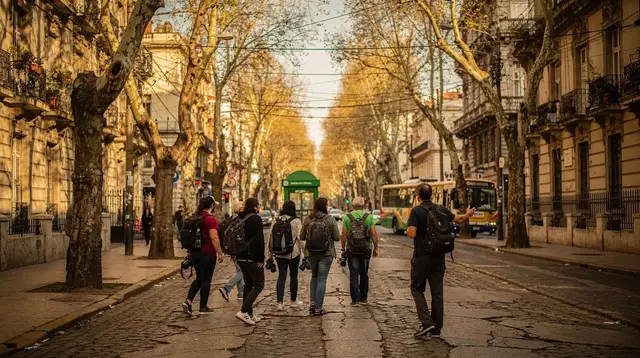
A commuter district, not a destination
Vicente López sits on the Río de la Plata immediately north of the Buenos Aires city limits, between Belgrano and San Isidro. It is one of the wealthier, greener municipalities of the conurbano — leafy streets, low-rise apartment blocks, a riverside jogging path, a handful of parks — and it is, above all, a place where people live and commute from, not a place people travel to see.
That distinction matters for planning. Vicente López has no cathedral, no museum of note, no market that draws a crowd, and no single street or square that functions as a landmark the way San Telmo or Caminito do. What it has is a pleasant riverside promenade, some sports clubs, and the kind of ordinary residential texture that is genuinely interesting to see once — through a train window, or on a short stop between two more compelling places — but that does not reward a dedicated half-day trip out from the centre.
This page treats Vicente López honestly, as a transition point on the northern axis toward San Isidro and Tigre, rather than inflating it into something it is not. If you are choosing where to spend a day on this side of the city, the answer is almost always San Isidro or Tigre, both a short distance further along the same line.
Vicente López is technically a partido (municipality) rather than a single neighbourhood, made up of several smaller barrios — Olivos, Florida and Munro among them — strung along the railway line and the riverbank. Visitors rarely need to distinguish between them: the train and the Tren de la Costa both cut across the whole municipality in a matter of minutes, and the character does not change much from one barrio to the next. What does change, occasionally, is the name printed on a station sign, which can be confusing if you are trying to match it against a map that only shows “Vicente López” as a single dot.
Where it sits, and how you get there
Vicente López lies along the Mitre railway line out of Retiro, and along the parallel Tren de la Costa light-rail line that runs closer to the water through the northern suburbs. Both routes pass through or near Vicente López on their way to San Isidro and on to Tigre.
- By train (Mitre line, from Retiro): roughly 20–30 minutes to the Vicente López area, using a SUBE card — the contactless card required on suburban trains, buses and the Subte, since drivers and conductors do not take cash fares.
- By car or taxi: roughly 25–35 minutes from the Microcentro in normal traffic, longer at rush hour.
- By Tren de la Costa: the scenic light-rail line threading the riverside suburbs from Maipú (reachable from the Mitre line) toward Tigre, stopping near the riverside parks of Vicente López and continuing to San Isidro.
There is no need to plan a special connection: anyone heading up the coast toward San Isidro or Tigre by train will pass through or very near Vicente López as a matter of course. See the general getting around Buenos Aires guide and the SUBE card guide before setting out.
What’s actually here
The honest inventory is short. Vicente López’s main asset is its stretch of the riverside path along the Río de la Plata, which continues the pedestrian and cycling route that starts down at the Costanera Sur reserve near Puerto Madero and runs north through Belgrano and into Vicente López and beyond. On a clear afternoon it is a genuinely pleasant walk or ride — wide brown river on one side, parkland and sports clubs on the other — and it is used far more by local residents exercising after work than by visitors.
A few municipal parks (Parque General San Martín and smaller riverside plazas) and a scattering of clubs and cultural centres round out what there is to see. None of this is a “sight” in the sense that the Recoleta Cemetery or the Teatro Colón are sights — it is ordinary suburban infrastructure, well kept because the district is comparatively prosperous, but not built for tourism and not marketed as an attraction.
There is no tango house, no colonial-era quarter, and no craft market comparable to Puerto de Frutos a little further north in Tigre. If those are what you are looking for on this axis, they exist — just not here.
One exception to the “nothing to see” rule is football, on a smaller scale than the city’s two giants. Club Atlético Platense, whose home ground sits in the Vicente López area, plays in a lower-key, more neighbourhood-scale atmosphere than the city’s two giant stadiums — closer to how most porteños actually experience football on an ordinary weekend, without the queues, the premium pricing or the international tour-group crowds that now surround Boca and River fixtures.
A match here is a genuinely different experience from a Boca or River game, not a lesser version of one: smaller crowds, cheaper tickets, and a stand full of local season-ticket holders rather than visitors. For travellers who want the ritual of Argentine football without the circus around the two biggest clubs, a guided outing to a Platense match, with a local host handling tickets and etiquette, is covered by the guided tour to a Platense match as a local.
Why this page doesn’t recommend a special trip
It would be easy to write Vicente López up as a hidden gem, a “local’s Buenos Aires” alternative to the tourist trail. That would not be an honest account of it. The riverside path is real and pleasant, but it is one of several comparable stretches along the same river, and the two towns immediately beyond it — San Isidro and Tigre — offer a genuinely richer half-day or full day out, with actual sights, food, and things to do that Vicente López does not have.
San Isidro, a short distance further along the same line, has a walkable historic centre around its neo-Gothic cathedral, a weekend crafts fair, and riverside parkland with more to see and do. Tigre, at the end of the line, opens onto the Paraná Delta — wooden lancha launches through wooded islands and stilt houses, the Puerto de Frutos market, and a genuinely different landscape from the city. Both are covered in their own guides: San Isidro day trip and Tigre day trip from Buenos Aires.
Given a single day on the northern axis, the practical recommendation is to ride through Vicente López rather than stop there specifically — save the time for San Isidro’s centre and Tigre’s delta, which is where the actual sightseeing on this route lives. A three-day version of the same axis, pairing Tigre, San Isidro and Belgrano into one loop, is laid out in the three-day Tigre, San Isidro and Belgrano itinerary.
If you do stop here
That said, a stop of an hour or two is entirely reasonable for a specific kind of traveller: someone breaking a train journey, someone staying nearby for other reasons (a relative, an apartment rental, a conference), or a cyclist extending the Costanera Sur path further north than most visitors bother to go. For that visitor, here is what a short stop looks like in practice.
| What | Where | Time needed |
|---|---|---|
| Riverside path walk or cycle | Along the Río de la Plata, Vicente López stretch | 30–60 min |
| Parque General San Martín | Central Vicente López | 20–30 min |
| Coffee or a light lunch | Local cafés near the train stations | 30–45 min |
| Continue north by train | Toward San Isidro / Tigre | — |
Food and services here are ordinary neighbourhood options — cafés, parrillas, bakeries — priced close to the rest of the city and aimed at residents rather than visitors. There is no need to seek out a “destination restaurant” in Vicente López; that kind of dining is better sought in Palermo or San Isidro.
Cyclists get more out of a stop here than most other visitors. The riverside path through Vicente López is flat, mostly shaded near the water, and wide enough for a comfortable ride even on weekends when it fills with local runners and families.
Someone riding a rented or tour bike up from the Costanera Sur reserve can treat the Vicente López stretch as a natural halfway point on a longer ride toward San Isidro, rather than a destination to stop and lock the bike for — the point of the ride is the river and the open air, not any single landmark along the way. Anyone planning that kind of longer ride is better served by one of the city’s dedicated bike-tour itineraries, which cover route planning and bike rental in more depth than a single-district page can.
Practical notes
Vicente López is a normal, safe, comparatively affluent residential district — the everyday caution that applies across greater Buenos Aires (keep phones and bags in view, be attentive around train stations) applies here as anywhere, without any particular local risk worth flagging.
A day’s budget here tracks the city average, since prices are set by ordinary residents rather than tourism: cafés, a light lunch and transport for a short stop typically run to a small fraction of a full day’s city budget. As with any peso figure on this site, treat the number as a dated snapshot rather than a fixed rate — Argentina’s inflation and exchange rules move quickly, so check a live conversion and current card-acceptance rules before budgeting, and see the wider getting around Buenos Aires guide for transport costs across the city.
Time of year matters more for the riverside walk than for anything indoors: spring (September–November) and autumn (March–May) are the most comfortable seasons across greater Buenos Aires, and the jacaranda trees that flower purple in the parks of the northern suburbs from late October into November are as visible here as in Palermo or Belgrano. Summer (December–February) brings heat and humidity that make an unshaded riverside walk less pleasant in the middle of the day; winter (June–August) is cool and damp but rarely uncomfortable for a short outdoor stop.
For onward travel, a wooded-islands boat trip is the main reason to keep going north: a hands-on grill outing on one of the delta’s islands is covered by the Tigre island grill immersion in hidden nature, and a lighter option pairing birdlife with lunch on the water is the Tigre Delta birdwatching tour with lunch.
Travellers building a longer first visit around this northern axis and the city centre together can look at the 4-day Discovering Buenos Aires tour, which covers more ground than a single stop in Vicente López ever will.
Vicente López: frequently asked questions
Is Vicente López worth visiting?
As a specific destination, not really — it has a pleasant riverside path and some parkland, but no landmark sight. It is worth passing through on the way to San Isidro or Tigre, both of which offer far more to see.
How do I get from Buenos Aires to Vicente López?
By Mitre-line train from Retiro (around 20–30 minutes) or by the Tren de la Costa light-rail line, both using a SUBE card; by car or taxi it is roughly 25–35 minutes from the Microcentro depending on traffic.
Should I stay overnight in Vicente López?
Most visitors do better staying in the city centre or in Palermo, which puts more sights, restaurants and transport options within easy reach. Vicente López works better as a quiet residential base for people with a specific local reason to be there than as a first-time visitor’s base.
What’s the difference between Vicente López and San Isidro?
Vicente López is largely residential with a riverside path and parks but no historic centre; San Isidro, a short distance further north on the same line, has a walkable centre around its neo-Gothic cathedral, a weekend fair, and more developed visitor infrastructure. San Isidro is the better stop for sightseeing.
Can I combine Vicente López with a Tigre day trip?
Yes in the sense that the train passes through the area on the way to Tigre, but there is little reason to build in a separate stop — most travellers ride straight through and spend their time in Tigre and San Isidro instead. See the Tigre day trip guide for a full plan.
Is Vicente López safe?
Yes, it is a comparatively affluent residential district with no particular safety concerns beyond the everyday caution — keeping valuables out of sight, being attentive near stations — that applies across greater Buenos Aires.
Is there anything to eat in Vicente López?
Ordinary neighbourhood cafés, bakeries and parrillas aimed at residents, priced in line with the rest of the city. There is no destination restaurant scene here comparable to Palermo or San Isidro.
What’s the best time of year to walk the Vicente López riverside path?
Spring (September–November) or autumn (March–May), for comfortable temperatures; summer afternoons can be hot and humid with little shade along the water, and winter is cool and damp but rarely prevents a walk outright.
Is Olivos the same as Vicente López?
Olivos is one of several barrios that make up the Vicente López partido (municipality), along with Florida and Munro among others. Visitors rarely need to tell them apart in practice — the train line and the riverside path run through all of them without an obvious change in character.
Can I see a football match in Vicente López?
Yes. Club Atlético Platense, based in the Vicente López area, offers a smaller-scale, more local football experience than the city’s two most famous clubs, with cheaper tickets and a crowd of regular local supporters rather than tour groups. A guided outing that handles tickets and match-day etiquette is the practical way to do this as a visitor.