San Isidro Day Trip: A Half-Day Escape North of Buenos Aires
Is San Isidro worth a day trip from Buenos Aires?
Yes, but budget a half-day rather than a full one. San Isidro's cathedral, riverside plazas and residential streets can be seen comfortably in two to three hours, which is why most visitors combine it with Tigre, reached a short distance further along the same rail line.
A quiet riverside town, not a full-day destination
San Isidro sits on the north bank of the Río de la Plata, roughly 20 to 25 km from central Buenos Aires, on the same rail corridor that continues on to Tigre. It is best known for its tall neo-Gothic cathedral, its leafy plaza, and a residential character that feels calmer and considerably greener than the dense grid of the capital. Many travel plans lump San Isidro in with a full-day Tigre and Delta excursion, and that instinct is understandable given the geography — but it overstates what San Isidro itself asks of a visitor.
Be honest about the scale of the place: the historic centre around the cathedral and plaza, plus a walk through the surrounding streets, is a two-to-three-hour outing. There is no equivalent here to the boat rides and island stilt houses that make Tigre and the Paraná Delta a genuine half-day-to-full-day activity in its own right. Treat San Isidro as a well-placed stop, not a destination that needs to fill an itinerary slot alone.
Getting there
The straightforward route is the Mitre line suburban train from Retiro station in Buenos Aires, which stops at San Isidro on its way toward Tigre. The ride takes roughly 30 to 40 minutes depending on the service, and like all urban rail and bus travel in the city, it runs on the SUBE contactless card rather than cash fares — buy or top up a card before travelling if you do not already have one.
The alternative is the Tren de la Costa, a scenic light-rail line that runs along the northern suburbs and has a station serving San Isidro’s centre, continuing on to Tigre. It is slower and more of a sightseeing ride than the Mitre line, with several small stations, cafés and river glimpses along the way — a pleasant option if the journey itself is part of the appeal, rather than simply a way to get somewhere.
Either way, San Isidro’s centre is a short walk from the station — plan on 10 to 15 minutes on foot, or a very short taxi ride if you are short on time or the weather is unhelpful.
| Option | Approx. journey time | Notes |
|---|---|---|
| Mitre line train (Retiro) | 30–40 min | SUBE card required, no cash fares |
| Tren de la Costa | Longer, scenic | Several stops, cafés along the route |
| Taxi / remise | 30–50 min depending on traffic | Convenient but no fixed price without a meter or app |
The cathedral and the plaza
The Catedral de San Isidro is the town’s unmistakable landmark: a neo-Gothic church with a slender spire visible from several streets away, built in the late 19th century and modelled loosely on French Gothic churches. Entry is free and the interior is worth a look for its stained glass and vaulted nave, though it is a working parish church rather than a major sightseeing attraction — a visit of 15 to 20 minutes covers it comfortably.
The cathedral faces the Plaza Mitre, a shaded square that functions as the town’s social centre, lined with older buildings, cafés and, on Saturdays, a craft fair selling leatherwork, jewellery and local food. If your visit falls on a Saturday, building in time for the fair is worthwhile; on other days the plaza is simply a pleasant place to sit before continuing on.
Walking the residential streets
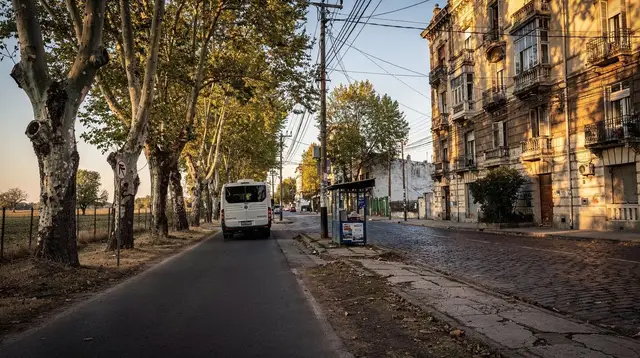
Beyond the plaza, San Isidro’s real character shows in its streets: early-20th-century houses, some with wrought-iron balconies and gardens, set along quiet, tree-lined blocks that feel closer to a European suburb than to central Buenos Aires. There is no single fixed walking route — the appeal here is an unhurried wander rather than a checklist of monuments, and 30 to 45 minutes of walking gives a fair sense of the area.
Toward the river, the ground drops away in a low bluff that gives San Isidro some of the more attractive green space along this stretch of the Río de la Plata, with paths and river views that are a good spot to pause before heading back to the station.
Pairing San Isidro with Tigre
The most common — and most efficient — way to see San Isidro is as a stop on the way to or from Tigre, rather than as a separate outing. Because both towns sit on the same Mitre line and Tren de la Costa route, the logistics line up naturally: get off the train in San Isidro first, spend two to three hours around the cathedral and plaza, then continue north to Tigre for the delta and the Puerto de Frutos market. This guide focuses on San Isidro on its own terms; for the fuller Tigre and Delta itinerary, including boat options, see the dedicated Tigre day trip guide.
If a single, longer day works better for your schedule, a private transfer that covers both towns removes the need to manage train changes and timing.
a private day tour from Buenos Aires that covers both San Isidro and TigreOnce in Tigre, the delta itself is a boat-based experience, and the options vary from short sightseeing loops to longer excursions with a meal included.
a combined Tigre Delta and Puerto de Frutos trip from Buenos Aires a panoramic boat tour through the Tigre river delta a classic delta boat ticket departing from Tigre For travellers who would rather not manage train connections at all, a handful of organised day trips depart directly from central Buenos Aires and cover both the town centre and a delta boat ride in a single booking.
a private day trip to the Tigre Delta departing from Buenos Aires a delta boat trip from Buenos Aires including transport to TigreBelgrano and the ride back into the city
The Mitre line and the Tren de la Costa both pass through Belgrano, one of Buenos Aires’s own residential barrios, on their way between Retiro and San Isidro. It shares some of the same character — leafy streets, older houses, a calmer pace than the Microcentro — without leaving the city limits, which makes it a natural stop to fold into the same day if San Isidro alone feels short.
Travellers coming back from San Isidro or Tigre in the late afternoon can break the return journey here rather than heading straight back to a hotel. For a closer look at the barrio’s own sights and a self-guided route through it, see the Belgrano neighbourhood guide and the Belgrano walking tour.
San Isidro against the pampas day trips
San Isidro is the closest and easiest of the region’s out-of-town stops, but it is worth knowing how it compares to the other half-day and full-day options that share the same general direction out of the capital. San Antonio de Areco, roughly 110 km west of the city, is the reference town for gaucho tradition, silverwork and criollo craft, and is usually visited as a full-day trip rather than a stop along a rail line — see the San Antonio de Areco day trip guide and, for the estancia visits that often accompany it, the estancia day trip guide.
The pilgrimage basilica at Luján is a different kind of stop again — a single major monument rather than a town to wander — covered in the Luján basilica day trip guide. And La Plata, roughly 60 km south-east, is a planned provincial capital built around a strict grid and a large neo-Gothic cathedral of its own, detailed in the La Plata day trip guide. None of these three requires a SUBE card or a suburban train the way San Isidro and Tigre do — they sit in a different direction and are typically reached by bus, car or organised transport instead.
Where San Isidro wins is convenience: no other stop on this list is as fast, as cheap, or as easy to combine with a second destination the same afternoon. Where it loses is scale — a gaucho estancia or a river delta gives a visitor more to actively do than a cathedral and a plaza, however pleasant.
Fitting San Isidro into a longer itinerary
For a first Buenos Aires trip that has room for one day outside the city, San Isidro slots naturally into the same day as Tigre — see the one-day Tigre Delta itinerary for how that day is usually structured, with San Isidro as the morning stop before the delta.
Travellers with more time can spread San Isidro, Tigre and Belgrano across a slightly slower three days using the three-day Tigre, San Isidro and Belgrano itinerary, which avoids trying to pack all three into a single long day. For a full week that also reaches the pampas towns above, the five-day Buenos Aires, Tigre and pampas itinerary gives San Isidro its own slot alongside San Antonio de Areco and Luján.
Suggested half-day plan
| Time | Activity |
|---|---|
| Morning | Train from Retiro (Mitre line) or Tren de la Costa to San Isidro |
| On arrival | Walk to the centre, visit the Catedral de San Isidro |
| Mid-morning | Plaza Mitre, café stop, Saturday craft fair if applicable |
| Late morning | Wander the residential streets and riverside green space |
| Early afternoon | Train onward to Tigre, or return to Buenos Aires |
This structure keeps San Isidro to what it actually offers — a relaxed, attractive stop of a few hours — while leaving the rest of the day free for Tigre, a return to central Palermo or Recoleta, or simply an unhurried afternoon.
Practical notes
San Isidro is a separate municipality within Greater Buenos Aires, in the Province of Buenos Aires rather than the Ciudad Autónoma de Buenos Aires — a detail that matters more for orientation than for travel planning, since transport and payment norms are the same as in the capital. The SUBE card used on the Subte and city buses works on the suburban trains as well, so there is no separate ticketing system to learn.
Bring the same everyday caution used anywhere in the metropolitan area: keep valuables out of sight, particularly around train stations. San Isidro’s centre is generally considered relaxed by the standards of Greater Buenos Aires, but it is not a reason to drop ordinary care.
Argentina’s seasons run opposite to the northern hemisphere, so a summer plaza fair in December or January will be hot and often humid, while a winter visit in June to August is cool and grey rather than freezing. Spring, from September into November, brings the jacaranda trees into their purple bloom across the wider Buenos Aires area, San Isidro included, and is one of the most comfortable times to walk its streets.
For the wider transport picture — how the Mitre line, Tren de la Costa and SUBE card fit together, and how to connect onward from San Isidro or Tigre — see the SUBE card guide and the Subte guide to Buenos Aires.
FAQ: visiting San Isidro on a day trip
How do I get to San Isidro from Buenos Aires?
Take the Mitre line suburban train from Retiro station, or the Tren de la Costa, which has a stop serving the town. Both journeys take roughly 30 to 40 minutes and use the SUBE card rather than cash.
Do I need a full day for San Isidro?
No. San Isidro’s centre — cathedral, plaza and a stroll through the residential streets — is a half-day outing. A full day only makes sense if it is combined with Tigre and the Paraná Delta further north.
What is the main sight in San Isidro?
The Catedral de San Isidro, a neo-Gothic church with a tall spire that anchors the main plaza. It is free to enter and is the town’s clearest landmark.
Can I combine San Isidro with Tigre in one day?
Yes, and it is the most common way to see both. San Isidro sits on the same Mitre line and Tren de la Costa route as Tigre, so visitors typically stop in San Isidro on the way north and continue to Tigre and the Paraná Delta afterward.
Is San Isidro safe to walk around?
San Isidro is a well-off, residential area of Greater Buenos Aires and is generally considered relaxed by the standards of the wider metropolitan area. Ordinary city-travel caution with phones and bags still applies, as anywhere.
What is there to do in San Isidro besides the cathedral?
The town has a compact historic centre with cafés and craft shops around the plaza, a Saturday craft fair, riverside green space toward the Río de la Plata, and quiet streets of early-20th-century houses that reward an unhurried walk.
Is San Isidro part of the city of Buenos Aires?
No. San Isidro is a separate municipality in the Province of Buenos Aires, within Greater Buenos Aires, north of the Ciudad Autónoma de Buenos Aires city limits.
Day Trips from Buenos Aires
Verified deep-linked GetYourGuide tours. Book through these links and we earn a small commission at no cost to you.
GetYourGuide does not provide a product photo for this activity — the image shows the meeting point, photographed by us.