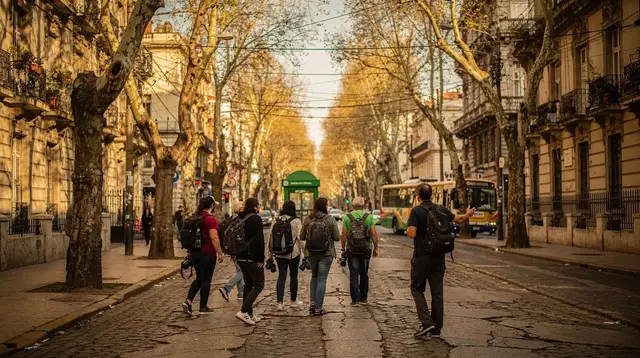
A working town, not a show
San Antonio de Areco sits on the banks of the Río Areco, about 110 km northwest of Buenos Aires in the flat cattle country of the pampas. It is widely treated, inside Argentina and out, as the reference town for gaucho tradition — the place where silversmithing, leatherwork and criollo horse culture were never revived for tourists because they never really stopped. Unlike a scripted gaucho show and asado at an estancia, Areco is a real town of roughly 25,000 people with its own bakery, its own parish, and workshops that have been run by the same families for generations. That is the whole appeal, and also the reason a visit rewards unhurried walking rather than a tight schedule.
This page is about the town itself: its colonial-era core, its silversmiths and talabarteros (leatherworkers), its museum, and the practicalities of getting there. It deliberately does not cover the asado-and-horseback-riding format sold by working estancias — some of which sit near Areco, others elsewhere in the pampas — because that is a different product with a different rhythm, covered separately on this site. Areco and an estancia day are easy to combine, but they are not the same visit.
Getting there and back — plan a full day
Areco is close enough to feel like a day trip and far enough that the drive matters. By road it is about 110 km, and the honest range for the one-way trip is 1 hour 45 minutes to 2 hours 15 minutes, depending on traffic leaving Buenos Aires and whether you travel by direct long-distance bus, a shared shuttle, or a hired car. Regular bus services run from Buenos Aires’ Retiro terminal; a private transfer or an organised tour, such as a private day tour to an estancia, typically routes through or near Areco on the way to a ranch.
Because the round trip alone can eat 3.5 to 4.5 hours, treat this as a full-day excursion, door to door — not a half-day add-on to something else in the city. A common, workable rhythm is an early-morning departure, three to four hours in town covering the museum, the historic quarter and the workshops, lunch at a local parrilla or pulpería, and a mid-to-late-afternoon return. Trying to also fit in La Plata or Luján the same day is possible on paper but rushed in practice; each of those day trips deserves its own day.
| Option | Approx. one-way time | Notes |
|---|---|---|
| Long-distance bus (Retiro) | 1h45–2h15 | Cheapest, several daily departures |
| Private transfer / driver | 1h30–2h | Door-to-door, flexible timing |
| Organised day tour | 1h30–2h to reach Areco or a nearby estancia | Often bundles Areco with an estancia stop |
| Self-drive | 1h30–2h | Most flexible, least support if something goes wrong |
The historic core
The town’s oldest quarter, around Plaza Ruiz de Arellano and the parish church, is still laid out on its colonial grid, with low adobe-and-brick houses, unpaved side streets, and the arched Puente Viejo (Old Bridge) over the Río Areco — a favourite spot for photographs and for watching the town go about its business. This is not a reconstructed “gaucho village”: people live here, run shops here, and the pace reflects that. A slow walking loop of the centre, without entering any single site, comfortably takes 45 minutes to an hour.
Museo Gauchesco Ricardo Güiraldes and the Parque Criollo
The town’s anchor sight is the Museo Gauchesco Ricardo Güiraldes, set inside the Parque Criollo on the edge of town. The museum is named for the Argentine writer whose 1926 novel Don Segundo Sombra did more than almost any other single work to fix the romantic image of the gaucho in Argentine culture; the complex includes a reconstructed pulpería — the general-store-cum-tavern that was the social hub of rural Argentina — alongside displays of silverwork, saddlery, and period rooms. Plan on an hour to ninety minutes for the museum and grounds, longer if a doma or folk display happens to be running. Opening days and hours change with the season, so check locally on the day rather than assuming it is open.
Silversmiths, leatherworkers and the artisan quarter
Areco’s reputation as the country’s centre for gaucho craft rests on its working ateliers, most of them small family workshops rather than shopfronts aimed at tour groups.
- Silversmiths (plateros): Areco is Argentina’s best-known centre for gaucho silverwork — the ornate rastras (belt buckles), facones (ceremonial knives) and stirrups that are still made and worn, not just sold as souvenirs. A handful of workshops welcome visitors to watch the process; prices for a genuine hand-worked piece run well above anything sold as a keychain in Buenos Aires.
- Leatherworkers (talabarteros): saddles, belts, mate gear and boleadoras are worked in small shops around the centre, many of them open to browsers.
- General criollo craft: ponchos, wool textiles and woodwork round out what the town produces, sold mostly from the workshops themselves rather than a single consolidated market.
Prices vary enormously by piece and by workshop, and — as with all Argentine peso figures on this site — should be treated as a dated snapshot rather than a fixed number; ask for a current price on the day and expect it to have moved since any guide was last checked.
Eating in Areco
Lunch is the natural anchor of an Areco day. The town has a handful of pulperías — some historic, some recreations of the format — serving classic pampas fare, and a scatter of parrillas around the centre for a straightforward grilled lunch. This is a lighter, town-based version of the asado experience built into a full estancia day; it is worth eating in Areco itself even for travellers who also plan to visit a ranch on the same trip, since not every estancia stop includes a sit-down meal.
Fiesta de la Tradición
Areco’s biggest event is the Fiesta de la Tradición, a week of gaucho parades, horsemanship displays, craft fairs and folk music that culminates around mid-November each year, timed to the birthday of the poet José Hernández, author of the gaucho epic Martín Fierro. If travel dates are flexible, this is the single best reason to time a visit deliberately rather than treat Areco as an interchangeable day trip — the town’s population roughly doubles for the occasion and accommodation books up well ahead. Outside that week, Areco is calm and unhurried, which is its own kind of appeal.
Areco versus an estancia day: two different visits
It is worth being explicit about the distinction, because the two are easy to conflate when planning:
| San Antonio de Areco (this page) | A day at an estancia | |
|---|---|---|
| What it is | A real town with a museum, workshops and historic streets | A working or tourism-oriented ranch, usually just outside a pampas town |
| The experience | Self-paced walking, browsing artisan workshops, a town lunch | A structured programme: transfer, asado lunch, horse riding or a carriage ride, doma display |
| Pace | Unhurried, mostly on foot | Fixed schedule set by the estancia |
| Where | The town of Areco itself | Often near Areco, but also elsewhere in the pampas |
Many visitors do both by choosing a tour that combines an Areco stop with an estancia visit nearby, but it is a longer day again — worth confirming the itinerary’s actual time allocation before booking, since “Areco and an estancia” sold as a single day can mean anywhere from twenty minutes in town to a genuine half-day.
a private day tour to an Argentinian estancia, which can be combined with time in Areco is the most flexible way to see both without juggling separate transport bookings.
Practical notes
- Money: Areco has ATMs and card acceptance in the centre, but smaller artisan workshops and market stalls often prefer cash. Bring Argentine pesos; card acceptance thins out quickly once you leave the main square.
- Timing your visit: arriving by mid-morning and leaving in the late afternoon gives the most usable time; the last afternoon buses back to Buenos Aires fill up, especially on weekends, so confirm the return schedule before you commit to a late lunch.
- Weather: the pampas offer little shade on the open plaza and along the riverbank; a summer (December–February) midday visit is hot, while winter (June–August) is cool and often damp rather than cold. Spring and autumn are the most comfortable seasons to walk the town at length.
- What not to expect: Areco is not a staged gaucho show. Craft demonstrations happen because the workshops are genuinely working, not because a tour bus is due; a quiet weekday visit may find some ateliers closed.
Combining Areco with the rest of the pampas
Areco sits within the same broad excursion zone as La Plata, the planned provincial capital with its large neo-Gothic cathedral, and Luján, home to the country’s most important pilgrimage basilica. All three are workable as separate single-day trips from Buenos Aires; none combines comfortably with another on the same day once real travel times are counted. Readers weighing all three against each other, or against a structured estancia day, may also want the broader pampas and day-trips overview before choosing.
For a shorter, city-based alternative to a full estancia programme, a guided city tour of La Plata covering its cathedral and museum makes a comparable half-day pampas excursion without the horseback-riding format. Travellers building a longer Argentina itinerary around Buenos Aires sometimes fold a pampas day into a wider multi-day package; a four-day Buenos Aires discovery itinerary is one way to see the city and a countryside day without piecing bookings together individually.
Where Areco fits in a wider itinerary
For first-time visitors building out a three-day pampas itinerary, Areco is usually the anchor day, with La Plata or Luján taking a second day and the city itself filling the rest. Travellers with only a single free day outside Buenos Aires should treat Areco and a working estancia as alternatives rather than both — see the comparison of estancia tours for how the ranch-based options differ from each other, and this page for the town-based alternative.
San Antonio de Areco FAQ
How far is San Antonio de Areco from Buenos Aires?
About 110 km. By road the trip takes roughly 1 hour 45 minutes to 2 hours 15 minutes each way, depending on traffic and the mode of transport, so a round trip alone accounts for 3.5 to 4.5 hours of the day.
Can I see San Antonio de Areco in a few hours?
Not really, once travel time is counted. The town itself can be walked in a couple of hours, but reaching it and returning takes the better part of a day; treat it as a full-day excursion rather than a quick stop.
Is San Antonio de Areco the same as visiting an estancia?
No. Areco is a real town with a museum, artisan workshops and historic streets, explored on foot at your own pace. An estancia day is a structured programme — transfer, asado lunch, horse riding, a doma display — usually at a ranch near a pampas town, sometimes near Areco and sometimes elsewhere. Many visitors combine both on one longer day.
What is there to do in San Antonio de Areco?
The main draws are the Museo Gauchesco Ricardo Güiraldes and its reconstructed pulpería, the historic centre around Plaza Ruiz de Arellano and the Puente Viejo, and the town’s working silversmiths and leatherworkers, several of which welcome visitors to watch the craft in progress.
When is the best time to visit?
Spring (September–November) and autumn (March–May) offer the most comfortable walking weather. Mid-November brings the week-long Fiesta de la Tradición, the town’s main gaucho festival, which is worth planning around if dates are flexible, though the town is noticeably busier and accommodation books up ahead of it.
How do I get from Buenos Aires to San Antonio de Areco?
Long-distance buses run from Retiro terminal several times a day; a private transfer, hired driver or organised day tour are the other common options. There is no direct train service to Areco.
Do I need cash in San Antonio de Areco?
Yes, at least some. ATMs and card payment exist in the centre, but many artisan workshops and market stalls prefer cash, particularly for smaller purchases.
Can I visit San Antonio de Areco and La Plata or Luján on the same day?
Not comfortably. Each is roughly a full day’s excursion from Buenos Aires on its own once travel time is counted; combining two in a single day leaves little time at either and risks missing the last transport back.