San Telmo Walking Tour: Cobblestones and Colonial Architecture
What does a San Telmo architecture walk actually cover?
It covers roughly two to three hours on foot around Defensa street, Plaza Dorrego, the Pasaje de la Defensa and the Mercado de San Telmo, focused on colonial and belle-époque facades, cobblestones and converted conventillo courtyards, rather than on food stops or tango shows.
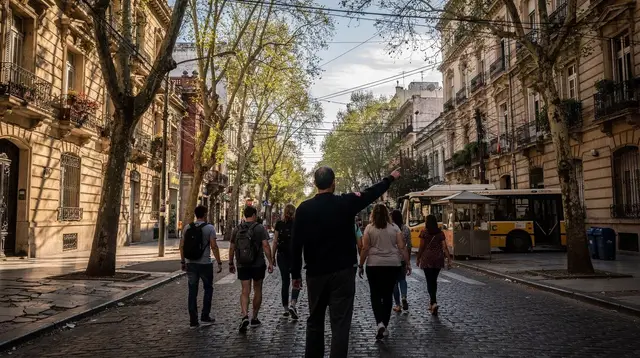
San Telmo is the oldest surviving residential barrio in Buenos Aires, and it looks it: single-storey colonial houses with deep window grilles sit next to grand two- and three-storey blocks from the Italian-immigration boom of the 1880s–1910s, all laid out along a grid of narrow streets still paved in cobblestone rather than asphalt. This walk is built around that fabric — facades, doorways, courtyards, ironwork — rather than around where to eat or where tango was supposedly invented. Those are worth doing separately, and covered elsewhere; this one is for people who want to understand what they’re looking at as they walk.
It is also worth saying plainly at the start: San Telmo today is not a preserved museum piece. It is one of the most visited and most commercial barrios in the city, its main street closes for a market every Sunday, and a large share of its ground-floor buildings now house antique dealers, cafés and souvenir shops aimed squarely at visitors. The architecture is real and the history is real, but the barrio you’ll walk through is a working tourist economy layered on top of that history, not a frozen relic of it. Both things are true at once, and a good walk here holds them together rather than pretending the second one away.
Why San Telmo looks the way it does
Buenos Aires grew south from the Plaza de Mayo in its early colonial centuries, and San Telmo was where the city’s merchant and landowning families first built their townhouses — long, narrow lots running back from the street to one or more interior patios, a layout borrowed from Andalusian and colonial Spanish American models. That pattern is still legible today: walk past an open doorway on Defensa and you’ll often glimpse a tiled patio running back into the block, sometimes two or three deep.
The barrio’s social character flipped in the late nineteenth century. A yellow fever epidemic in 1871 drove the wealthiest families north to the newly fashionable Recoleta and Barrio Norte, and their grand San Telmo houses were subdivided and rented out, room by room, to the wave of Italian and Spanish immigrants arriving through the port.
A single family house built for one household might end up holding a dozen or more, each family in one or two rooms around a shared patio, with a shared kitchen and washing area. This building type has a name — the conventillo — and it is the single most useful concept for reading San Telmo’s architecture, because so much of what looks like “one grand house” from the street was actually functioning as dense multi-family housing for generations.
The result on the street today is a mix of eras and states of repair: some colonial-era one-storey houses with thick walls and small windows, many more Italianate two- and three-storey buildings from roughly 1880 to 1910 with cast-iron balconies and elaborate cornices, a scattering of early twentieth-century Art Nouveau details, and, increasingly, careful restorations that have turned old conventillos into boutique hotels, design shops and restaurants. Reading a facade in San Telmo often means reading several decades of alteration at once — a colonial door frame under a later balcony, a patio subdivided and then reopened.
The route
This walk starts at Plaza de Mayo, the historic seat of government and a natural point to begin moving south into the older city, and finishes at the Mercado de San Telmo, with an optional extension to Parque Lezama.
Plaza de Mayo to Avenida San Juan (about 45 minutes)
Head south from Plaza de Mayo along Defensa street, which forms the spine of the entire walk. The first few blocks sit technically in the Microcentro/Monserrat area before you properly cross into San Telmo, and they’re worth a slower look precisely because fewer visitors linger here: this stretch has some of the barrio’s oldest surviving colonial-period buildings, low and thick-walled, alongside government and institutional buildings from later periods.
Around Chile and Defensa you’re properly inside San Telmo, and the scale shifts — buildings get taller, balconies more ornate, and the street starts filling with the antique shops the barrio is known for. Look up as often as you look at shopfronts: the ground floors have mostly been converted to commercial use, but the upper storeys often keep their original window surrounds, ironwork and cornice details untouched.
Plaza Dorrego and the Pasaje de la Defensa (about 45 minutes)
Plaza Dorrego is San Telmo’s historic main square and the second-oldest public square in the city after Plaza de Mayo. On weekdays it’s a quiet, shaded plaza ringed by cafés with outdoor tables; on Sundays it becomes the crowded centre of the Feria de San Telmo, discussed below. Either way, it’s the natural pause point on this route — take a few minutes on a bench to look at the buildings framing the square rather than walking straight through.
A block or so from the plaza, at Defensa 1179, is the Pasaje de la Defensa, one of the barrio’s best-preserved former conventillos and the single easiest place to actually step inside one rather than just imagining it from the street. Built as a grand single-family house in the early nineteenth century, subdivided into rental rooms after the 1871 epidemic, and later restored, it now holds small shops and workshops arranged around its original patio and gallery. It’s open during shop hours and free to walk through — the layout, more than any facade on the street, is what makes the conventillo pattern click.
Mercado de San Telmo and side streets (about 30–45 minutes)
The Mercado de San Telmo, a cast-iron and glass market hall dating to 1897, sits a couple of blocks from Plaza Dorrego and is worth entering as much for the structure as for what’s sold inside — antiques, food stalls, and a permanent flea-market atmosphere under an intact period iron roof. It’s open through the week, unlike the Sunday-only street fair, so it’s a good anchor if you’re walking on a quieter day.
From here, it’s worth ducking off Defensa onto one or two of the smaller residential streets running parallel — Bolívar, Perú, Balcarce — where there’s no market stalls and far fewer shopfronts, just ordinary San Telmo housing stock, parked cars and laundry on balconies. This is the part of the walk that most directly answers the “is it still authentic” question: yes, a block or two off the tourist spine, in the sense that it’s still a functioning residential barrio — but that’s also a reminder that the commercial main street is the exception being sold to visitors, not the default state of the neighbourhood.
Optional extension: toward Parque Lezama (30–45 minutes)
Continuing south along Defensa past Avenida San Juan takes you into a less-visited stretch of San Telmo, ending at Parque Lezama, a hillside park that (by tradition, not settled archaeological fact) marks the site of the first Spanish founding of Buenos Aires in 1536. The park itself has a small city history museum and, on weekends, an informal antiques market of its own, smaller and less crowded than the one around Plaza Dorrego. This stretch is a reasonable add-on if you have the time and want to see where San Telmo shades into La Boca, but it’s optional — most of the architectural interest is concentrated in the first two sections above.
Reading the buildings as you go
A few things worth watching for that make the walk more than a stroll:
- Door and window grilles (rejas): heavy wrought-iron grilles over ground-floor windows are a colonial security feature that persisted well into the Italianate era; older ones are simpler and more geometric, later ones more decorative.
- Cast-iron balconies: imported largely from British and Belgian foundries during the late nineteenth-century building boom, these are one of the clearest markers of the 1880–1910 Italianate wave rather than the earlier colonial period.
- Patios and zaguanes: the entrance hallway (zaguán) leading to an interior patio is the core organising feature of the old San Telmo house type; many are now gated or converted to shopfronts, but plenty of doorways still open onto a visible tiled patio if you glance in as you pass.
- Restoration seams: look for a clean, bright section of facade next to a weathered one, or a modern steel lintel under an old cornice — these mark where a building has been partially restored, usually for a hotel, restaurant or shop, and they’re a useful visual cue for how much of what you’re seeing is original fabric versus recent intervention.
Planning notes
| When to go | What you’ll find |
|---|---|
| Weekday morning | Quietest option; permanent antique shops open at their own pace, easiest for photographing facades without crowds |
| Weekday afternoon | Cafés and restaurants busier, light good for the east-facing side of Defensa |
| Sunday | Feria de San Telmo fills Defensa and Plaza Dorrego with antique stalls; lively and colourful but slow going and crowded for architecture-focused looking |
A practical note on pacing: San Telmo’s cobblestones are uneven and can be slick after rain, so flat, sturdy shoes matter more here than in most of the flatter, better-paved barrios like Palermo or Puerto Madero. Cafés around Plaza Dorrego and along Defensa give plenty of excuses to sit down partway through.
Combining this with other San Telmo visits
Because San Telmo is compact, this architecture-focused walk pairs easily with other angles on the same streets on a different visit, or later the same day:
- a local-led walking route through San Telmo and on toward Caminito, useful if you’d rather have a guide narrate building histories than work them out from a map
- a small-group San Telmo neighbourhood walking tour for a more intimate, slower-paced version of the same ground
- a combined guided walk covering both San Telmo and La Boca, if you want to continue on to Caminito the same day
- a private walking tour pairing Corrientes and San Telmo, for a custom pace and a look at the city’s theatre street beforehand
If your interest is more in eating your way through the barrio than in reading its facades, the separate San Telmo food tour guide covers that angle properly; if it’s tango history you’re after, the tango history walking tour guide traces performance venues and milonga sites rather than architecture. For the barrio’s famous Sunday market itself, see the dedicated San Telmo Sunday market guide, and for accommodation and general orientation, the San Telmo neighbourhood guide is the place to start.
For getting to and from San Telmo, it sits within easy walking or short taxi distance of Plaza de Mayo and the Microcentro, and connects onward to La Boca and Caminito for those extending the day south. If you’re combining it into a broader first day in the city, the one-day historic centre walk itinerary and the one-day San Telmo and La Boca itinerary both build around this same stretch of streets.
Frequently asked questions about walking San Telmo’s streets
Is San Telmo still an authentic, untouristy barrio?
Not really, and it is worth being honest about that. Defensa street and Plaza Dorrego are heavily commercial, especially on Sundays, with antique stalls, tourist-facing cafés and street performers. The architecture is genuine and the residential streets a block or two off the main axis are quieter, but the core walking route is unambiguously a tourist circuit today.
How long does a San Telmo walking tour take?
A focused architecture walk along Defensa, through Plaza Dorrego and the Pasaje de la Defensa, and into the Mercado de San Telmo takes about two to three hours at an unhurried pace, including stops to look at facades and courtyards. Add an hour if you continue toward the Parque Lezama end of the barrio.
What is a conventillo and can I see one?
A conventillo was a subdivided colonial or post-colonial house rented out room by room to immigrant families, San Telmo’s dominant housing form from the late nineteenth century. Several survive as converted courtyards you can walk into, most accessibly the Pasaje de la Defensa at Defensa 1179, now home to small shops and workshops around its original patio.
Is the walk different on a Sunday than on a weekday?
Yes, substantially. On Sundays, Defensa street closes to traffic for the Feria de San Telmo, and the antique market fills the route from Plaza Dorrego for several blocks, which is lively but crowded and slower for looking at buildings. On a weekday the same street is quieter, the permanent antique shops are open at their own pace, and facades are easier to actually see.
Do I need a guide, or can I walk San Telmo on my own?
The barrio is compact and walkable independently with a map, and this guide lays out a route. A guided option adds context on building dates, ownership history and restoration versus original fabric that is not visible just by looking, which matters more here than in barrios with less layered architecture.
Is San Telmo safe to walk around?
The Defensa/Plaza Dorrego tourist corridor is generally fine in daylight, with the ordinary big-city caution against phone snatching in busy market crowds. Some side streets are quieter and less busy after dark; as in the rest of Buenos Aires, keep valuables out of sight rather than avoiding the barrio altogether.
What’s the difference between this walk and a San Telmo food tour or tango tour?
Those are different angles on the same streets. A food tour moves between specific restaurants and bars for tastings; a tango-history walk follows sites tied to the dance’s origins and performance venues. This walk is organised around building dates, facades, courtyards and streetscape, and treats food and tango as things you’ll notice in passing rather than the point of the route.
Walking Tours of Buenos Aires Neighborhoods
Verified deep-linked GetYourGuide tours. Book through these links and we earn a small commission at no cost to you.
GetYourGuide does not provide a product photo for this activity — the image shows the meeting point, photographed by us.