Empanadas Tasting: A Guide to Buenos Aires' Favourite Snack
What is an empanadas tasting in Buenos Aires, and how is it different from a parrilla meal?
It is a light, informal way to sample several small stuffed pastries — beef, chicken, ham-and-cheese and other fillings — rather than sitting down to a full steak dinner. Empanadas are sold by the piece at bakeries, delis and casual counters across the city, so a tasting can be a quick stop, a self-guided crawl through a few spots, or a short guided walk, and it is usually finished within an hour.
Ask a porteño for their favourite empanada and you will get an opinion, not a definition. That is the honest starting point for anyone planning a tasting in Buenos Aires: the empanada is less a single dish than a whole family of small stuffed pastries, shaped by region, family recipe and whichever bakery happens to be on the corner. This guide treats it that way — as a snack worth sampling widely, not a single “correct” recipe to track down.
What an empanada actually is
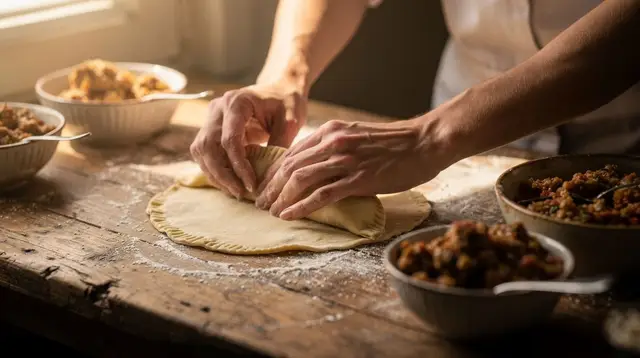
At its simplest, an empanada is a disc of pastry folded over a filling and sealed along the edge, either baked in an oven (al horno) or fried (frita). The size is roughly a fistful — bigger than a dumpling, smaller than a hand pie — and it is eaten with the hands, no cutlery required. That portability is the whole point: empanadas are working-day food, sold individually at bakeries, delis and dedicated empanada counters, and bought a few at a time rather than ordered as a single plated dish.
This is what separates a tasting from a restaurant meal. You are not booking a table and choosing one dish; you are picking up two, three, five pieces, often from more than one counter, and comparing them side by side. A tasting can be as short as a single stop on the way somewhere else, or as long as a slow crawl through a barrio’s bakeries over an afternoon.
Regional variety, not one recipe
Argentina is a large country, and empanada styles travel with regional cooking traditions. Buenos Aires, as the capital and biggest city, is where many of those traditions turn up on the same counter rather than staying confined to their home province. A few of the fillings most visitors will meet:
- Carne (beef) — the most common everyday filling, typically hand-chopped beef rather than minced, often mixed with onion, hard-boiled egg and green olive. Recipes vary by household and by region; some are drier, some are juicier, some season more heavily with cumin or chili.
- Pollo (chicken) — usually shredded chicken with onion and sometimes bell pepper, a lighter alternative to beef.
- Jamón y queso (ham and cheese) — a straightforward, mild option and a safe choice for anyone unsure about spice or offal-adjacent fillings.
- Picante or norteño-style — a spicier beef filling associated with north-western Argentine cooking, sometimes labelled explicitly as “estilo Salta” or “estilo Tucumán” on a menu.
- Humita — a creamy, sweet-savoury corn filling, meat-free and distinct in texture from the others.
- Caprese or verdura — tomato and mozzarella, or spinach and cheese, common vegetarian options where available.
None of these is “the” Argentine empanada. A bakery in Buenos Aires might offer a version influenced by Tucumán next to one that is purely local city style, and neither is more authentic than the other — they are different regional answers to the same basic format. Menus that promise “the original recipe” are making a marketing claim, not a factual one; the more useful question to ask at a counter is simply which fillings they make well, not which one is real.
The seal itself is another small tell worth watching for once you have tried a few. Bakeries often close each filling with a slightly different fold — a plain crimped edge for one, a repunte (the twisted rope edge) for another — partly as decoration and partly as a practical label so staff and regulars can tell fillings apart at a glance without cutting one open. It is not a rule you can rely on across the city, since conventions vary from bakery to bakery, but once you notice it, it becomes a quick way to guess what is inside before you bite in, and a good conversation starter if you are tasting alongside someone else.
Baked versus fried
The second axis of variety, alongside filling, is technique. Horno (oven-baked) empanadas have a firmer, slightly drier crust, closer to a savoury pastry. Fritas (fried) empanadas are richer, with a crisper, sometimes flakier exterior from the oil. Many places specialise in one or the other rather than offering both, which is one more reason a tasting that visits two or three spots tells you more than a single stop.
| Style | Texture | Where to expect it |
|---|---|---|
| Al horno (baked) | Firmer, drier pastry, holds its shape | Most bakeries and everyday delis |
| Frita (fried) | Crisper, richer, glossier crust | Specialist empanada counters, some north-western-style spots |
How to structure a tasting
Because empanadas are cheap and quick relative to a full meal, the most natural way to taste several kinds is informally: buy two or three at one counter, walk to a second one, repeat. There is no reservation required and no fixed sitting time — most places will box or bag empanadas to eat standing, on a bench, or on the walk to the next stop.
A workable shape for a self-guided tasting:
- Start at a traditional bakery for a baseline carne and jamón y queso.
- Move to a dedicated empanada counter or a place advertising norteño-style fillings for something spicier.
- Finish somewhere offering humita or a vegetarian option, for contrast.
Four to six empanadas across two or three stops is a filling but not excessive amount for one person, and it costs a fraction of what a sit-down parrilla dinner would. Because Argentine peso prices move quickly with ongoing inflation, treat any specific figure as a dated snapshot: check current menu prices on arrival and convert at a live exchange rate rather than relying on an old number, including any general figures published elsewhere on this site.
Where in the city to go
San Telmo and Palermo are the two barrios most workable for an informal empanada crawl, simply because each has a good concentration of bakeries, delis and casual counters within a comfortable walking radius. San Telmo pairs naturally with a visit to the Mercado de San Telmo or a wander through the San Telmo Sunday market, since both are food-adjacent stops already. Palermo, spread across Palermo Soho and Palermo Hollywood, has a denser mix of traditional counters and newer, more design-led bakeries, which makes for a good contrast in styles within a short walk.
For visitors who would rather not pick counters at random, a guided food tour of San Telmo or a food tour of Palermo typically builds in an empanada stop alongside other tastings, with the choosing done for you. None of the bookable activities on this page is an empanada-specific tour — empanada tasting in Buenos Aires is largely a self-directed, low-cost activity — but a broader city or bike tour is a natural way to structure a day that includes one.
Pairing an empanada stop with the rest of a food day
Because a tasting takes so little time, it slots easily into a longer day rather than needing to be planned as a destination on its own. A short empanada stop works well:
- On the way to or from a walking tour of San Telmo or the Palermo street art walking tour, as a mid-walk refuel.
- Before an afternoon at El Ateneo Grand Splendid, a short visit in itself and easy to combine with a quick bite nearby.
- As a light lunch ahead of a proper asado or parrilla dinner later that evening — a sensible pacing choice given that dinner in Buenos Aires rarely starts before 21:00 and often later, leaving a long gap that a light lunch fills better than nothing at all.
- Alongside a Buenos Aires biking tour or a Palermo bike tour, stopping at a bakery along the route rather than pausing for a sit-down meal.
If you would rather build tasting into a structured tour rather than assembling your own crawl, a guided coffee tasting experience covers a comparable format — short, walkable stops sampling something specific — and is a useful reference for pacing even though its focus is coffee rather than empanadas.
For a broader introduction to the city that leaves room to duck into a bakery along the way, the Essential Buenos Aires Tour and the private city tour with mate tasting both move through several central barrios on foot or by vehicle, which makes it easy to add an empanada stop of your own choosing. Travellers who prefer to cover more ground between tastings sometimes pick a city biking tour instead, since it opens up barrios like Palermo and Puerto Madero that would take longer to cross on foot.
Taking it further: watching or making your own
A tasting is about eating, but for visitors who want to understand the fillings well enough to try them at home, Palermo has a small cluster of hands-on options built around empanadas and the wider parrilla tradition. An empanadas cooking experience in Palermo walks through the dough, the fold and a couple of classic fillings in a small group, which turns the tasting from something you watch on a counter into something you can repeat at home.
It sits alongside the broader empanadas cooking class options in the city and the more general Argentine cooking class in Palermo, for anyone who wants to fold a longer session around more than just the pastry.
For visitors building a full day of Argentine food rather than a single stop, an Argentine asado masterclass in Palermo covers the grill side of the tradition that empanadas sit next to on most menus, and pairs naturally with an empanada tasting earlier in the day — light first, heavier grill session later.
The Argentine cooking class designed by a Michelin chef is a higher-end alternative for travellers who want more structure and technique than a casual counter crawl can offer, and the wine pairing cooking class is worth a look for anyone who wants to close the loop between empanadas, a parrilla dinner and a glass of malbec in a single guided session.
None of this is required — most visitors taste empanadas simply by walking into a bakery — but for a traveller who has enjoyed the snack and wants to leave with more than a memory of it, a short cooking class is the natural next step, and one that also works well on a rainy afternoon when an outdoor food crawl is less appealing. If your schedule stretches beyond the city, the weekend Mataderos fair is another place where empanadas turn up alongside grilled meats and folk craft, in a more local, less touristed setting than San Telmo or Palermo.
Practical notes
Empanadas are sold individually, so there is rarely a minimum order — buying one or two to try is completely normal and not considered a small or awkward purchase. Most bakeries and delis will let you eat standing at a counter, and some casual empanada shops have a few stools or a narrow bar; sit-down seating with table service is the exception rather than the rule for this kind of stop, which is part of what keeps it quick.
Vegetarian options exist (humita, verdura, Caprese) but are not universal — smaller neighbourhood bakeries may carry only meat fillings, so it is worth asking or checking a menu board before assuming a vegetarian choice will be available. If you are also curious about the malbec and wine side of Argentine food culture, an empanada stop makes a good low-commitment lunch ahead of an evening wine tasting, since it is filling without being heavy.
For a wider view of what else the barrio has to offer beyond food, see the San Telmo neighbourhood guide or the Palermo Soho and Hollywood guide — both cover the empanada spots as one part of a longer list of things to do nearby, alongside markets, bars and walking routes through each barrio.
Frequently asked questions about empanadas tasting in Buenos Aires
What is the difference between an empanadas tasting and a parrilla meal?
A parrilla meal is a sit-down grill dinner built around cuts of beef, often lasting two hours or more. An empanadas tasting is smaller and faster: a handful of pastries, eaten standing at a counter or over a short table, usually finished in well under an hour and costing a fraction of a grill dinner.
Is there one true Argentine empanada?
No. Argentina has strong regional empanada traditions — from the north-west, from Tucumán, from the coast — and Buenos Aires bakeries and delis draw on several of them at once. Treat any claim that a single recipe is “the real one” with caution; the honest answer is that the variety itself is the tradition.
What fillings will I find in Buenos Aires?
The everyday trio is beef (carne, often with egg and olive), chicken (pollo) and ham-and-cheese (jamón y queso). Many counters also carry a spicy version modelled on the north-western style, a creamy corn filling called humita, and sometimes spinach with cheese or a Caprese-style tomato-mozzarella version.
How much does an empanada cost in Buenos Aires?
Peso prices move quickly with inflation, so treat any figure as a dated snapshot rather than a fixed number. As a rough shape, a single empanada at a casual counter is inexpensive relative to a restaurant main, and a tasting of four or five pieces plus a drink remains a budget outing compared with a parrilla dinner. Check a current menu and a live exchange rate before planning a budget.
Are empanadas baked or fried?
Both styles exist side by side. Horno (baked) empanadas have a firmer, drier pastry; fritas (fried) ones are richer and crisper. Many bakeries offer only one style, so it is common to try both by visiting more than one place.
Where in the city is best for an empanadas tasting?
San Telmo and Palermo both have a good density of casual counters and traditional bakeries within walking distance of each other, which makes either barrio workable for an informal crawl. A guided food tour is an alternative for visitors who would rather not choose stops themselves.
Can I do an empanadas tasting as part of a longer food day?
Yes — because it is quick and inexpensive, an empanada stop pairs easily with a walking tour, a market visit, or an evening that later includes a full parrilla dinner, since dinner in Buenos Aires rarely starts before 21:00 in any case.
Food Tours and Argentine Wine Tastings
Verified deep-linked GetYourGuide tours. Book through these links and we earn a small commission at no cost to you.
GetYourGuide does not provide a product photo for this activity — the image shows the meeting point, photographed by us.