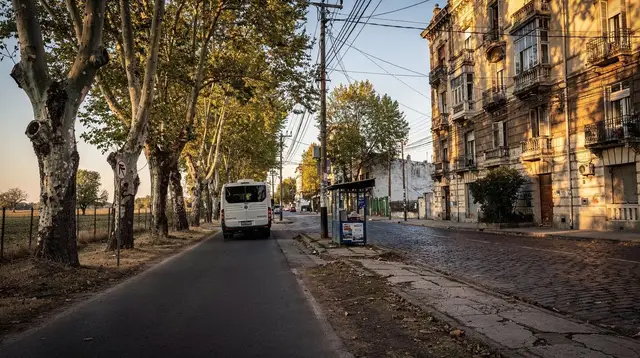
Hop-On Bus or Walking: How to See Buenos Aires
Should I see Buenos Aires by hop-on hop-off bus or on foot?
Neither wins outright. A bus covers the city's long distances and spares your legs in summer heat, but it skips the barrios' street life and stops less. Walking gets you into San Telmo, Palermo and La Boca properly, but only over a compact area and mostly in cooler months. Most visitors do best combining a half-day bus loop with two or three neighbourhood walks.
Bus or on Foot: Which Actually Suits You
Buenos Aires is a flat, sprawling, European-looking capital, and that combination is exactly why the bus-versus-walking question does not have one right answer. The city is easy on the feet — no hills, wide pavements, a grid you can read in an afternoon — but it is also large: the distance from Recoleta to San Telmo alone runs 5 to 6 km, and La Boca sits further out again. A hop-on hop-off bus solves the distance problem.
A walking tour solves the problem that most of what makes Buenos Aires interesting — the antique stalls on Defensa street, the painted corrugated-iron of Caminito, the parrilla smoke drifting out of a Palermo doorway — only exists at walking pace, on streets a bus cannot enter. This guide sets the two options against each other honestly, including the cases where each one is clearly the wrong choice, rather than pushing you toward whichever is easier to sell.
If you only want the bus itself explained — routes, stops, ticket types — see the dedicated guide at /guides/buenos-aires-hop-on-hop-off-bus/. This page assumes you are still deciding.
What the Hop-On Hop-Off Bus Actually Gives You
An open-top hop-on hop-off bus in Buenos Aires runs a fixed loop, typically threading Puerto Madero, Recoleta, Palermo, the Microcentro and Plaza de Mayo, with a day pass letting you get off at any stop and rejoin a later bus. Its real value is threefold.
First, orientation: on a first day, riding the full loop once, without getting off, gives a mental map of the city that is hard to build any other way in under two hours. Second, distance: it moves you between barrios that are genuinely far apart without a taxi fare or a SUBE top-up. Third, accessibility: for anyone with limited mobility, small children who tire fast, or a short layover between an EZE arrival and a hotel check-in, sitting on an upper deck beats a forced march.
Its limits are just as real. The bus stops where its route says, not where the interesting street begins — San Telmo’s antique fair on Plaza Dorrego and Caminito in La Boca are both pedestrian zones you still have to walk once you step off. Commentary is broad and general rather than street-by-street. And a loop that takes 90 minutes without stops can eat most of a morning once you factor in waiting for the next bus at each stop. For a table comparing this properly against a guided walk, see below.
For a guided version that puts a local’s judgment behind the same territory rather than a recorded commentary, consider a sightseeing tour with a local expert guide, which covers similar ground with room to ask questions.
What a Walking Tour Actually Gives You
A walking tour trades coverage for depth. Buenos Aires’s barrios each have a distinct character within a few blocks — Palermo Soho’s design shops and street art, San Telmo’s cobbled antique trade, the Microcentro’s early-20th-century banking architecture — and none of it reads properly from a moving vehicle. Walking also lets you stop: an unplanned coffee, a doorway worth a photo, a market stall worth ten minutes. It is the only way to actually experience the Feria de San Telmo on a Sunday or to linger on Caminito without a bus schedule pulling you back.
The honest downside is scope. A walking tour covers one or two barrios well, not the whole city, and Buenos Aires’s real distances mean you cannot walk from Recoleta to La Boca and back in a morning without it becoming the whole day. Heat is the other constraint: summer (December to February) in Buenos Aires is hot and humid, and a two-hour midday walk in January is a different experience from the same walk in October. A full-day option exists for travellers who want to commit to walking as the main activity — a full-day walking tour of the city covers considerably more ground than a standard two-hour outing, with breaks built in.
For a themed alternative that goes deeper than general orientation, an early 20th-century Buenos Aires walking tour with food tasting pairs the Microcentro’s architecture with stops to eat, which suits a traveller who wants a narrative rather than a checklist.
Side by Side
| Factor | Hop-on hop-off bus | Walking tour |
|---|---|---|
| Distance covered | City-wide, multiple barrios in one loop | One or two barrios per outing |
| Depth of experience | Broad, general commentary | Street-level detail, local context |
| Physical effort | Minimal — mostly seated | Moderate to high, several km on foot |
| Weather sensitivity | Low (covered/open-top, brief stops) | High, especially in summer heat |
| Access to pedestrian zones (Caminito, San Telmo fair) | Requires getting off and walking anyway | Direct |
| Typical time commitment | 1.5–3 hours for the full loop | 2–4 hours per barrio |
| Best for | First-day orientation, limited mobility, long transfers | Depth, photography, specific barrios |
| Cost per person (approximate, September 2026) | Similar range to a half-day guided walk; check current listing | Similar range to the bus; check current listing |
Prices for both change with the season and operator, so treat any figure as a snapshot to verify at booking rather than a fixed rate.
Weather, Season and Which Option Wins
Season decides more of this question than either option’s marketing admits. Buenos Aires sits in the southern hemisphere, so its summer runs December to February — hot, humid, and genuinely uncomfortable for several consecutive hours on foot, particularly around midday. In that window, the bus’s shade and moving air are a real advantage, and a walking tour is better scheduled for early morning or the late afternoon. Winter (June to August) is cool and damp but rarely cold enough to matter, and it is one of the more comfortable seasons for a full day of walking, if you are prepared for occasional rain.
Spring (September to November) and autumn (March to May) are the sweet spot for either option — mild temperatures, and in spring the added bonus of the city’s jacaranda trees flowering purple from late October into November, best appreciated slowly, on foot, in Palermo or Recoleta. For month-by-month detail, /guides/buenos-aires-best-time-to-visit/ breaks this down further.
Rain changes the calculus too: an open-top bus in a downpour is a poor experience, and most walking tours simply reschedule or shorten in heavy rain. Check the forecast the morning of, not the week before.
Match the Option to Your Trip
First-time visitor, three days or fewer. Start with a half-day bus loop to build a mental map, then spend the remaining time walking San Telmo, Palermo and La Boca on foot. This is the combination most first-time itineraries converge on, and it appears in /itineraries/three-days-first-time-buenos-aires/.
Traveller with limited mobility or travelling with young children. Lean toward the bus for the bulk of sightseeing, supplementing with short, flat walks in a single barrio — Puerto Madero’s riverside promenade is a good low-effort choice, and /destinations/costanera-sur/ nearby offers a flat nature walk if energy allows.
Photographer or slow traveller with five or more days. Walking wins outright here. The bus adds little once you have already oriented yourself, and the barrios reward the kind of unhurried, backtracking movement a fixed loop does not allow. A private option such as a private Buenos Aires sightseeing tour can also be built around your own pace rather than a shared schedule.
Short layover between flights, or a single free afternoon. The bus is the pragmatic choice: maximum coverage for minimum planning, with the option to get off once if something catches your eye.
Hot summer visit (December–February). Bias toward the bus at midday and reserve walking for early morning or after 17:00, when the heat eases and the light is better for photos in any case.
Cool, mild months (spring, autumn, or dry winter days). Walking has no real drawback here, and it is the better use of time if your trip is barrio-focused rather than checklist-focused.
A Combined Half-Day That Works for Most Visitors
For visitors who cannot decide, the most efficient single day mixes both. Ride the bus loop once in the morning, without getting off, purely for orientation — roughly 90 minutes to 2 hours depending on traffic and stop waits. Note two or three barrios that looked interesting from the top deck. Then spend the afternoon walking one of them properly: San Telmo on a Sunday for the antique fair, Palermo for its street art and cafés, or Recoleta for the cemetery and the surrounding streets. This sequencing avoids the bus’s main weakness — shallow coverage — while still solving the distance problem that makes walking the whole city impractical.
For a version of a single day built walking-first instead, with a fixed route through the historic centre, see /itineraries/one-day-historic-center-walk/. For the two-barrio combination of San Telmo and La Boca specifically, /itineraries/one-day-san-telmo-la-boca/ lays out a route that neither a bus nor a single tour typically covers in one pass.
Practical Notes Before You Book
Whichever option you choose, a few details affect the experience more than the choice itself. Buenos Aires’s Subte and colectivo buses both require the SUBE card — useful to know if you plan to supplement either the bus tour or a walking day with public transport between stops. Wear proper walking shoes even on a bus day, since every hop-on hop-off ticket still involves walking to the stop and around whichever attraction you disembark for.
Carry minimal valuables and keep phones out of sight on the street, particularly near Retiro and Constitución stations and after dark — standard advice, and it applies equally whether you are on a bus platform or a pedestrian street. And if your visit includes a Sunday, note that the San Telmo fair runs that day specifically, which should influence which day you schedule your walking half of the itinerary, bus loop or not.
Buenos Aires Sightseeing: Bus vs Walking — Questions Answered
Is the Buenos Aires hop-on hop-off bus worth it?
It is worth it for orientation on your first day, for covering ground between Recoleta, Palermo and Puerto Madero without a taxi, and for travellers with limited mobility or small children. It is less worth it if your trip is entirely centred on San Telmo, Palermo Soho and La Boca, where the interesting parts are pedestrian streets a bus cannot enter.
Can you walk everywhere in Buenos Aires?
No. Buenos Aires is flat and walkable within a barrio, but the distances between barrios are real: Recoleta to San Telmo is roughly 5 to 6 km, and La Boca sits further south again. Walking the whole city in one day is not realistic; walking one or two barrios thoroughly is the honest plan.
Is it safe to walk in Buenos Aires?
Central, touristed areas are generally fine to walk in daylight, with the usual opportunistic theft risk around phones and bags. Be more deliberate near Retiro and Constitución stations and after dark, and in La Boca keep to the Caminito and Vuelta de Rocha tourist strip rather than the surrounding streets.
How hot does it get for walking tours in Buenos Aires?
Summer (December to February) is hot and humid, often into the low 30s Celsius with high humidity, which makes multi-hour walking uncomfortable, especially at midday. Spring and autumn are markedly more comfortable, and winter (June to August) is cool and damp but rarely uncomfortable for walking.
Does the hop-on hop-off bus go to San Telmo or La Boca?
Routes vary by operator and change over time, so check the current stop map before booking. Even where a route includes a stop near these barrios, the parts worth seeing — Defensa street, Plaza Dorrego, Caminito — are themselves pedestrian and need to be walked once you step off.
Is a walking tour with a guide better than doing it yourself?
A guided walking tour adds context — history, safety pointers, and a fixed route — which suits a first visit or a specific theme, such as street art or 20th-century architecture. Self-guided walking costs nothing beyond your time and suits a return visitor or someone with a specific barrio already in mind.
What is the best way to see Buenos Aires in one day?
With a single day, a morning hop-on hop-off loop through Recoleta, Palermo and Puerto Madero, followed by an afternoon on foot in San Telmo or La Boca, covers more ground than either option alone. See /itineraries/one-day-historic-center-walk/ for a walking-first version of a single day.
Tour Comparisons
Verified deep-linked GetYourGuide tours. Book through these links and we earn a small commission at no cost to you.
GetYourGuide does not provide a product photo for this activity — the image shows the meeting point, photographed by us.