Buenos Aires Night City Tour: Lights, Skyline and the Obelisco
What is a Buenos Aires night city tour, and is it a nightlife tour?
No. A night city tour is a guided drive, bike ride or boat ride through illuminated Buenos Aires — Puerto Madero's lit towers and bridge, the Obelisco, and the wide avenues of the Microcentro — built around views and photography, not bars or clubs. It usually runs for two to three hours in the early evening and ends before the city's dinner hour even properly begins.
What a night city tour in Buenos Aires actually is
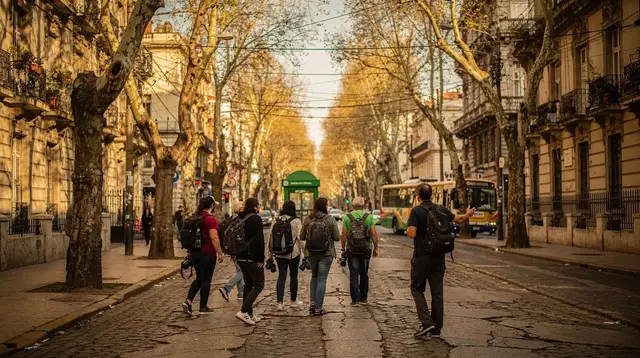
Buenos Aires after dark has a version of itself that daytime sightseeing does not show: the glass towers and Puente de la Mujer of Puerto Madero lit up against the Río de la Plata, the Obelisco floodlit at the centre of Avenida 9 de Julio, and the wide, mostly empty avenues of the Microcentro running quiet between illuminated facades. A night city tour is built around that — a guided drive, e-bike ride or short boat outing timed for the two or three hours after sunset, stopping at a handful of fixed viewpoints for photographs rather than moving fast through a checklist.
It is worth separating this clearly from what it is not. This is not a bar crawl, a club night, or a guide to where the city’s late-night drinking scene happens — that subject is covered on its own, for readers planning an evening around Palermo nightlife or San Telmo bars. A night city tour ends by around 22:00 or 22:30, well before Buenos Aires dinner service is even in full swing, and its focus is entirely on architecture, skyline and photography. If what you actually want is a night out, this is the wrong page; if you want to see the city lit up and bring back usable photos of it, keep reading.
Why night, and why these particular places
Buenos Aires by day is a flat, dense, largely 19th- and early-20th-century city, and its skyline drama is concentrated in a few 20th- and 21st-century set pieces that read very differently once the sun goes down. Puerto Madero’s redeveloped docklands — glass office towers, converted brick warehouses, and Santiago Calatrava’s white cable-stayed Puente de la Mujer — are lit for effect after dark in a way the daytime version, competent but unremarkable, is not.
The Obelisco, a 67-metre concrete monument at the intersection of Avenida 9 de Julio and Avenida Corrientes, does the same thing: unremarkable stone by day, a clean white column against the traffic and theatre lights of Corrientes by night. Both are the reason this format exists as a distinct product rather than a late add-on to a standard half-day city tour.
A well-run route typically strings together three or four stops: a photo stop at the Obelisco and along Corrientes’ theatre strip, a longer stop walking or cycling through Puerto Madero’s waterfront and across or alongside the Puente de la Mujer, and a drive-past of Plaza de Mayo, the Casa Rosada facade and the exterior of the Teatro Colón — none open for entry at that hour, all worth seeing lit. Some operators extend the route into Recoleta for its illuminated French-style facades; check the specific itinerary before booking if that stop matters to you, since it is not universal.
Vehicle, bike or boat: the three formats
Night tours run in three broad formats, and they suit different travellers.
Van or minibus tours cover the most ground with the least physical effort, moving between four or five stops with a guide narrating en route and getting out at each viewpoint for a fixed few minutes. This is the easiest option after a full day of walking and works for any age or mobility level. A private guided city tour booked for an evening slot follows this pattern with your own vehicle and pace rather than a fixed group departure.
E-bike tours trade some coverage for a closer, street-level experience — Puerto Madero’s waterfront paths and the Microcentro’s wide avenues both work well by bike, and stopping for photos is faster and more spontaneous than with a group vehicle. A night tour by e-bike is the standard group version of this format; for a slower pace, more flexible stops or a route built around specific photo spots, a private night bike tour is worth the difference in price.
Premium and combined tours add a car, better vehicle access to restricted viewpoints, or pair the night circuit with an earlier dinner or show — a premium city tour is the category to check if comfort and a smaller group matter more than budget.
None of these three formats functions as, or substitutes for, a night out. If bars, clubs or a late dinner scene are what you actually want after the lights, treat the tour and the evening as two separate plans.
What to expect: timing, length, and what’s included
| Element | Typical detail |
|---|---|
| Start time | 19:00–20:30, once it is properly dark |
| Duration | 2–3 hours |
| Finish time | Around 22:00–22:30 |
| Core stops | Obelisco / Av. 9 de Julio, Puerto Madero, Plaza de Mayo drive-past |
| Format options | Van/minibus, e-bike, private car, boat add-on |
| Entry included | No interior visits — all stops are exterior/photo stops |
| Dinner included | Not on standard tours; premium versions sometimes add one |
Because every stop on a night tour is exterior — Puerto Madero’s promenade, the Obelisco’s traffic island, Plaza de Mayo from the pavement — nothing here requires advance tickets the way Teatro Colón’s interior or Recoleta Cemetery does during the day. What matters is booking with enough daylight margin that the operator confirms an actual departure, since a handful of no-shows can lead to a cancelled evening slot at short notice, more so than for daytime tours.
Photography on a night tour: what actually works
The honest caveat first: a moving group tour is not the setting for a tripod-and-long-exposure session. Stops are timed in minutes, not the twenty or thirty a serious night photographer would want at the Obelisco or on the Puente de la Mujer, and most operators will not wait for one traveller to set up a full manual exposure while the rest of the group is ready to move on.
What does work reasonably well: a modern phone camera’s night mode, handheld, braced against a railing or your own body at the Puerto Madero waterfront stops, where the tour typically allows the longest dwell time of the route. The Obelisco stop is usually shorter and busier with traffic and other visitors, so treat it as a quick, well-composed shot rather than an experimental one. If photography is genuinely the priority rather than a side benefit, a private bike tour or a private guided vehicle gives you the standing to ask for an extra few minutes at a specific stop, which a scheduled group departure generally cannot offer.
Night tours versus daytime sightseeing of the same places
Several of the buildings and viewpoints on a night route are also standard daytime stops, and it is worth being clear about what changes. Puerto Madero by day is a pleasant, ordinary waterfront walk best combined with the Costanera Sur reserve next door; by night it becomes a lit architectural set piece and loses the reserve entirely, since that closes with daylight.
Plaza de Mayo and the Casa Rosada are a working seat of government by day, with the option to go inside on a Casa Rosada visit; at night they are an exterior-only photo stop with no public access. The Obelisco does not meaningfully change function between day and night — it has no interior to visit either way — but its visual effect changes completely once it is lit against the dark.
If your schedule only allows one pass through these places, the honest recommendation depends on what you are optimising for: daytime gives you Costanera Sur and the option of going inside the Casa Rosada; night gives you the skyline and the Obelisco at their most photogenic, with neither building open regardless. Many visitors on a three-day Buenos Aires itinerary do both, since the daytime and night versions of Puerto Madero are different enough sights to justify two visits.
How this fits around the rest of your stay
A night city tour is a two-to-three-hour evening slot, not a half or full day, so it pairs naturally with whatever else is already on the schedule. It works well on an arrival evening when jet lag rules out a late dinner or a night out but a low-effort look at the city still appeals, and it works equally well as the last evening of a stay, closing out a full Buenos Aires itinerary with a different view of places already seen by day. Because it finishes by around 22:00, there is still time afterward for a proper Buenos Aires dinner, which rarely starts before 21:00 anyway — the tour and a late meal are not competing for the same slot the way they would in most other cities.
For travellers building a longer stay, a night tour also makes sense stacked against day trips: after a full day out at Tigre or an estancia, an evening city circuit is a lighter way to close the day than another full walking tour would be. It is a poor fit, on the other hand, immediately before an early flight or an early departure for Iguazú, given the late finish time.
Booking notes
Group departures for the standard van and e-bike formats run most evenings in season, but confirm the specific night before committing to it, since weather and low demand can occasionally push a departure to the following evening. Private options — the guided car tour and the private bike tour — are the more reliable choice if your evening is fixed and cannot shift, since they run to your own schedule rather than a group minimum.
As with any evening activity here, dress for a Buenos Aires night: the Río de la Plata waterfront at Puerto Madero picks up a breeze that the inland streets of the Microcentro do not have, and it is noticeably cooler after dark than the same spot at midday, in every season except the height of summer.
Frequently asked questions about Buenos Aires night city tours
Is a night city tour the same thing as a night out in Buenos Aires?
No. A night city tour is a sightseeing circuit focused on illuminated architecture and skyline views, typically starting soon after sunset and finishing by around 22:00 or 22:30. It is unrelated to the bar and club scene covered separately for Palermo and San Telmo nightlife.
What do you actually see on a Buenos Aires night tour?
The standard route covers the lit towers and Puente de la Mujer of Puerto Madero, the Obelisco and Avenida 9 de Julio, and usually a pass by Plaza de Mayo, the Casa Rosada facade and the Teatro Colón exterior, all illuminated after dark.
What time does a night city tour start and finish?
Most operators start between 19:00 and 20:30, once the sky is dark but before Buenos Aires’ late dinner hour, and run for two to three hours, finishing around 22:00 to 22:30.
Is Buenos Aires safe to visit at night on a tour like this?
A guided vehicle, bike group or boat tour with a leader is a low-risk way to see the city after dark, since you are not walking unfamiliar streets alone. Keep phones and cameras secured between stops, as with any city outing, and treat solo late-night walking as a separate question from a guided tour.
Can I photograph the Obelisco and Puerto Madero properly on a night tour?
Yes, that is the point of the format: stops are timed at the Obelisco and along Puerto Madero’s waterfront specifically for photography, rather than a drive-by. Bring a phone or camera that handles low light reasonably well, since tripods are rarely practical on a moving group tour.
Is a night bike tour better than a night bus or van tour?
A bike tour, usually by e-bike, gets closer to street level in Puerto Madero and the Microcentro and stops more freely for photos, while a van or bus tour covers more ground with less physical effort and works better for anyone who does not want to cycle at night.
Do night city tours include Recoleta or La Boca?
Some extended or premium versions add a pass through Recoleta’s illuminated buildings, but La Boca and Caminito are a daytime destination and are not part of standard night circuits, since the barrio is not treated as a nighttime tourist area.
Buenos Aires and San Telmo City Tours
Verified deep-linked GetYourGuide tours. Book through these links and we earn a small commission at no cost to you.
GetYourGuide does not provide a product photo for this activity — the image shows the meeting point, photographed by us.