Street Tango at La Boca and Caminito: What It Really Is
Is the tango at Caminito in La Boca a real tango show?
No. It's a short, informal street performance by one or two dancers for tips, aimed at passers-by on Caminito, not a staged theatrical show. A real tango show is a separate, ticketed evening performance in a dedicated venue, usually with a live orchestra, several couples and often dinner included.
What you’ll actually see on Caminito
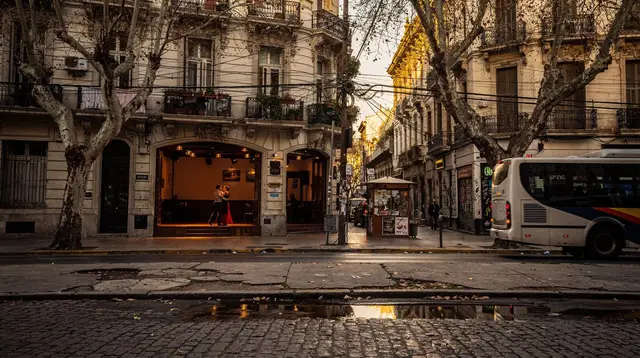
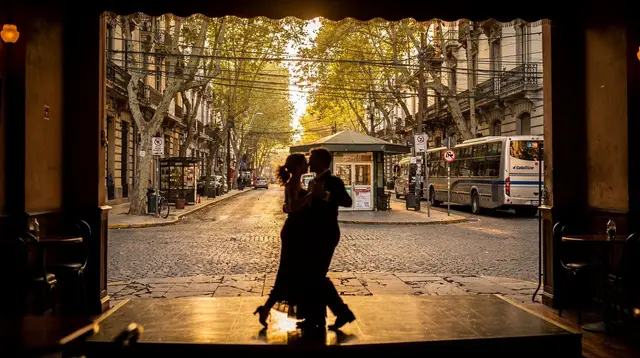
Walk down Caminito on almost any afternoon and, sooner or later, you’ll find a small crowd gathered around a pair of dancers on the cobbles: a tight embrace, a few sharp turns, a leg flick timed to a bandoneón track playing off a speaker, then a bow and a hat or open case passed around for tips. That’s it. It lasts a few minutes, it repeats a little later with the same or different performers, and it happens all day without a schedule, a ticket booth or a stage.
It’s worth stopping for. It’s also worth being clear about what it is, because this is the single most common mix-up visitors bring to La Boca: treating a few minutes of street performance as if it were the tango show they’ll tell people about back home. It isn’t, and it was never meant to be.
Street tango, honestly described
This is a street performance for tips, done in the open, on the same short pedestrian lane where everyone is also buying souvenirs, eating choripán and photographing the painted corrugated-iron houses. The dancers who work Caminito are professionals — many trained, many performing there for years — but the format itself is informal by design:
- One couple, sometimes two, not a full company.
- Recorded music through a portable speaker, not a live orchestra.
- A short, repeatable routine, a few minutes long, built to catch passing foot traffic rather than tell a complete story.
- No seating, no staging, no lighting design — it happens on the pavement, among the crowd.
- Payment is a tip (propina), not a ticket, and it’s genuinely optional, though customary if you stop to watch or ask for a photo.
- No booking and no fixed time slot — you either catch it or you don’t.
None of that is a criticism. It’s a long-standing feature of Caminito’s street life, alongside the tango-themed murals, the vendors and the painted balconies with mannequins of Maradona and Evita leaning out over the lane. It’s a genuine slice of porteño street culture. It is just categorically not the same product as a tango show, and treating it that way sets visitors up to be disappointed by something that was never trying to be a full performance in the first place.
What it isn’t: a dinner-show or a staged performance
Buenos Aires’ actual tango shows are a different business entirely, usually held in dedicated venues in San Telmo, Recoleta or elsewhere in the centre. A typical evening there runs like this:
| Street tango at Caminito | Tango dinner-show | |
|---|---|---|
| Setting | Open-air pedestrian lane | Dedicated theatre or show venue |
| Length | A few minutes, repeated | 90 minutes to 2+ hours |
| Performers | 1–2 dancers | Several couples, singers, musicians |
| Music | Recorded, one speaker | Live orchestra, in most venues |
| Cost | Tip, no fixed price | Ticketed, often with dinner included |
| Booking | None — turn up and hope | Reserved seat, booked in advance |
| Production | None | Lighting, staging, costume changes |
If what you actually want is a seated, choreographed, full-length programme — the kind with a live orchestra, several featured couples and often a set dinner menu — that’s a tango dinner-show, and it’s worth comparing formats before booking rather than assuming any tango-branded evening covers the same ground. Some visitors specifically want the show without the meal; see the tango show without dinner options if that’s your preference. Either way, it’s a separate outing, on a separate evening, bought as a separate ticket — not something La Boca’s street performers are attempting to substitute for.
Where the confusion comes from
It’s an easy mistake to make. Caminito is heavily associated with tango in every guidebook and every souvenir shop window, the murals on the lane are full of tango imagery, and the street performers themselves are genuinely skilled — good enough that a first-time visitor can reasonably assume they’re watching a scaled-down version of “the real thing.” Add to that the fact that some travel write-ups describe La Boca’s tango loosely as “a tango show,” without specifying that it means a few minutes on the pavement, and the expectation gets set before anyone arrives.
The practical result: visitors who came to La Boca expecting a full tango evening leave a little underwhelmed, while visitors who understood it correctly — a nice, free (tip-based) few minutes as part of a wider neighbourhood walk — tend to enjoy it a lot more, because it was never being asked to do more than that.
How to actually enjoy it
Treat it as one stop on a longer La Boca and Caminito walk, not as the reason for the trip on its own:
- Time it for daylight. La Boca’s tourist strip is a daytime destination; stick to the Caminito and Vuelta de Rocha area and plan to be elsewhere by evening.
- Watch a round or two, then move on. A single routine runs a few minutes; there’s rarely a reason to wait for more than one or two before continuing your walk.
- Have small cash ready. A modest note per person is the normal gesture if you stop to watch, and expected if you ask for a posed photo afterward.
- Combine it with the rest of the lane. The painted houses themselves, the murals, the craft stalls and the odd café are as much the point as the dancing.
- Don’t wander off the tourist strip looking for “a better view.” The residential streets around Caminito aren’t part of the visitor circuit, and there’s no reason to leave the strip to see more of the same performance.
- Book a proper show separately, on a different evening, if that’s what you actually want.
For the photography side of a La Boca visit specifically — getting a good shot of the painted houses and the lane itself, as distinct from the tango performance — see the dedicated Caminito photo session guide, which covers light, timing and composition rather than the dancing.
If you want the real thing instead
Buenos Aires has a genuine, deep tango scene beyond both the street performers and the polished dinner-shows, and it’s worth knowing the map of it before you commit an evening:
- Dinner-shows, as above, aimed squarely at visitors, are the most expensive and most produced option, sold by the seat.
- Milongas are the real social dance halls where porteños go to dance, usually with a short class beforehand for newcomers — see the milongas for visitors guide for how to walk into one without feeling lost.
- Standalone shows without dinner, for travellers who want the performance and the orchestra without committing to a full meal.
- Beginner lessons, a practical, hands-on alternative if watching makes you want to try it yourself.
None of these compete with what happens on Caminito — they’re simply a different, ticketed category of experience. A well-regarded venue-based option is a full evening tango show at La Ventana, which runs the live-orchestra, multi-couple format that street performance doesn’t attempt. Visitors who’d rather skip the line and lock in a seat can use a skip-the-line ticket for the same show, and those who want dinner built into the evening can look at the La Ventana show with an optional dinner add-on.
San Telmo has its own venue tradition too, worth considering with a tango show at La Carbonera in San Telmo. And for anyone who’d rather move than watch, a beginner tango lesson at La Ventana is a practical way to leave with more than a photo.
For a broader sense of what’s out there before picking one, the full tango shows overview and the budget-focused options both lay out the range by price and format, and the beginner’s guide to tango in Buenos Aires covers the etiquette and history behind all of it, street performance included.
Practical notes for a La Boca tango stop
- It’s not bookable. There’s no ticket, no reservation and no guaranteed performer or time — build in flexibility rather than a fixed slot.
- It’s outdoors and weather-dependent. Rain thins out both the crowds and the performers; a sunny afternoon is the reliable bet.
- It’s genuinely photogenic, with the painted houses as a backdrop, but be considerate about how close you get and ask before photographing performers directly.
- Combine the stop with lunch nearby rather than building a whole day around it — an hour or two on Caminito, tango included, is the honest reading for most visitors.
- Stay on the tourist strip. Caminito and the Vuelta de Rocha waterfront are set up for visitors in daylight; the surrounding residential blocks are not part of the circuit.
For the wider neighbourhood context — where La Boca sits relative to the rest of the city and how to fit it into a day — see the one-day San Telmo and La Boca itinerary, and for general orientation on staying safe while sightseeing, the is Buenos Aires safe guide covers the same daylight-hours, stay-on-the-strip logic that applies here.
Street tango vs. real tango show, in short
The confusion is understandable, but the distinction matters for planning: what happens on Caminito is a free-to-watch, tip-supported street performance, a few minutes long, with no booking and no live orchestra — a nice, low-commitment moment inside a longer La Boca walk. A tango show is a paid, staged, full-length theatrical performance, booked in advance, usually with a live orchestra and often dinner. Enjoy the first for what it is on your way through La Boca, and book the second separately if you actually want the full tango evening.
Frequently asked questions about tango in La Boca
Is the tango at Caminito in La Boca a real tango show?
No. It’s a short, informal street performance by one or two dancers for tips, aimed at passers-by on Caminito, not a staged theatrical show. A real tango show is a separate, ticketed evening performance in a dedicated venue, usually with a live orchestra, several couples and often dinner included.
Is the tango at Caminito free?
There’s no admission fee — dancers work for tips (propina). A few hundred pesos per person, or a similar small note, is the normal gesture if you stop to watch or take photos; check a current rate before you go, since peso values move fast.
How long does a Caminito street tango performance last?
A single routine typically runs two to four minutes, repeated every so often through the afternoon and early evening. Most visitors watch one or two rounds, which takes ten to twenty minutes including photos.
Can I take photos with the dancers?
Usually yes, and a posed photo afterward is exactly when a tip is expected. Ask first, agree on whether it’s included in what you’re already giving, and keep small notes handy so you’re not relying on the dancers for change.
Is street tango in La Boca the same quality as a dinner-show?
No. Dinner-shows run a full choreographed programme — several dancers, a live orchestra, costume changes, staging and lighting — for ninety minutes or more, and are rehearsed to a professional theatrical standard. Street tango is one or two dancers doing a short, repeatable set on uneven paving, for tips, between other jobs.
What time of day does the tango happen at Caminito?
Mostly daylight hours, roughly midday into early evening, when the street is busiest with visitors. There’s no fixed schedule or booking — it depends on which dancers are working that day, so treat it as something you might catch rather than something you can plan around precisely.
Should I skip La Boca and go straight to a proper tango show?
Not necessarily — they answer different questions. Go to La Boca for the neighbourhood, the painted houses and a few minutes of street performance as part of that walk. Book a proper show separately if you actually want to sit through a full tango programme.
Is it safe to watch tango in La Boca?
On the Caminito and Vuelta de Rocha tourist strip in daylight, yes — it’s busy, watched over, and set up for visitors. Keep it to that strip; the residential streets around it are not part of the tourist circuit and aren’t a place to wander looking for a better view.
Tango Shows and Milongas
Verified deep-linked GetYourGuide tours. Book through these links and we earn a small commission at no cost to you.
GetYourGuide does not provide a product photo for this activity — the image shows the meeting point, photographed by us.