Caminito Photo Session: How to Actually Shoot It
Can you get uncrowded photos at Caminito?
Rarely a fully empty frame. Caminito is a short pedestrian lane and a headline stop for every Buenos Aires tour, so tourists, performers and touts fill it through the day. The realistic goal is working the crowd into or around the shot, not eliminating it, and going at opening time or late afternoon for the calmest light and the thinnest foot traffic.
Shooting Caminito Without Chasing an Empty Street
Caminito is one short, painted lane in La Boca, and it photographs beautifully — but it does not photograph empty. This page is about the session itself: where to stand, what light to chase, how to work around the tango dancers and tour groups rather than pretend they are not there, and how a focused photo visit differs from simply walking through. If you want the fuller neighbourhood context and history, that lives on the separate La Boca and Caminito walking tour guide; this page assumes you already know roughly where you are going and want to come away with good frames.
Set expectations first, honestly: Caminito is roughly 100 metres of corrugated-iron houses painted in blues, yellows, reds and greens, running between La Bombonera’s neighbourhood and the small inlet at Vuelta de Rocha. It sits on the standard circuit for every La Boca tour, every hop-on-hop-off stop and most cruise-ship shore excursions. There is no time of day when it is genuinely quiet. The craft of a Caminito photo session is composing around people — tango couples posing for tips, tour groups clustering at the best-known corners, other visitors doing exactly what you are doing — not waiting them out.
Timing the Light and the Crowd
The lane runs roughly north-south with buildings close on both sides, so direct sun only reaches deep into it for part of the day; for much of the morning and late afternoon the facades sit in soft, even light, which suits the saturated paint better than harsh midday sun does. Two windows work best:
- Right at opening, before the first coach tours arrive. This is the closest Caminito gets to calm, and the light is gentle.
- The last hour or so before sunset, when the crowd from the day’s tours has mostly thinned and the light turns warm. Some evenings bring a second wave of visitors timed to sunset photos, so this window is good rather than guaranteed.
Midday is the least forgiving slot: harsh overhead light flattens the colour, and it typically coincides with the day’s peak foot traffic, including large tour groups moving through in blocks. If your schedule only allows a midday visit, plan on composing tighter shots — doorways, balconies, single facades — rather than wide lane shots that need clear space.
Where to Stand
A few reliable spots, from the entrance near La Boca’s main approach through to the inlet:
- The entrance corner, where the lane’s colour palette is at its most concentrated. Popular, so expect company in frame; use it for close, cropped shots rather than a clean wide view.
- The elevated walkway sections, a few short raised platforms along the lane that give a slightly higher angle over the street-level crowd and make a useful wide shot of the facades without people’s heads dominating the foreground.
- Vuelta de Rocha, the small inlet at the end of the lane, where a stretch of open water gives a genuine break in the built-up crowding and a different, more open composition — boats, water, colour reflected on the surface.
- Side alcoves and doorways, tucked just off the main line of the lane, where smaller groups gather and a single doorway or balcony can be isolated without half of Caminito’s foot traffic in the background.
Working the lane in both directions — out toward Vuelta de Rocha and back — costs little time and roughly doubles your options, since the light and the crowd both shift over even a 30-minute walk.
Camera Settings and Practical Gear
Caminito rewards simple, deliberate gear choices over a heavy kit. A single wide-to-normal zoom, or a phone with a wide-angle lens option, covers almost everything the lane offers: full facade shots need the wide end, while doorway and balcony details work fine at a normal focal length. A polarising filter helps cut glare off the corrugated-iron panels in direct sun, which is one of the few technical tricks that actually changes the result here, since the painted metal reflects light differently from painted plaster or brick.
Because the lane is narrow and the light shifts fast between sun and shade as you move a few metres, auto-exposure with a touch of negative compensation generally outperforms manual settings unless you are used to Caminito’s particular light already. Shoot in bursts around performers, since a tango couple’s pose changes quickly and the best frame is rarely the first one. If you are working with a phone only, cleaning the lens before you start and shooting in the native camera app rather than a heavily processed third-party one keeps the saturated colours closer to what the eye actually sees on the street.
Pairing Caminito with the Rest of La Boca
A focused Caminito session rarely stands alone. Most visitors fold it into a broader look at La Boca, and the natural companion stop is La Bombonera, Boca Juniors’ stadium a few streets inland — either a full stadium tour or the club museum works well before or after the photo walk, since both sit within easy walking distance of the painted lane. Football fans visiting around a fixture can also check the match-day guide for how ticketing and access differ from an ordinary museum visit.
If tango is more of a draw than football, the same strip hosts genuine street tango performances rather than the dinner-show format found elsewhere in the city, and a Caminito photo session naturally overlaps with watching a few songs before moving on. For visitors staying in or near San Telmo, Caminito is a short taxi or a longer walk south, and combining the two barrios in one outing — antique streets first, painted lane second — is a common and efficient pairing that several guided tours already build around, rather than something you need to improvise on the day.
Working Around Tango Dancers and Tour Groups
Tango couples perform on the Caminito strip for tips, in the street tango tradition rather than a milonga or a dinner show. They are a genuine part of the scene and often make the strongest single photograph you will get here, but a few practical points:
- A small tip is the norm if you photograph a dancer closely or ask them to pose; treat it as paying a working performer, not a park statue.
- Large tour groups move through in blocks and tend to cluster at the same two or three well-known corners — if one arrives while you are set up, it is usually faster to move a few metres to a side alcove than to wait it out.
- Restaurant terraces along the lane sometimes discourage photography of their tables and displays without a purchase; a polite ask solves this in either direction.
None of this is a reason to avoid Caminito. It is a reason to plan the session as “work with the crowd” rather than “wait for the crowd to leave.”
Self-Guided vs a Guided Photography Tour
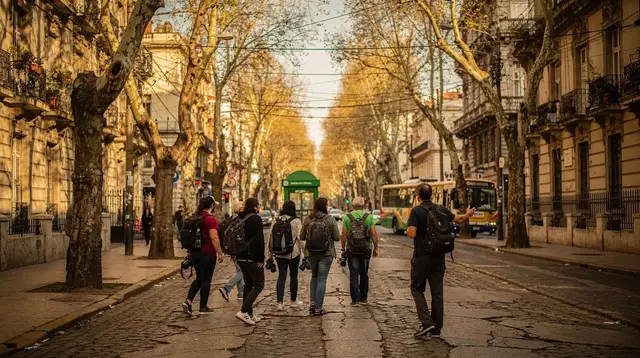
a guided walking photography tour through La Boca and Caminito puts a photographer alongside you for the visit, which helps mainly with timing (they know which corner is clear when) and with getting yourself into the frame rather than only shooting the street. It is a different product from simply walking the lane with a camera, and it typically covers more of La Boca than Caminito alone.
If you want photographs with yourself in them without hiring a private guide, a dedicated Buenos Aires photo experience built around getting portrait shots at key spots is built for exactly that, with Caminito typically one stop among several rather than the whole session.
For a slower, more personal alternative that treats the visit as a discovery walk with a camera rather than a fixed shot list, a photo tour framed around seeing the city from a different angle is worth comparing against the more structured options above.
And if Caminito is one stop on a broader San Telmo-to-La Boca walk rather than the sole destination, a local-led walking tour covering San Telmo and Caminito together folds the photo opportunity into a longer route, which suits visitors who want context alongside the pictures.
Two further options worth knowing about, if the ones above do not quite fit: a private photo shoot built specifically around Caminito and the colours of the harbour is a closer match for visitors who want a shorter, more targeted session than the broader city photo experiences above, staying within La Boca rather than covering multiple neighbourhoods.
And for a session styled less like a tour and more like a personal shoot, with someone shadowing you to capture candid moments rather than posed portraits, a personal paparazzi-style photo shoot is a different format again, useful for visitors who want the resulting photos to look unplanned rather than staged.
When to Visit: Season and Day of Week
Beyond the daily light cycle, Caminito’s crowd level shifts with the broader travel calendar. Cruise-ship days bring a concentrated wave of shore excursions that can fill the lane within an hour of docking, and weekends generally draw more domestic visitors than weekdays. None of this is precise enough to plan a whole trip around, but if your schedule has any flexibility, a weekday morning visit is a reasonably safe bet for the calmer end of Caminito’s normal range.
For a broader sense of how Buenos Aires as a whole varies by month and season, the best time to visit guide covers weather and crowd patterns citywide, and the day trips overview is useful if a Caminito session is being planned alongside a trip out of the city on the same visit.
Comparing the Options
| Approach | Best for | Typical length | Crowd handling |
|---|---|---|---|
| Self-guided visit at opening or late afternoon | Independent photographers, flexible schedules | 45–90 min | You choose the timing yourself |
| Guided photography tour of La Boca and Caminito | Learning the best angles quickly, technical guidance | 2–3 hours | Guide times the visit around known busy spots |
| Dedicated photo-experience session | Getting yourself in the shot, portrait-style results | 1–2 hours | Photographer positions you around the crowd |
| Combined San Telmo–Caminito walking tour | Pairing photos with a longer neighbourhood walk | 3–4 hours | Caminito is one stop, not the full focus |
Practical Notes for the Visit
Caminito sits within the La Boca tourist strip, and the standard safety guidance for the barrio applies directly to anyone carrying visible camera gear: stay on the Caminito–Vuelta de Rocha strip in daylight, and treat the surrounding residential streets as a different, non-tourist area rather than somewhere to wander looking for an untouched backdrop. A photo session here is not the moment to test that boundary for a better angle.
Most visitors combine Caminito with the wider La Boca neighbourhood, often on the way to or from La Bombonera, Boca Juniors’ stadium a few streets away — a stadium tour or museum visit pairs naturally with a morning photo session before the lane fills up further. Bring cash for tips to street performers, keep gear on a shoulder strap or crossbody bag rather than loose in hand near the busier corners, and budget slightly more time than you think you need: the best frames at Caminito tend to come from a second slow pass once you already know the lane, not the first walk-through.
If a single-neighbourhood photo session is only part of a longer visit, pairing it with sessions in Palermo or Recoleta — each with a different architectural character — rounds out a set of Buenos Aires photographs that reads as more than one repeated colourful street.
Caminito Photo Session: Frequently Asked Questions
Is Caminito ever actually empty for photos?
No, not during opening hours. It is one lane, roughly 100 metres long, and it sits on the standard circuit for every La Boca tour and cruise-ship excursion. Arriving right at opening or in the last hour of light thins the crowd but does not clear it.
What is the best time of day to photograph Caminito?
Early morning, close to opening, gives the softest light on the painted facades and the fewest people. Late afternoon works too, with warmer light, though tour groups often peak again before sunset. Midday sun is harsh and the lane is at its most crowded.
Do I need a professional camera, or is a phone enough?
A phone is enough for the classic colourful-doorway and balcony shots; the subject is the paint, not shallow depth of field. A camera with a wider lens helps if you want the whole lane in frame, since the street is narrow and buildings crowd both sides.
Is it safe to bring camera gear to La Boca?
On the Caminito and Vuelta de Rocha tourist strip in daylight, yes, with normal care. The surrounding residential streets of La Boca are a different matter and are not somewhere to wander with visible gear, in daylight or otherwise.
Do I need to pay to take photos at Caminito?
Walking the lane and photographing the buildings is free. Tango dancers performing on the street work for tips, and photographing them closely is generally expected to come with a small tip; some restaurant terraces and vendors may object to photographing their displays without buying anything.
How long does a Caminito photo session take?
For a self-guided session, 45 minutes to 90 minutes covers the lane properly, including a slow walk to Vuelta de Rocha and back for a second look at the light. A guided photography tour usually runs two to three hours and includes surrounding La Boca streets, not just Caminito itself.
Is Caminito worth photographing if I have already seen photos of it online?
Yes, because the light, the crowd and the specific combination of colours and angles change hour to hour, and a personal photo from a particular morning is a different thing from a stock image. Come with a plan for light and timing rather than expecting to replicate an empty reference shot.
Photo Sessions in Buenos Aires
Verified deep-linked GetYourGuide tours. Book through these links and we earn a small commission at no cost to you.
GetYourGuide does not provide a product photo for this activity — the image shows the meeting point, photographed by us.