Milongas for Visitors: How to Watch or Join a Real Buenos Aires Dance
What is a milonga and can a beginner just walk in and dance?
A milonga is a real social tango dance, not a performance, and anyone can attend and watch respectfully. Dancing well from the first night is unlikely without prior experience, because milongas run on unwritten social codes, especially the eye-contact invitation, that take time to read.
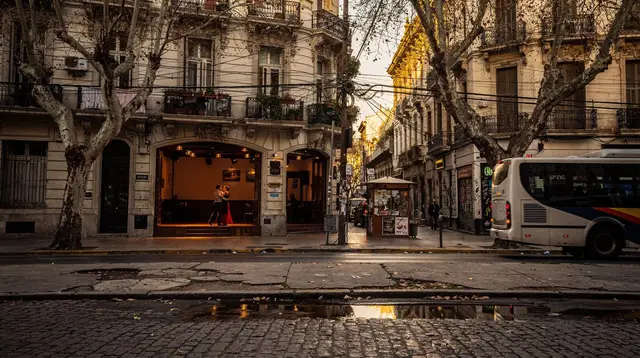
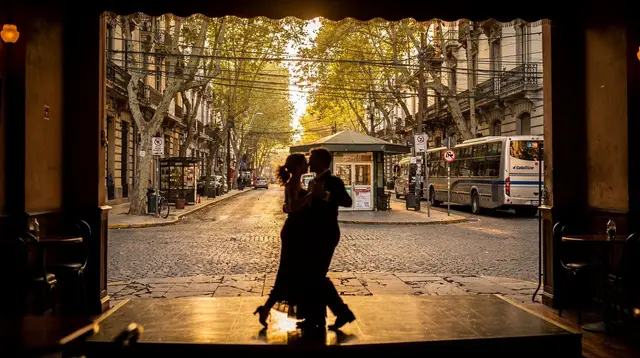
Ask a porteño where to see “real” tango and most will not point you toward a stage at all. They will name a milonga: a recurring social dance night, held in a rented hall, a converted cinema, a cultural centre, or a café back room, where ordinary people come to dance tango with each other for a few hours. There is no ticket to a seat, no choreography, no spotlight. The room itself is the show, and almost everyone in it is a participant rather than an audience member. That is both the appeal and the difficulty for a visitor: a milonga rewards attention and a little homework, and it does not perform itself for you the way a staged show does.
This guide explains what a milonga actually is, how it differs from the tourist tango show, what the unwritten codes are, and how to spend an evening in one without disrupting the room, whether you dance or not.
A Milonga Is a Dance, Not a Performance
The word “milonga” does triple duty in Buenos Aires: it names a style of music, a step pattern within tango, and — the sense that matters here — a social dance event. When someone says “there’s a milonga tonight at such-and-such club,” they mean a gathering where recorded or live tango, milonga and vals music plays in sets, and people dance with a rotating cast of partners drawn from the room.
Compare that to a tango dinner show: a seated audience, a stage, a fixed cast of professional dancers performing choreographed numbers, and a running order that ends on schedule. A milonga has none of that structure. There is no stage because the floor is shared by everyone. There is no cast because the dancers are the paying guests. There is no script because each couple improvises within the music. If you go expecting a performance to watch passively from a table, you will find the room confusing at first — the “show” is distributed across dozens of ordinary-looking pairs, some visibly skilled, some visibly still learning, moving in a shared counter-clockwise flow around the floor.
This is also why a milonga is a poor substitute for a tango show without dinner if what you actually want is a polished, photogenic performance in an hour or two. A milonga is not designed to entertain a visitor on a fixed timetable. It is a piece of ordinary social life that happens to be extraordinary to watch.
Watching Is a Legitimate Way to Experience One
You do not need to dance to have a good evening at a milonga. Many rooms have tables around the perimeter specifically for people having a drink and watching, and it is entirely normal, even among regulars, to sit out several sets in a row. A milonga for visitors that is welcoming to newcomers will usually have staff or a host who can seat you sensibly, often near other visitors or near the edge where the view of the floor is good without being in anyone’s way.
Watching well means paying attention to a few things beyond the dancing itself: the way couples form before a song starts, the pause between songs where partners often thank each other and return to their seats, and the grouping of songs into tandas — sets of three or four pieces by the same orchestra or style, followed by a short different piece, the cortina, that signals it is time to change partners. Understanding the tanda-cortina structure alone makes a milonga far more legible: what looks like an unstructured crowd is in fact organised into fifteen-minute blocks with a clear beginning and end.
If your main interest is tango as spectacle rather than as social ritual, pair a milonga visit with a proper stage performance. A Rojo Tango Show or a similar production gives you the choreography and the costumes; the milonga gives you the culture the choreography is drawn from. Seeing both, ideally on different nights, gives a fuller picture than either alone.
a staged dinner-and-tango performance at a historic Buenos Aires venue is the complementary experience to book if you want a guaranteed, seated evening of tango after visiting a milonga as an observer.
The Cabeceo: Why No One Walks Up and Asks
The single most disorienting thing for a first-time visitor is usually the invitation system. In many milongas, especially the more traditional ones, dancers do not walk across the room and ask someone to dance out loud. Instead, they use the cabeceo: eye contact held for a moment, sometimes with a small nod, exchanged from a distance, before the two people approach each other as the next tanda begins. It lets both sides invite and decline without a spoken, public request — a decline is simply not making or holding eye contact.
This has real, practical consequences for a visitor:
- Where you sit matters. Traditional milongas often seat men and women separately or in a way that makes sightlines part of the game; modern and visitor-friendly rooms are usually more relaxed about this.
- Looking around the room, rather than down at your phone, is part of participating, even if you are only watching.
- A newcomer who does not know the system can misread a lack of invitations as unfriendliness, when it is more often simply that the cabeceo takes a session or two to learn to use and to read.
None of this is meant to be exclusionary in spirit, but it can feel that way on a first visit, and it is worth knowing about in advance rather than discovering it mid-evening. Some milongas aimed specifically at tourists and beginners relax the cabeceo in practice, with more verbal, direct invitations — asking at the door or checking a room’s reputation beforehand (through a hotel concierge, a tango lesson for beginners, or a local tour) will tell you which kind of room you are walking into.
Skill Levels Vary, and Some Rooms Are Genuinely Advanced
Milongas are not uniform in atmosphere or ability. Some are aimed squarely at visitors and beginners, often paired with an introductory class beforehand and a more forgiving, patient crowd. Others are longstanding neighbourhood institutions where the average dancer has years of experience, the floor craft is dense and fast, and a hesitant beginner can genuinely disrupt the flow for everyone else.
It is worth being honest about this rather than promising an easy night: a first-timer with little or no tango experience should not expect to dance fluently, or even much at all, at a serious milonga on the first visit. That is not a failure — it is simply what the room is built for. The realistic path for someone who wants to dance, not just watch, looks something like this:
- Take one or more beginner tango lessons before or during the trip, ideally including a class that ends by walking straight into a milonga, which several venues offer.
- Choose a milonga explicitly described as beginner-friendly or visitor-oriented for a first outing, rather than the most famous or most traditional room in the city.
- Go as an observer first if dancing is not essential, and treat a second or third visit — once the tanda-cortina rhythm and the room’s cabeceo style feel familiar — as the realistic point to try dancing.
- Consider a private tango lesson if you specifically want a milonga to be a dancing success rather than a cultural observation, since one-on-one instruction closes the gap far faster than a single group class.
A single evening cannot be relied on to turn a non-dancer into a confident milonga participant, and any guide that promises otherwise is not being straight with you.
Milonga, Class, or Practica: Know Which One You’re Attending
Several related but distinct events share space in tango listings, and conflating them leads to mismatched expectations:
| Event type | What it is | Good for a visitor if… |
|---|---|---|
| Milonga | Social dance night, full tanda-cortina structure, cabeceo often in use | You want the authentic social scene, with or without dancing yourself |
| Milonga with beginner class | A milonga preceded by a group lesson, often at the same venue | You want a gentle, structured entry point before the floor opens |
| Práctica | An informal practice session, more relaxed, dancers may stop to work on technique | You already have some tango and want low-pressure floor time |
| Tango show | Staged, seated performance by professional dancers | You want a guaranteed, polished spectacle rather than a social occasion |
Reading listings carefully before choosing a venue avoids the two most common disappointments: turning up to a serious milonga expecting a show-like performance, or turning up to a beginner-oriented class night expecting the dense, traditional cabeceo scene described above.
Where Milongas Sit Within Buenos Aires’s Tango Scene
Buenos Aires holds all three forms of tango side by side, and distinguishing them is genuinely useful for planning a trip:
- Staged dinner-and-show houses — polished, scripted, aimed at visitors, and the most expensive option. See the comparison of Buenos Aires tango dinner shows for how the main venues differ.
- Milongas — real social dance nights, the subject of this guide, ranging from beginner-friendly to serious neighbourhood institutions.
- Street tango — dancers performing for tips in San Telmo and along Caminito in La Boca, casual and free to watch, but not a substitute for either of the above.
A well-rounded trip can reasonably include all three: a staged show for spectacle, a milonga for the real social culture (watched or danced), and a few minutes of street tango caught in passing while exploring San Telmo on a Sunday.
an intimate tango dinner show in a historic Recoleta mansion works well as the polished counterpart to a milonga evening, particularly for travellers who want one guaranteed spectacular night alongside a more exploratory one.
Milongas Aimed at Visitors: What to Expect
A number of milongas in Buenos Aires actively welcome tourists, often through partnerships with hotels, tango schools, or organised evenings that combine a short class, a milonga, and sometimes a simple meal. These rooms tend to be more forgiving of imperfect etiquette, more likely to use verbal rather than purely visual invitations, and more comfortable for someone attending alone. They are a sensible first stop, even for a visitor who later wants to try a more traditional room later in the trip.
Independent milongas, by contrast, are simply part of the city’s ordinary social calendar, running on their own schedule in neighbourhood clubs and cultural centres across barrios like Palermo, San Telmo, Almagro and beyond. These are not organised for tourists at all, and attending one is closer to being a respectful guest at someone else’s regular night out than to attending a show.
Either way, a few practical points apply broadly:
- Timing runs late. Milongas typically start well into the evening and build through the night, in keeping with the generally late rhythm of Buenos Aires social life — dinner itself rarely starts before nine. Exact opening and closing times vary considerably by venue and night of the week, so check the specific listing rather than assuming a fixed schedule.
- Dress code is smart-casual, not costume. Closed, comfortable shoes suitable for dancing (or simply for looking the part if you are only watching) matter more than formality; very casual sportswear or beach clothing will stand out.
- A door fee (entrada) is normal, usually modest, and a pre-milonga class, where offered, often has its own small separate charge.
- Photography etiquette matters. Milongas are social events for the people attending them, not photo backdrops; discreet, occasional photos are usually fine, but treat it as someone’s night out, not a tourist attraction with paid access to shoot freely.
A Practical First Visit, Step by Step
For a visitor who wants to attend a milonga with minimal awkwardness, a reasonable plan looks like this:
- Choose a visitor-friendly milonga for the first night, ideally one paired with a beginner class beforehand, rather than the most storied traditional room in the city.
- Arrive a little after the stated opening, since the floor typically fills gradually rather than being busy from the first minute.
- Sit somewhere you can see the floor clearly, order a drink, and spend the first tanda or two simply watching how couples form, dance, and separate.
- If dancing, wait and observe the cabeceo in action for at least one tanda before attempting to use it yourself, and do not be discouraged if the first night yields only a dance or two rather than a full evening of partners.
- Leave whenever it suits you. Unlike a staged show with a fixed running time, a milonga has no obligation to stay until closing, and slipping out between tandas, at the cortina, is the polite way to leave without interrupting a set.
Combining a Milonga With the Rest of a Tango Evening
A milonga rarely needs to be the only tango-related thing on the itinerary for a trip. A common and satisfying combination for visitors is a walking tour through San Telmo by day, a staged tango dinner show on one evening, and a milonga — attended as an observer if not as a dancer — on another. For travellers who want structure around the whole subject, an Essential Buenos Aires tour covering the historic centre and tango-associated neighbourhoods provides useful context before venturing into a milonga independently.
a guided introduction to the city’s historic centre and tango-associated barrios is a sensible way to get oriented in daylight before attempting a milonga at night, particularly for a first visit to Buenos Aires.
For travellers who prefer a single guaranteed, high-production tango evening without the social uncertainty of a milonga, the original Rojo Tango production remains the most consistently recommended option among staged shows.
a flagship staged tango dinner show at the Faena Hotel in Puerto Madero is the closest thing Buenos Aires offers to a guaranteed, no-uncertainty tango night, which pairs naturally with a more open-ended milonga visit on another evening of the same trip.
The Honest Summary
A milonga is not a tourist attraction dressed up as tango — it is tango’s actual social home in Buenos Aires, and visitors are welcome in it largely on the terms the room already runs by. Watching is enough for many evenings, and a good one rewards attention even from a table on the sidelines. Dancing is possible but should be approached as a skill built over more than one night, not a guarantee for a first visit. Go in with that expectation, choose a visitor-friendly room for the first attempt, and treat the codes — the cabeceo, the tanda-cortina structure, the late hours — as part of what makes the experience worth having, not an obstacle to complain about.
Frequently Asked Questions About Milongas in Buenos Aires
What exactly is a milonga?
A milonga is a recurring social dance event where people come to dance tango with each other, following shared floor etiquette and an invitation system based on eye contact rather than walking up and asking out loud.
Is a milonga the same as a tango show?
No. A tango show is a seated, staged performance by professional dancers, usually with dinner included. A milonga has no stage: the room itself is the dance floor, and the people dancing are the audience and the performers at once.
Can I just watch without dancing?
Yes. Most milongas welcome spectators, especially at a side table with a drink, and many attract a mix of dancers and onlookers, particularly earlier in the evening or at events aimed at visitors.
Will I be able to dance on my first night as a beginner?
Possibly a little, but do not expect fluent dancing on day one. Milongas are social spaces built around codes that take a few visits to read, and many rooms are genuinely intermediate or advanced in skill level.
What is the cabeceo?
The cabeceo is the traditional invitation by eye contact and a small nod across the room, used instead of walking over and asking aloud. Reading and using it correctly is part of what makes a milonga feel foreign to newcomers.
What should I wear to a milonga?
Smart-casual is normal and comfortable, closed shoes matter more than a specific dress code, and very casual gym wear or beach sandals will stand out at most rooms.
What time do milongas start and finish?
Milongas generally run late by international standards, often opening with a beginner class in the early evening and building through the night, with some continuing well past midnight on weekends. Exact schedules vary by venue and night, so check the specific milonga before planning around it.
Do I need to book, and is there a cover charge?
Most milongas charge a modest door fee (entrada) and do not require advance booking for entry alone, though a pre-milonga class sometimes has a separate small fee and limited space.
Tango Shows and Milongas
Verified deep-linked GetYourGuide tours. Book through these links and we earn a small commission at no cost to you.
GetYourGuide does not provide a product photo for this activity — the image shows the meeting point, photographed by us.