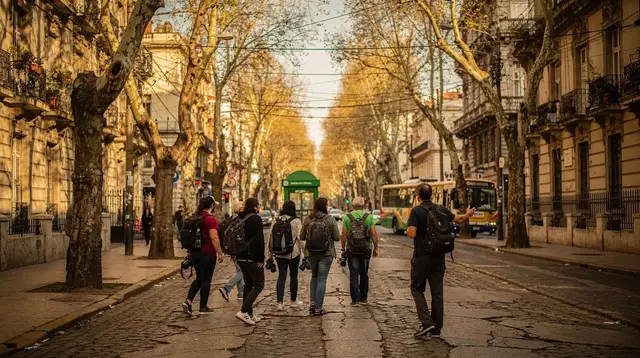
Abasto sits inland from the tourist core, a barrio most first-time visitors to Buenos Aires never plan to see and many end up liking more than they expected — not for a view or a monument, but for a story. This is where Carlos Gardel, the singer who turned tango from a disreputable dance-hall music into a national art form, spent his youth, and the barrio has organised its identity around that fact ever since. The other anchor is physical: the Mercado de Abasto, once the city’s central wholesale produce market, closed as a market decades ago and now operates as a shopping mall inside its own restored 1934 building.
Both of those facts matter for setting expectations correctly. Abasto is not a tango-show district, and it is not primarily a sightseeing barrio. It is a residential and commercial neighbourhood that happens to carry a heavyweight cultural association, expressed mainly through memorials, murals, a museum and a handful of cafés and shops that trade on the Gardel connection, plus one large building that has changed its purpose entirely while keeping its shell.
Carlos Gardel and why this barrio matters to tango
To understand why Abasto is on any tango itinerary at all, it helps to know what Carlos Gardel actually did. In the 1910s through the early 1930s he took tango — until then dance-hall music with a rough reputation — and made it something people listened to as much as danced to, through recordings, film and a stage presence that turned him into Argentina’s first true national celebrity. He died in a plane crash in Colombia in 1935 at the height of his fame, and the mythology around him has only grown since.
He grew up in Abasto, close to the old market, at a time when the barrio was full of the same working-class, immigrant energy that shaped early tango generally. That biographical fact is the entire reason Abasto appears on tango-history routes today. It is not that tango is performed here more than elsewhere in the city — it plainly is not — but that this is the streetscape a formative figure of the genre actually walked. A statue of Gardel, street murals referencing him, a Subte station named Carlos Gardel, and a small dedicated museum a short walk from the market all keep that link visible for anyone who comes looking for it.
This is worth being direct about, because it is easy for a barrio’s marketing to blur into overclaiming. Abasto does not offer the density of milongas, street performers and dinner-show venues that San Telmo does, and it should not be sold to a visitor as an equivalent tango destination. What it offers instead is context: the place, not the performance. A walking tour that follows Gardel’s own history through the barrio is a genuinely good way to spend an hour or two if the music itself interests you; turning up expecting a nightly show scene on the same footing as San Telmo will disappoint.
The Mercado de Abasto, then and now
The building that gives the barrio its name opened in 1934 as the Mercado de Abasto, Buenos Aires’s central wholesale market for fruit, vegetables and general produce — the word abasto itself means “supply” or “provisioning.” It was, in its working decades, one of the largest markets of its kind in South America, and its Art Deco design and scale made it a landmark independent of what was sold inside.
The market closed in the 1980s as the city’s food-distribution logic shifted to the outskirts, and the building sat mostly empty for years before being redeveloped in the 1990s as a large shopping mall, reopening under the same Mercado de Abasto name. The Art Deco facade and much of the original structural shell were preserved; the interior is now a conventional mall with a wide mix of shops, a food court, multiple cinema screens, and — a detail families appreciate — a small children’s museum and play area inside the complex.
For a visitor, the honest way to think about this building is as two layers stacked on top of each other: a striking piece of 1930s civic architecture, worth a look from outside and a walk through even if shopping is not the goal, and an entirely ordinary contemporary mall once you are inside it. It photographs well, particularly the facade, and it is a useful landmark for orienting yourself in the barrio, but it is not a museum piece — treat a stop here as a half-hour to an hour, not a full outing.
What else is actually in the barrio
Outside the market building, Abasto is a working residential and commercial barrio rather than a curated tourist circuit, and that is part of its appeal for visitors who have already covered the obvious stops elsewhere in the city. A short list of what is genuinely there:
| What | What it actually is |
|---|---|
| Mercado de Abasto | Restored 1934 market building, now a shopping mall with cinema and food court |
| Gardel statue and murals | Street-level tributes near the market and Carlos Gardel Subte station |
| Museo Casa Carlos Gardel | Small house-museum near the barrio, dedicated to his life and career |
| Carlos Gardel Subte station | Line B stop with tango-themed decoration, named for him |
| Neighbourhood cafés | A handful of long-running cafés with Gardel-era or tango branding |
| Surrounding streets | Ordinary residential blocks, useful for a sense of everyday porteño life |
None of these individually justifies a long detour, but together, on a quiet afternoon, they make a coherent short visit for anyone who wants to see tango’s roots rather than its performance. If you are choosing between spending an extra two hours in Recoleta or coming out to Abasto, the honest answer depends on what you are chasing: monumental architecture and the Recoleta Cemetery, or the biography behind the music.
How Abasto compares with San Telmo
This comparison comes up constantly, and it is worth being precise about, because the two barrios get lumped together as “the tango neighbourhoods” when they serve different purposes.
San Telmo is where tango is visible in daily life: street dancers performing for tips around Plaza Dorrego, a dense concentration of milongas — the real social dance halls where locals and visitors alike go to dance — and a cluster of dinner-and-show venues aimed squarely at tourists. It is also the city’s antiques barrio, with a Sunday street fair that draws large crowds. If you want to watch tango danced, in almost any of its forms, San Telmo (along with a handful of dedicated venues in Microcentro and La Boca) is where that happens.
Abasto is quieter and more residential and commercial. Its relationship to tango is historical and biographical rather than performative: this is where a formative figure lived, not where the dance is staged nightly. A visitor who arrives in Abasto expecting a San Telmo–style concentration of shows and street performance will be looking in the wrong place. A visitor who arrives wanting to understand where Gardel came from, and to see a genuinely local, non-touristy stretch of the city along the way, will find exactly what the barrio promises.
Practically, this means: if tango performance is the priority, plan your evening around a show or a milonga in San Telmo or a dedicated venue, and treat Abasto as a separate, shorter, daytime visit focused on history and the market building — not as a substitute for the other.
Getting there and planning your visit
Abasto sits a short distance inland from the Microcentro, reachable by Subte Line B to the Carlos Gardel station, about 15 to 20 minutes from central stops, followed by a brief walk. Taxis and ride-hailing apps cover the same distance quickly outside peak traffic hours. The SUBE card required across the city’s public transport applies here as everywhere — buy or top it up before boarding if you have not already.
A visit works best as a few hours rather than a full day: the market building’s exterior and interior, the Gardel statue and nearby murals, and the small dedicated museum if tango history particularly interests you. Pairing it with a nearby barrio on the same day is the efficient approach — Recoleta or Palermo both sit within a reasonable taxi ride, and a half-day city tour that includes Abasto as one stop among several is a sensible way to see it without dedicating an entire day to a single barrio.
For the tango performance itself, book separately and elsewhere. A polished dinner-and-show evening such as the Rojo Tango show, a well-regarded dinner-and-performance evening gives a full theatrical staging of tango’s history and drama, while an immersive tango show built around a more intimate, close-up staging suits travellers who want less spectacle and more atmosphere. Either pairs naturally with an afternoon spent in Abasto on the same trip: history in daylight, performance after dark.
If Abasto is one stop within a broader first visit to the city, a structured multi-day option such as a four-day guided programme covering the city’s main highlights can fold a Gardel-focused stop into a wider itinerary without requiring you to plan the logistics barrio by barrio. For travellers building their own route instead, a self-guided walking tour tracing Gardel’s Abasto is the more flexible option, and can be combined with a stop at the Mercado de San Telmo or a Palermo food tour later the same day.
Beyond Abasto: day trips worth knowing about
Abasto’s appeal is narrow and historical, which makes it a good candidate to pair with something larger rather than build a whole day around. Travellers with time beyond the city itself have several credible options within reach. A short excursion to La Plata, the planned provincial capital with its very large neo-Gothic cathedral, makes a full but manageable day trip from the centre.
Further out, a day trip across the river to Montevideo is possible but tight; a guided Montevideo excursion with lunch and the return ferry included removes the logistics of an international border crossing for a single day out. None of these connect directly to Abasto itself, but they illustrate the range available once the city-centre barrios, Abasto included, have been covered.
Abasto FAQ: Carlos Gardel, the old market and what to actually expect
Is Abasto a good place to see a tango show?
Not really. Abasto is where tango’s history lives, above all through Carlos Gardel, but the barrio’s own tango-show and milonga scene is thin compared with San Telmo or the dedicated dinner-show venues elsewhere in the city. Book a show through a venue in a district built for it, then come to Abasto for the story behind the music.
What is the Mercado de Abasto today?
It is a large shopping mall inside the restored 1934 Art Deco building that was once Buenos Aires’s main wholesale produce market. The market hall’s structure and facade survive; inside are shops, a cinema, a food court and, for children, a small museum and play area.
Who was Carlos Gardel and why is he linked to Abasto?
Carlos Gardel was the singer and composer who, more than any other figure, defined tango as a sung, popular art form in the 1920s and 1930s. He grew up in Abasto, and the barrio still trades on that association — street murals, a statue, a museum dedicated to him, and stations and cafés that carry his name.
How is Abasto different from San Telmo for tango?
San Telmo has street tango performed for tips, tourist-facing milongas, and a dense antiques-and-café tourist circuit that puts tango in plain sight. Abasto is quieter and more residential and commercial, with tango present in memorials and museum displays rather than in nightly performance. Go to San Telmo to watch tango; go to Abasto to understand where it came from.
Is Abasto safe to walk around?
The immediate area around the mall, the Gardel museum and the Once/Abasto Subte stations is generally fine to walk in daylight with normal city caution. As in most of central Buenos Aires, keep phones and bags out of easy reach and be more careful after dark, particularly near Once station a few blocks away.
How do I get to Abasto from the centre?
The simplest route is Subte Line B to Carlos Gardel station, about 15–20 minutes from Microcentro stops, followed by a short walk. Taxis and ride-hailing apps also cover the distance quickly outside rush hour.
Is a visit to Abasto worth the time?
For most itineraries, a few hours is enough: the market-mall building, a coffee at a Gardel-themed café, and the small museum if tango history interests you. It is a reasonable half-day add-on rather than a headline stop, and works well paired with Palermo or Recoleta on the same day.