Tango Lessons for Beginners in Buenos Aires
Can a beginner really learn tango in one lesson in Buenos Aires?
One lesson teaches the basic walk, an open embrace and one or two simple figures — enough to feel the dance, not enough to lead or follow confidently at a milonga. Real competence takes several weeks of regular classes, which is why serious learners book a short course rather than a single drop-in session.
Buenos Aires sells tango constantly — on flyers outside restaurants, in hotel lobbies, on every second street corner in San Telmo. Somewhere in that noise is a genuine, structured way to learn the dance as a complete beginner, and it looks nothing like the show posters. This page is about that: what a first class actually covers, what you’ll be able to do afterwards, and why one hour is a taste, not a transformation.
What a first tango lesson actually covers
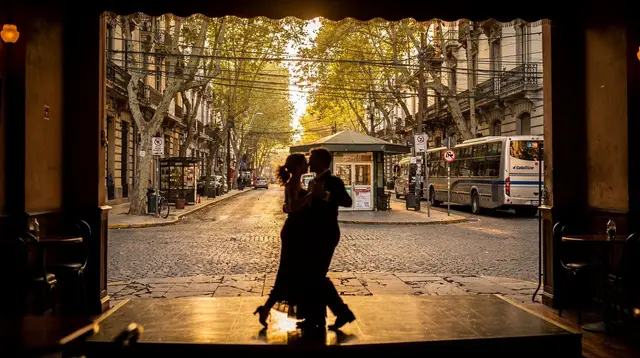
A beginner class in Buenos Aires almost always starts in the same place, because tango itself starts in the same place: posture and the embrace. You’ll be shown how to hold a partner — usually an open embrace for beginners, arms visible, some space between chests, rather than the close embrace seen in milongas among experienced dancers. From there the class moves to the walk: tango has no fixed step sequence at its core, it’s built from walking to the music with intention, weight fully transferred from one foot to the other before the next step begins. Teachers spend real time on this because it’s the single skill that everything else depends on.
After the walk, a typical hour-long class adds one or two simple figures — commonly the ocho (a pivoting figure that traces a figure-eight with the feet) or a basic turn around the leading partner. Classes rotate partners every few minutes, which is standard practice and not awkward in context: everyone in the room is there to learn, and rotating means you get to feel the same figure led or followed by several different bodies, which is closer to what real social dancing demands than practising with one fixed partner.
A few operators frame the lesson as preparation for the evening, folding it into a group class at La Ventana that runs before dinner and a show, so a first-timer gets a supervised introduction to the steps before watching professionals perform the same vocabulary at full speed.
The realistic level after one lesson
Be honest with yourself about what one lesson buys you. You will leave able to recognise the embrace, take a basic walk with some sense of the beat, and possibly execute a simplified ocho or turn when a patient, familiar partner leads you through it slowly. You will not leave able to walk into a milonga and dance confidently with a stranger.
That gap is not a failure of the class or the teacher — it’s the nature of a partner dance built on improvisation rather than fixed choreography. Tango has no set routine to memorise and repeat; it’s a constant, in-the-moment negotiation between two people moving to music that changes tempo and mood from one track to the next. A single class gives you the vocabulary’s first few words, not the ability to hold a conversation.
This matters because plenty of marketing around Buenos Aires tango implies the opposite — that an evening class plus a show adds up to “learning to tango” in any meaningful sense. It doesn’t, and no honest teacher will claim it does. What it does deliver, reliably, is a genuine physical sense of how the dance works, which makes watching a show afterwards more interesting, and gives you a informed basis to decide whether to go further.
One lesson vs. a real beginner course
The difference between a single drop-in class and structured learning is really a difference in what you’re buying.
| Single drop-in lesson | Multi-week beginner course | Private lessons | |
|---|---|---|---|
| Typical length | 45–60 minutes | 4–8 weekly sessions | 1 hour per session, flexible schedule |
| Group size | Often large, rotating partners | Smaller, same group over weeks | One-on-one or couple |
| What you learn | Embrace, walk, one figure | Walk, several figures, floor navigation, musicality | Whatever you need, at your pace |
| Realistic outcome | A taste of the mechanics | Enough to dance simply at a beginner-friendly milonga | Fastest correction of individual habits |
| Best suited to | A short visit, curiosity, pairing with a show | Anyone staying weeks or committing to the dance | Couples, tight schedules, specific goals |
| Typical setting in Buenos Aires | Attached to a dinner show or tourist package | Dedicated dance schools (academias) | Private studios or a teacher’s own space |
For most visitors on a standard trip, the single lesson is the honest choice — it fits the schedule and sets expectations correctly. Anyone staying in the city for several weeks, or genuinely drawn to the dance rather than the spectacle, gets far more out of committing to a course at a dedicated school, ideally followed by attending a milonga’s early hours, when the floor is quieter and more forgiving of beginners.
If your schedule is short and you want faster, more personal correction than a group setting allows, a private masterclass built specifically for first-timers compresses a lot of that individual feedback into a single booked session, which suits couples travelling together or anyone with a specific event — a milonga, a show, an anniversary dinner — they want to be slightly more prepared for.
Different formats of beginner class
Not every beginner lesson looks the same, and the format matters as much as the content. A relaxed group class served with mate and snacks treats the lesson as much as a social icebreaker as a dance class — useful for solo travellers who want the evening to feel less like a formal lesson and more like a shared activity with other beginners in the room.
At the other end, a class held inside a working dance hall like El Beso gives a first-timer a small taste of what a real milonga venue feels like before the room fills with experienced dancers later in the night — useful context, since the venue itself is part of what a beginner is usually curious about.
For anyone whose evening is built around dinner rather than a stand-alone class, a dinner-show-and-lesson format folds the beginner instruction into the same evening as the meal and the performance, so there’s one booking and one venue rather than three separate stops across the city. None of these formats teaches materially different content — walk, embrace, a figure or two — but they change the atmosphere considerably, and picking the one that matches your energy for the evening matters more than most people expect going in.
Live music changes the feel of a class too. Where it’s on offer, a lesson accompanied by a live bandoneón — the accordion-like instrument that defines tango’s sound — replaces recorded tracks with a musician playing in the room, which makes the connection between the steps you’re learning and the music itself far more direct than practising to a speaker.
What a lesson is not: shows and milongas
It’s worth being precise about what a beginner class is not, because the three things get blurred in a lot of tourist marketing.
A tango show — including the polished, theatrical kind such as the Rojo Tango dinner show — is a seated performance by professional dancers. You watch, you don’t participate, and nothing you learn there is a skill you take away, beyond an appreciation for what the dance looks like at its most refined. It’s a different evening entirely from a lesson, even when the two are sold together as a package.
A milonga is a real social dance hall — the place where people who already know how to dance go to dance with each other, following unwritten but strict etiquette: the counter-clockwise line of dance around the floor, and the cabeceo, an invitation made across the room by eye contact and a small nod rather than walking up and asking aloud.
Milongas often start with a class before the social dancing begins, and that beginner-friendly opening slot is the best on-ramp for a newcomer — but the milonga itself, once the social dancing starts, is not a lesson and moves too fast for someone who took a single class the week before. For a fuller picture of how milongas work and how to behave at one as a visitor, see the dedicated guide on that subject rather than treating this page as milonga advice.
For understanding tango’s history and cultural roots — how it emerged from immigrant Buenos Aires, its links to the barrios and the golden age of the 1940s — that’s a separate, non-participatory subject covered by a walking tour built around the story rather than the steps. If what you actually want is context and history rather than a physical skill, that’s a better fit than a dance class.
Practical basics for a first class
What to wear. Flat shoes or low heels with a smooth sole are the standard advice — trainers with heavy rubber grip make pivots harder and are the main reason beginners feel clumsy in their first hour. Clothes should allow a full, uninhibited stride; nothing tight around the knees. Anyone who decides to continue past a first class typically buys dedicated tango shoes later, but there’s no need to invest before knowing if you’ll come back.
Do you need a partner? No. Group beginner classes are built for solo arrivals of all levels and rotate partners deliberately, so arriving alone is completely normal and, if anything, more typical than arriving as a couple.
Where lessons happen. Central Buenos Aires — particularly San Telmo, Palermo and parts of Recoleta — has the highest concentration of both tourist-oriented classes attached to shows and dedicated dance schools (academias) running serious multi-week courses. Both exist side by side; the difference is in how the class is marketed and structured, not the neighbourhood.
Language. Most beginner classes aimed at visitors run in English or bilingually, with instructions demonstrated physically enough that language is rarely a real barrier — tango teaching leans heavily on showing, not explaining.
How much time to set aside. A single class runs 45 minutes to an hour. If it’s bundled with a show, as many tourist packages are, budget a full evening: class, then dinner, then the performance.
Booking ahead vs. showing up. Tourist-oriented classes attached to a dinner or show almost always require booking in advance, since the operator needs to plan seating and instructor numbers around a fixed group size. Classes run purely at a dance school (an academia) are sometimes more flexible about drop-ins, but arriving without checking the schedule risks finding the class already full or not running that evening — worth confirming rather than assuming.
Group size and what it changes. A class of six or eight people behaves very differently from one of thirty. Smaller groups mean more individual correction and more repetitions with each rotating partner; larger groups, more common in packages bundled with a show, move faster through the material and rely more on watching the demonstration than on personal feedback. Neither is wrong, but it’s worth knowing which you’re booking, since it changes how much you’ll actually retain by the end of the hour.
Extending the evening beyond the lesson
A beginner class rarely stands entirely alone in a visitor’s schedule — it’s usually one piece of a longer evening or a longer stay. If the lesson is the start of a night that continues into an actual milonga, going in with a lesson-then-milonga format that includes guided time on the social floor with professional dancers on hand is a gentler bridge than walking into an unfamiliar milonga cold straight after a single class — someone experienced is there to help you actually use what you just learned, rather than leaving you to find a partner and navigate the floor etiquette alone.
Anyone treating the trip as a deeper introduction to the dance, rather than a one-off evening, should also revisit how the city’s milongas actually work day to day, since the etiquette and rhythm of a real social dance floor is a separate skill from anything taught in a beginner class. And for travellers based in Palermo, where a large share of both tourist classes and dedicated dance schools cluster, the neighbourhood’s nightlife scene more broadly is worth knowing, since a tango evening there often sits alongside dinner and drinks options within a short walk.
Setting expectations before you book
The honest pitch for a beginner tango lesson in Buenos Aires is this: it’s a genuine, hands-on introduction to how the dance actually works, taught by people who know it properly, and it will leave you with real physical understanding of the walk and the embrace. It will not leave you able to dance tango. If you’re after a memorable one-off experience that deepens an evening built around a show or a city tour, a single class delivers exactly that. If you’re drawn to the dance itself, treat the first lesson as the opening move, not the whole game, and look at a multi-week course or a run of private lessons instead. Either way, walking in with the right expectation is what makes the hour worthwhile rather than a mild disappointment.
Pairing a first tango lesson with a broader look at the city works well for a short stay — the Essential Buenos Aires tour covers the historic centre earlier in the day, leaving the evening free for the class and, if you choose, a show afterwards.
Before booking, it’s worth reading how tango shows compare to milongas if you’re still deciding what kind of tango evening you actually want, and the comparison of dinner-and-show formats if a lesson is going to be part of a longer evening out. For the cultural and historical side of the dance rather than the physical one, the tango history walking tour fills that gap well, and milongas for visitors explains how to behave once you’re ready to actually use what you’ve learned socially.
Neighbourhood-specific options are worth knowing too: classes and shows cluster in San Telmo, La Boca and Recoleta, each with a slightly different character. If cost is the deciding factor, the budget tango show options and the luxury end of the spectrum frame the full price range, and a show with transfer included removes the logistics for anyone staying further out.
For a lesson with no crowd and full attention, private tango lessons is the dedicated page on that option, and for a no-frills evening focused purely on the performance, see tango show, no dinner. Historic Café Tortoni, one of the city’s oldest cafés, also runs its own tango evenings — covered separately in the Café Tortoni tango show guide — and the café itself is worth knowing on its own terms via the Café Tortoni guide.
If your evening in Palermo also needs a place to eat well beforehand, the best parrillas in Palermo is a reliable companion page, and anyone staying in San Telmo for the antique fair by day and a class by night should also look at the San Telmo neighbourhood guide for orientation.
Tango Shows and Milongas
Verified deep-linked GetYourGuide tours. Book through these links and we earn a small commission at no cost to you.
GetYourGuide does not provide a product photo for this activity — the image shows the meeting point, photographed by us.