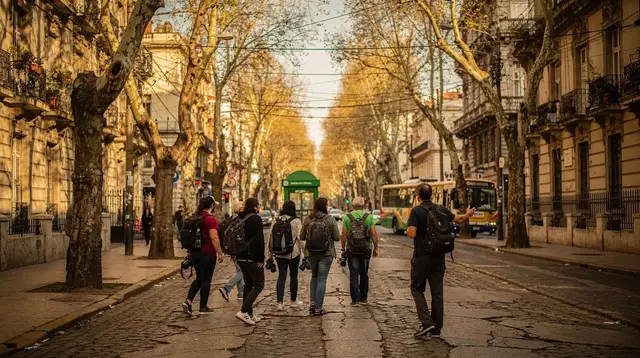
Recoleta City Tour: A Neighbourhood Guide Beyond the Cemetery
What does a Recoleta city tour actually cover?
A Recoleta-only tour stays inside one barrio: the cemetery, the Basílica del Pilar, the belle-époque mansions around Alvear and Quintana, El Ateneo Grand Splendid, and Recoleta's cafés and squares. It is a half-day walk, not a citywide loop through La Boca or San Telmo.
One Barrio, Not a Whole City
Most “Buenos Aires city tour” itineraries try to cover four or five barrios in a single loop: the Microcentro, La Boca, San Telmo, sometimes Palermo. A Recoleta city tour is a different, more focused format. It stays inside one district — Recoleta — and gives it the time a citywide loop never can. That means the cemetery, yes, but also the streets around it: the Belle Époque apartment blocks along Avenida Alvear, the French-inspired mansions repurposed as embassies and cultural centres, the shaded plazas, the bookshop inside an old theatre, and the café terraces where porteños linger over coffee on a Sunday.
It is worth saying plainly what a lot of marketing copy blurs: Recoleta is not only its cemetery. The Recoleta Cemetery is the barrio’s best-known landmark and deserves real time, but reducing a Recoleta visit to an hour inside its walls skips a neighbourhood with its own architectural identity, its own shopping streets, and its own rhythm of daily life. This guide treats Recoleta as a place to walk, not just a monument to tick off.
Who This Format Suits
A single-barrio Recoleta tour suits a few kinds of traveller in particular. First-time visitors staying near Palermo or the Microcentro who want a half-day that does not eat the whole day. Architecture and design-minded travellers who want to slow down rather than skim five districts. Anyone travelling with family members who tire on long multi-stop days — a barrio-scale walk is easier to pace, with cafés and benches never far away. And it works well as one component slotted into a longer stay, paired later with a separate day in San Telmo or Palermo rather than compressed into the same afternoon.
It suits less well the traveller with only one full day in Buenos Aires who wants a broad first impression of the whole city — for that, a multi-district half-day city tour or a full-day tour covering the Microcentro, La Boca and Recoleta together is the more efficient format, even though each stop gets less time.
How a Recoleta-Only Route Typically Runs
A sensible route starts at or near Plaza Francia, moves through the cemetery, crosses to the Basílica Nuestra Señora del Pilar next door, then works outward through the surrounding streets before finishing near Avenida Santa Fe.
| Stop | What it covers | Typical time |
|---|---|---|
| Plaza Francia & surrounding squares | Orientation, weekend crafts fair if in season | 15–20 min |
| Recoleta Cemetery | Mausoleums, Duarte family vault, notable tombs | 45–60 min |
| Basílica del Pilar | Colonial-era church beside the cemetery gate | 15–20 min |
| Avenida Alvear & Quintana | Belle Époque mansions, embassies, boutiques | 30–40 min |
| El Ateneo Grand Splendid | Converted 1919 theatre, now a bookshop | 15–30 min |
| Café stop | Recoleta’s classic café culture | 20–30 min |
Add it up and a comfortable, unrushed version runs two and a half to four hours depending on how much time is spent inside the cemetery and how many café or shopping detours are made along the way. That is longer than a cemetery-only visit and shorter than a citywide loop — which is the point.
The Cemetery, Properly Framed
Recoleta Cemetery is a walled city of mausoleums sitting in the middle of one of the city’s wealthiest barrios, and it is genuinely worth the 45 minutes to an hour a careful visit takes. Entry is ticketed for non-residents, and both the price and the opening hours have changed more than once in recent years, so check current figures rather than relying on an old number. A guided visit usually folds this ticket into the tour price, which is one of the practical reasons travellers book a guide here rather than turning up alone.
Eva Perón — “Evita” — is buried here, in the Duarte family vault, not in a monument built for her alone and not in the Chacarita cemetery, where some visitors mistakenly expect to find her. The vault is modest enough that it is easy to walk past without a guide or clear signage; staff and posted maps point the way, and most guided walks make a point of stopping there.
Beyond Evita, the cemetery rewards slower looking: statuary in marble and bronze, family crypts built by the same architects who designed the mansions outside the walls, and a layout dense enough that a first pass without a map or guide tends to feel like wandering rather than seeing.
What Lies Outside the Walls
This is the part a cemetery-only stop skips entirely. Recoleta’s streets carry the same architectural ambition as the cemetery’s monuments — the barrio was built by and for the city’s elite from the late nineteenth century onward, and it shows. Avenida Alvear and the streets around Plaza Francia and Plaza de Mayo-era civic buildings are lined with mansard roofs, wrought-iron balconies and stone façades that would not look out of place in a European capital — which is exactly the comparison locals themselves reach for.
El Ateneo Grand Splendid, a short walk away on Avenida Santa Fe, is a bookshop set inside a converted 1919 theatre — the stage is now a café, the boxes hold reading nooks, and the ceiling fresco remains intact overhead. Entry is free and the visit is genuinely brief, 15 to 30 minutes for most travellers, but it is one of the most photographed interiors in the city and worth building into a Recoleta route rather than treating as an afterthought.
The barrio’s commercial streets add a third layer: boutiques, design shops, and café terraces where a mid-morning or late-afternoon coffee is as much a part of the Recoleta experience as anything behind the cemetery’s gates. A route that only stops at the cemetery and the basilica misses this entirely — which is why a proper Recoleta city tour builds in time to simply walk the surrounding blocks.
Guided, Self-Guided or Private
There are real trade-offs between formats here, and which one suits depends on time and budget.
A guided group tour bundles the cemetery ticket, historical context on who is buried where and why, and a fixed, efficient route — useful for travellers who want the Duarte vault pointed out rather than searched for. A skip-the-line Recoleta walking tour is built around exactly this: entry sorted in advance and a guide who knows the cemetery’s layout.
A self-guided walk costs nothing beyond the entrance ticket and suits travellers who prefer their own pace, though first-timers often find the cemetery’s internal layout genuinely disorienting without a map or guide.
A private tour suits families, photographers or anyone wanting a slower pace or a route adjusted on the spot — starting later to avoid the morning cemetery crowds, for instance, or spending longer on the architecture than the tombs. A private tour covering Recoleta alongside other barrios is one option if a single-neighbourhood format still leaves time in the day.
For travellers whose main interest is the barrio’s architecture rather than the cemetery specifically, a tour built around Recoleta’s classical architecture and photogenic corners reframes the same streets around the mansions and façades rather than the tombs. And for a slightly different narrative thread — Recoleta read as Buenos Aires’s answer to Paris — a tour framed around Recoleta as “Little Paris” leans into the Belle Époque comparison that gives the barrio its nickname.
Recoleta Versus a Multi-Barrio City Tour
It helps to be explicit about what a Recoleta-only tour is not. A multi-district tour such as one linking Recoleta with La Boca and San Telmo, or one adding the Obelisco into the same day, covers more ground and gives a broader first impression of the city — but each stop gets compressed, often to 30–45 minutes, with transit time between barrios eating into the total. A Recoleta-only format trades that breadth for depth: more time inside the cemetery, more time on the architecture, and room to sit down for a coffee without the itinerary running late.
Neither format is objectively better — they answer different questions. “What does Buenos Aires look like overall?” points toward a multi-barrio tour. “What is Recoleta actually like, beyond the postcard shot of the cemetery gates?” points toward the format this guide describes.
When to Go
Recoleta works at almost any time of year given Buenos Aires’s inverted, southern-hemisphere seasons — summer runs December to February, winter June to August — but a few practical notes matter for this specific barrio. The cemetery has no shade to speak of inside its walls, so a midday visit in January or February can be uncomfortably hot; late morning or late afternoon is more comfortable. Spring, from late October into November, brings the city’s jacaranda trees into purple bloom, and Recoleta’s tree-lined streets are among the better places in the city to see it. Weekends bring a crafts and antiques fair to the squares around the cemetery, adding a market atmosphere that is absent on weekdays.
Getting There and Getting Around
Recoleta sits north of the Microcentro and east of Palermo, and it is not directly served by a Subte line — the nearest stations (on Line D and Line H) are a walk or a short bus ride from the cemetery itself, which is one reason many visitors arrive by taxi, ride-hailing app or colectivo bus rather than the metro. From most central hotels it is a manageable taxi ride of 10–20 minutes depending on traffic; from Palermo, a short bus or a 20–30 minute walk through Palermo Chico is a pleasant approach on a cool day.
Within the barrio itself, everything described in this guide sits inside a compact, comfortably walkable area — the whole loop from Plaza Francia to El Ateneo covers well under two kilometres on foot.
A Recoleta Frequently Asked Questions
Is a Recoleta city tour the same as a Recoleta Cemetery tour?
No. A cemetery tour is one stop lasting roughly an hour. A Recoleta city tour includes the cemetery plus the surrounding streets, mansions, the basilica, cafés and El Ateneo — usually half a day.
How long does a Recoleta city tour take?
Budget two and a half to four hours on foot for the full neighbourhood, including 45–60 minutes inside the cemetery. A guided version with a fixed group typically runs closer to two and a half hours.
Do I need a ticket for Recoleta Cemetery?
Entry is ticketed for non-residents; the price and hours have changed more than once, so check the current figures before you go. A guided tour usually bundles this ticket into the price.
Is Recoleta worth visiting if I don’t care about cemeteries?
Yes. Recoleta is one of the city’s wealthiest, most architecturally consistent barrios, with Belle Époque mansions, boutique shopping streets, and El Ateneo bookshop — all independent of the cemetery.
Can I combine Recoleta with Palermo or San Telmo in one day?
You can, but it changes the format: a Recoleta-only tour is a neighbourhood walk on foot, while combining barrios turns it into a citywide tour that usually adds transport and cuts time in each place.
Where is Eva Perón buried in Recoleta Cemetery?
In the Duarte family vault, not in a monument of her own. It is modest and easy to miss; look for the small crowd or ask cemetery staff, who point visitors toward it routinely.
What is El Ateneo Grand Splendid and is it near the cemetery?
It is a bookshop inside a converted 1919 theatre on Avenida Santa Fe, a short walk from the cemetery entrance. Entry is free and a visit is brief — 15 to 30 minutes is typical.
Is Recoleta safe to walk around?
Yes, it is one of the city’s more orderly barrios by day. Ordinary city caution applies — keep phones and bags in view, particularly around busy café terraces and bus stops.
Buenos Aires and San Telmo City Tours
Verified deep-linked GetYourGuide tours. Book through these links and we earn a small commission at no cost to you.
GetYourGuide does not provide a product photo for this activity — the image shows the meeting point, photographed by us.