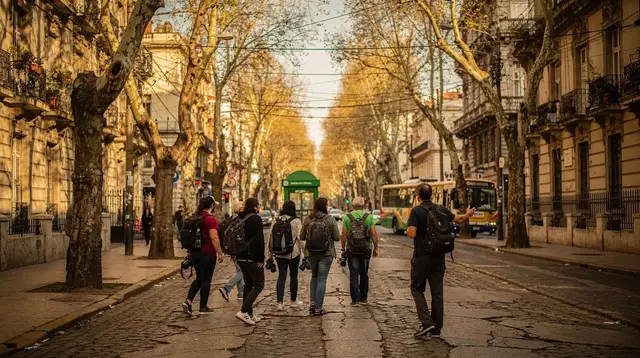
Buenos Aires Accessible Travel Guide
Is Buenos Aires accessible for wheelchair users and people with reduced mobility?
Only partially. Pavements are frequently cracked or narrow, and the historic Subte network has many stations without lifts, so most visitors with reduced mobility rely on accessible colectivos, taxis and ride-hailing apps rather than the metro alone. Newer stations, main avenues and Puerto Madero are noticeably easier than San Telmo's cobbles or the older Subte lines.
The honest picture
Buenos Aires is a rewarding city for a visitor with reduced mobility, but it is not a uniformly accessible one, and no guide does anyone a favour by pretending otherwise. The city’s charm is largely built on a nineteenth- and early twentieth-century street plan: narrow original pavements, decorative but uneven tiling, mature trees whose roots have lifted the stone over a century, and a metro system whose oldest line opened in 1913. All of that is exactly what makes the city beautiful to walk through, and exactly what makes parts of it genuinely difficult to navigate with a wheelchair, a walking frame, or a mobility condition that makes stairs and long distances hard.
This guide sets out, barrio by barrio and mode by mode, what actually works, what is a real obstacle, and how most visitors with reduced mobility get around in practice: not by relying on the historic core of the Subte alone, but by combining short planned walks on the better streets with accessible colectivos, taxis and ride-hailing apps for the rest.
Pavements: the single biggest variable
Pavement quality in Buenos Aires changes block by block, and it is the factor that shapes an accessible itinerary more than any single attraction does.
- Puerto Madero has the best pavements in the city by a wide margin: wide, flat, purpose-built promenades along the old docks, with ramps rather than steps at level changes. It is the one district where a wheelchair user or someone with a walking frame can cover real distance without constant obstacles.
- Recoleta and Palermo’s main avenues (Avenida del Libertador, Avenida Santa Fe, the broad streets around the Bosques de Palermo) are generally wide and in reasonable repair, though tree roots and the odd broken tile still turn up.
- The Microcentro and Plaza de Mayo area mixes wide official routes with narrower side streets; the main square and the approach to the Casa Rosada are manageable, but side streets nearby can be crowded and uneven.
- San Telmo is the hardest central barrio: much of it is genuine cobblestone, with narrow, historic pavements and few consistent kerb cuts. It is worth visiting for its architecture and its Sunday fair, but it rewards a short, deliberate route rather than a long unplanned wander.
- La Boca, and Caminito itself, has a mixed pedestrian surface within the tourist strip and rougher streets immediately around it; this is also an area where the general safety advice is to stay on the marked tourist route in daylight, which happens to be the better-paved one too.
Kerb cuts (rebajes de vereda) exist widely in newer developments but are inconsistent or missing in older barrios, and even where they exist they are sometimes blocked by parked cars or street vendors. None of this makes Buenos Aires impassable — but it means routes need to be planned rather than improvised.
The Subte: partial accessibility, not full accessibility
The Subte, Buenos Aires’s six-line metro (A to E, plus H), is over a century old on its oldest line and was not built with step-free access in mind. Accessibility has improved over the years, with lifts and ramps added at a growing number of stations, particularly newer stations on Line H and some renovated interchanges, but a large share of the network, especially older central stretches of Lines A, B, C, D and E, remains stairs-only.
This matters in practice: a visitor with a wheelchair or a significant mobility limitation should never assume a Subte journey is step-free by default. Before travelling, check the specific pair of stations for the day’s route, because a line can be accessible at one end and not the other. The SUBE card itself, required for all fares, works the same way regardless of a station’s physical accessibility — it solves payment, not stairs.
Given this, most visitors with reduced mobility treat the Subte as a useful option on a case-by-case basis rather than a default, and plan around it with:
| Mode | Typical accessibility | Best for |
|---|---|---|
| Subte | Uneven — some stations step-free, many stairs-only | Short single-line hops where both stations are confirmed accessible |
| Accessible colectivos | Growing share of low-floor buses | Longer surface routes, flexible stops |
| Taxis | Plentiful, standard vehicles | Door-to-door, short notice |
| Ride-hailing apps | Plentiful, standard vehicles | Door-to-door, fare shown in advance |
| Specialist adapted vehicles | Limited fleet, book ahead | Wheelchair users needing a ramp or lift vehicle |
| Walking on planned routes | Depends entirely on barrio | Puerto Madero, main avenues, short stretches |
Colectivos, taxis and ride-hailing: the practical backbone
The city’s colectivo bus network has been gradually renewing its fleet with low-floor, kneeling buses, and an increasing share of routes now run at least some accessible vehicles, though it is not yet universal across every line. For a visitor without a fixed route requirement, colectivos plus taxis, remises and ride-hailing apps together form the most dependable way to get around: doors close to kerb level, no stairs, and drivers used to picking up and dropping off at a specific address rather than a station entrance.
Standard taxis and ride-hailing cars are abundant and inexpensive by international standards, which makes door-to-door transport a realistic default rather than an occasional splurge. The caveat is that vehicles specifically adapted for wheelchairs — with a ramp or lift and space to travel without transferring — are a small minority of the fleet. Travellers who need one should arrange specialist adapted transport in advance through a local operator or their accommodation, rather than expecting to hail one on the street.
Between the two city airports, both Ezeiza (EZE) and Aeroparque (AEP) offer wheelchair assistance and generally reliable accessible facilities; requesting assistance through the airline ahead of the flight is the standard and most reliable route. The difference between the two airports matters for accessibility mainly in transfer time and distance, not in the level of on-site assistance offered.
Neighbourhood by neighbourhood
Puerto Madero is the easiest district in the city: flat, wide, step-free promenades along the old docks, modern buildings with lifts, and the Costanera Sur Ecological Reserve next door has a mostly flat, if occasionally uneven, gravel and dirt circuit — manageable for many but not fully paved.
Palermo, especially its main avenues and the Bosques de Palermo parks, is comfortable walking territory, though Palermo Soho’s smaller residential streets can narrow and roughen.
Recoleta has broad, well-kept main streets, but the Recoleta Cemetery itself is a dense grid of narrow stone passages between mausoleums, some barely a metre wide, with uneven paving underfoot — a place best visited slowly and with realistic expectations of full access to every corner.
San Telmo is genuinely difficult: cobblestones throughout, narrow historic pavements, and a lively but crowded Sunday fair along Defensa street that adds foot traffic to already tight surfaces. A short, planned visit on a quieter day works better than an ambitious wander.
La Boca and Caminito have a manageable surface within the marked tourist strip; the streets beyond it are rougher and, separately, not an area to explore off the beaten path regardless of mobility.
Belgrano and the northern suburbs generally have wider, calmer streets than the historic centre, closer in feel to Palermo than to San Telmo.
Attractions: what to expect
Larger, newer, or recently renovated museums in Buenos Aires typically offer lifts and step-free circulation, but this is building-by-building rather than city-wide, and some of the most historic sites carry real limitations. The Teatro Colón, a working opera house built in the early twentieth century, has accessible elements but also level changes typical of a heritage theatre; contacting the venue ahead of a visit, whether for a guided tour or a performance, is worth doing rather than assuming.
a small-group guided tour of the Teatro Colón is a good way to see the hall’s interior at a manageable pace with a guide aware of the building’s layout, rather than navigating it solo.
A guided walking tour more generally can be the easier way to see the historic centre, because a local guide will typically route around the worst pavement rather than through it. a guided highlights walking tour of the city centre covers the main historic sights at a paced, guided speed, and a guided walk through Palermo Soho sticks largely to Palermo’s easier streets.
For Recoleta Cemetery, a guided tour of Recoleta Cemetery in English is worth considering specifically because a guide can point out which passages are wider and which are dead-end narrow stone corridors, saving unnecessary backtracking.
Planning a realistic day
A workable pattern for a visitor with reduced mobility looks less like “walk the whole Microcentro in one go” and more like: a short, planned walk on good pavement (Puerto Madero, a stretch of Palermo, or Recoleta’s main streets), a taxi or ride-hailing transfer to the next stop, and a Subte journey only when both stations on that particular trip are confirmed accessible in advance. Building slack into the day — for detours around blocked kerb cuts, for a taxi instead of a planned Subte leg, for a slower pace through San Telmo’s cobbles — makes far more difference than any single piece of equipment or booking.
None of this should discourage a visit. Buenos Aires’ flat topography is, if anything, an advantage: there are no hills to contend with, and the worst obstacles are surface quality and stepped stations rather than gradient. The city rewards travellers who plan routes around its unevenness rather than assuming it away.
Frequently asked questions about accessibility in Buenos Aires
Is the Buenos Aires Subte wheelchair accessible?
Unevenly. Some stations, mostly newer ones and a handful of renovated interchanges, have lifts or ramps, but a large share of the network, especially on Line A and older central stretches of B, C, D and E, has stairs only. Check the specific station pair before planning a Subte journey and always have a backup plan.
Are the streets and pavements in Buenos Aires wheelchair friendly?
Not consistently. Central avenues like 9 de Julio and Puerto Madero’s promenades are wide and reasonably level, but many residential streets, and almost all of cobbled San Telmo, have cracked, narrow or high kerbed pavements. Kerb cuts exist in newer areas but are missing or broken in older barrios.
What is the best way to get around Buenos Aires with limited mobility?
A mix of accessible colectivos (an increasing share of the bus fleet is low-floor), taxis, and ride-hailing apps, combined with short, planned walks on the better pavements. Door-to-door transport removes the two weakest links: broken pavements and stepped Subte stations.
Are taxis and ride-hailing apps a reliable option?
Yes, and for many visitors with reduced mobility they are the most practical option. Standard taxis and ride-hailing cars are plentiful and inexpensive by international standards, though vehicles adapted for wheelchairs are a small minority of the fleet, so travellers who need one should book specialist transport in advance rather than hailing on the street.
Which neighbourhoods are easiest to visit with a wheelchair or walking frame?
Puerto Madero, with its flat, wide, purpose-built promenades, and Palermo’s main avenues are the easiest. Recoleta’s broad streets are manageable, though the cemetery itself has narrow stone passages. San Telmo, with its cobblestones and colonial-era pavements, and La Boca’s uneven side streets are the hardest.
Are museums and major attractions in Buenos Aires accessible?
Many larger and newer museums have lifts and step-free routes, but this varies by building, and some historic sites, including parts of the Recoleta Cemetery and older theatres, have narrow passages or level changes that are only partly resolved. Contact a venue in advance, especially for the Teatro Colón and older museum buildings.
Do Buenos Aires airports have good accessibility services?
Both Ezeiza (EZE) and Aeroparque (AEP) offer wheelchair assistance and accessible facilities that are generally reliable by regional standards; request assistance with the airline in advance. The bigger accessibility gap is usually the city itself, not the airports.
Accessibility Guide
Verified deep-linked GetYourGuide tours. Book through these links and we earn a small commission at no cost to you.
GetYourGuide does not provide a product photo for this activity — the image shows the meeting point, photographed by us.